Overview (Leaving Cert Agricultural Science): Revision Notes
📚Revision Notes
Overview
Understanding the physical properties of soil is essential for successful agricultural management. These properties determine how well plants can grow, how water moves through soil, and how farming practices affect soil health. As a Leaving Cert Agricultural Science student, you need to understand how these properties interact and influence crop production.
Note
Physical properties are fundamental to soil management because they directly affect plant growth, water movement, and the success of farming operations. Mastering these concepts will help you make informed decisions about soil management throughout your agricultural career.
What are physical properties of soil?
Physical properties describe the structural characteristics of soil that you can observe and measure. These properties affect how easily plants can establish roots, how water and nutrients move through soil, and how farming operations impact soil health. Unlike chemical properties, physical properties relate to the soil's structure, texture, and behaviour rather than its nutrient content.
Note
Key Distinction: Physical properties focus on the soil's structure and behaviour, while chemical properties relate to nutrient content and soil chemistry. Both are important, but physical properties form the foundation that determines how chemical properties function in practice.
Soil structure and particle arrangement
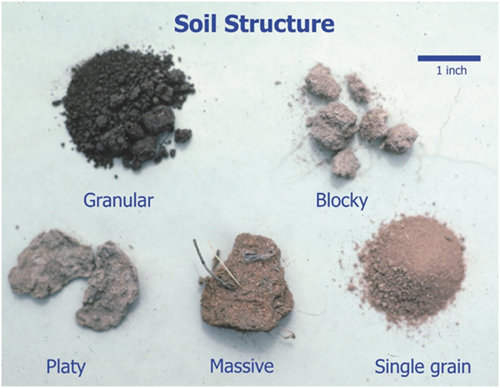
Soil structure refers to how individual soil particles group together to form larger units called aggregates. Think of it like building blocks - individual particles stick together to create larger clusters with spaces between them.
Good soil structure creates a network of pores and channels that allow:
- Air to reach plant roots and beneficial microorganisms
- Water to infiltrate and drain properly
- Roots to penetrate easily and spread throughout the soil
Poor soil structure results in dense, compacted layers that restrict plant growth and water movement. Well-structured soils have a crumbly, granular appearance, whilst poorly structured soils appear dense and cloddy.
Example
Identifying Soil Structure in the Field:
Good Structure:
- Crumbly, granular appearance when squeezed
- Visible pore spaces between aggregates
- Easy root penetration
- Good water infiltration rates
Poor Structure:
- Dense, cloddy appearance
- Few visible pores
- Hard, compacted layers
- Water pooling on surface
Particle size and soil texture
Soil texture depends on the proportions of three particle types:
- Sand particles are the largest - they create good drainage but don't hold nutrients well
- Silt particles are medium-sized - they provide fertility and reasonable water retention
- Clay particles are the smallest - they hold water and nutrients effectively but can restrict drainage
Loam represents the ideal balance of all three particle types, providing good drainage whilst maintaining fertility and water-holding capacity. Understanding texture helps predict how your soil will behave and what management practices work best.
Note
Texture Triangle: Professional soil scientists use a texture triangle to classify soils based on the exact percentages of sand, silt, and clay. While you don't need to memorise all classifications, understanding the basic concept helps you assess your own farm soils.
Water movement and drainage
Proper drainage ensures plant roots and soil microorganisms receive adequate oxygen. Well-drained soils allow excess water to move away whilst retaining enough moisture for plant needs.
Sandy soils drain quickly but may become too dry during dry periods. Clay soils hold water effectively but can become waterlogged, preventing air from reaching roots. Both extremes can be improved through adding organic matter or installing artificial drainage systems where necessary.
Important
Critical Balance: Poor drainage creates anaerobic conditions that harm plant roots and beneficial soil life, whilst excessive drainage leads to drought stress and nutrient leaching. The goal is achieving the right balance for your specific crops and conditions.
Temperature effects on soil
Soil temperature significantly influences:
- Seed germination rates - most crops require specific temperature ranges to sprout
- Root development - warmer soils generally promote faster root growth
- Microbial activity - soil organisms become more active as temperatures increase
- Nutrient availability - biological processes that release nutrients speed up in warmer conditions
Dark-coloured soils rich in organic matter warm up more quickly in spring than light-coloured soils. Wet soils heat up more slowly than well-drained soils because water requires more energy to warm than air. Good soil structure and drainage help regulate soil temperature by improving air circulation.
Note
Irish Growing Conditions: In Ireland's cool, wet climate, soil temperature often becomes the limiting factor for spring planting. Understanding how soil colour, organic matter content, and drainage affect warming rates helps you time field operations effectively.
Soil compaction problems
Compaction occurs when soil particles are pressed together, reducing pore space between them. This commonly happens when heavy machinery or livestock operate on wet soils, squashing the natural soil structure.
Compacted soils create several problems:
- Reduced pore space restricts root growth and water infiltration
- Increased surface runoff leads to erosion and flooding
- Poor air circulation limits microbial activity and nutrient cycling
Clay soils are particularly vulnerable to compaction because their fine particles pack together easily.

Important
Prevention is Key: Avoiding traffic on wet soils and maintaining good organic matter levels to improve soil structure is much more effective and economical than trying to repair compaction damage after it occurs. Always check soil moisture before field operations.
Organic matter and soil health
Organic matter (OM) consists of decomposed plant and animal materials that greatly improve soil physical properties. It acts like a glue, binding soil particles into stable aggregates that resist compaction and erosion.
Benefits of organic matter include:
- Improved soil structure and stability
- Enhanced water-holding capacity during dry periods
- Better drainage in heavy soils
- Increased Cation Exchange Capacity (CEC) for nutrient retention
Important
Maintaining OM Levels: When organic matter levels decline through intensive cultivation or overuse, soils become more vulnerable to structural problems, erosion, and fertility loss. Regular additions of compost, farmyard manure, or cover crops help maintain healthy organic matter levels.
Erosion and sedimentation processes
Erosion represents the loss of valuable topsoil through wind or water action. This removes the most fertile soil layer and reduces long-term productivity. Eroded soil particles eventually settle in water systems, causing sedimentation that degrades water quality and harms aquatic ecosystems.
Common erosion prevention methods include:
- Growing cover crops to protect bare soil surfaces
- Contour ploughing across slopes rather than up and down them
- Establishing shelter belts of trees or hedges to reduce wind speed
- Maintaining good ground cover throughout the year
Note
Irish Conditions: In Ireland, erosion is particularly problematic on sloping fields during periods of heavy rainfall when soils lack protective vegetation cover. The mild, wet climate makes maintaining ground cover throughout winter especially important.
Weathering and soil formation
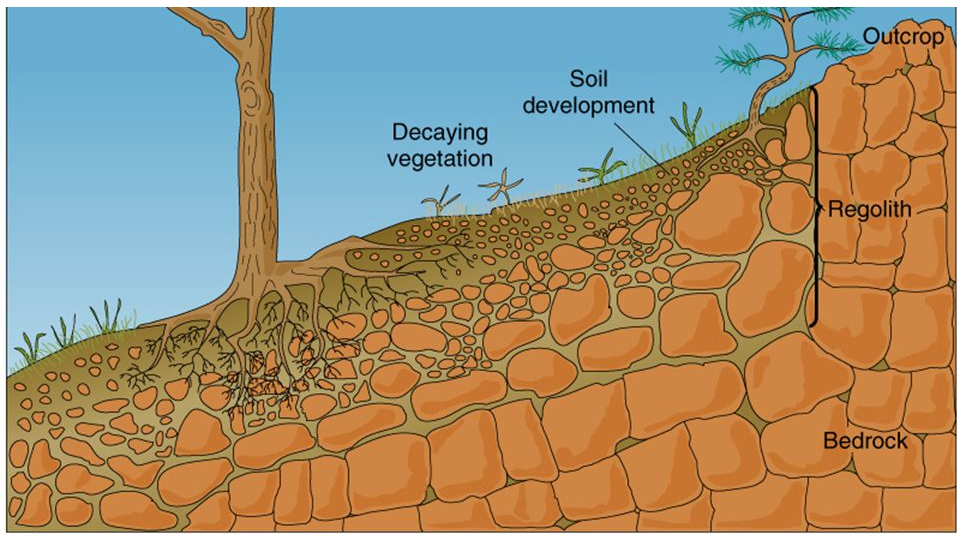
Weathering describes the natural breakdown of rocks into soil particles through three main processes:
- Physical weathering occurs through freeze-thaw cycles and temperature changes that crack rocks apart
- Chemical weathering involves dissolution and oxidation reactions that change rock composition
- Biological weathering happens when plant roots and organisms break down rock materials
These weathering processes continuously supply new mineral particles to soils, replacing nutrients removed by crops and maintaining soil fertility over long time periods.
Example
Weathering in Action:
Physical Example: Water freezing in rock cracks expands by about 9%, creating enough pressure to split solid rock apart over repeated freeze-thaw cycles.
Chemical Example: Carbonic acid (formed when CO₂ dissolves in rainwater) slowly dissolves limestone, releasing calcium and other nutrients into soil.
Biological Example: Tree roots growing into rock crevices gradually widen cracks, whilst root acids chemically break down surrounding minerals.
Total pore space importance
Total Pore Space (TPS) measures the percentage of soil volume occupied by air- and water-filled spaces between particles. This measurement helps assess soil health and productivity.
Healthy, uncompacted soils typically contain 50-60% pore space, with a mixture of:
- Macropores (large spaces) that allow rapid air and water movement
- Micropores (small spaces) that hold water against gravity
Important
Compaction Warning Signs: Compacted soils show reduced TPS of only 30-40%, with significant loss of macropores leading to poor aeration and drainage problems. Regular monitoring of pore space helps identify compaction issues before they severely impact crop production.
Summary
Key Points to Remember:
- Soil structure determines how easily air, water, and roots can move through soil - good structure creates stable aggregates with adequate pore space
- Texture based on sand, silt, and clay proportions controls drainage rates and nutrient-holding capacity - loam provides the ideal balance
- Organic matter acts as nature's soil conditioner, improving structure, water retention, and fertility whilst reducing erosion risk
- Compaction reduces pore space and restricts plant growth - prevention through careful timing of field operations is more effective than trying to repair damage
- Total Pore Space should reach 50-60% in healthy soils to ensure adequate aeration and water movement for optimal crop production