Overview (Leaving Cert Applied Maths): Revision Notes
📚Revision Notes
Overview
What are differential equations?
A differential equation is a special type of mathematical equation that is quite different from the algebraic equations you might be familiar with, such as x² - 3x + 2 = 0. Instead of finding numerical solutions like x = 1 or x = 2, differential equations ask us to find entire functions as solutions.
Note
The key difference is that differential equations involve both functions and their derivatives (rates of change). Think of it this way: whilst a regular equation might ask "what number satisfies this condition?", a differential equation asks "what function satisfies this relationship involving its rate of change?"
Understanding derivatives in context
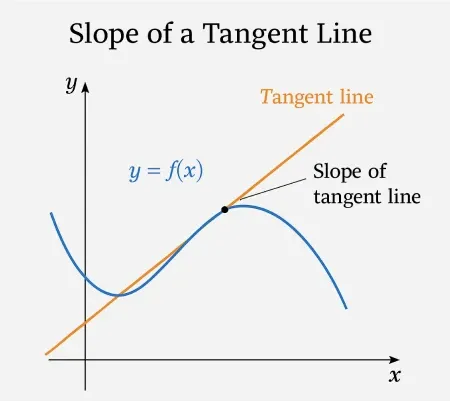
Before diving deeper into differential equations, it's crucial to understand what a derivative represents. The derivative of a function f(x) tells us the slope of the tangent line to the curve at any given point (x₀, f(x₀)).
A simple differential equation example
Consider this differential equation:
Example
Worked Example: Understanding a Differential Equation
This equation is asking: "What function has the property that its slope at any point equals ?"
Notice how this is fundamentally different from solving a regular algebraic equation. We're not looking for specific x and y values, but rather for a complete function that satisfies this relationship between the function and its derivative.
The connection to calculus fundamentals
Differential equations are deeply connected to the two main operations of calculus: differentiation and integration. In fact, these two processes are inverses of each other, a relationship captured by the Fundamental Theorem of Calculus.
Note
This connection means that:
- If we can differentiate a function to get its derivative, we can also work backwards
- Integration allows us to "undo" differentiation
- This reverse process is essential for solving differential equations
Why study differential equations?
At Leaving Cert level, understanding differential equations helps bridge the gap between:
- Simple algebraic problem-solving
- More advanced mathematical modelling
- Real-world applications where rates of change are important
The techniques you learn for solving differential equations build directly on your knowledge of differentiation and integration, making them a natural next step in your mathematical journey.
Summary
Key Points to Remember:
- Differential equations involve functions and their derivatives, not just numbers
- The derivative represents the slope of the tangent line to a curve at any point
- Solutions to differential equations are entire functions, not individual values
- Integration and differentiation are inverse operations, connected by the Fundamental Theorem of Calculus
- Differential equations ask "what function has this rate of change pattern?" rather than "what number satisfies this condition?"