Real-World Applications (Leaving Cert Applied Maths): Revision Notes
📚Revision Notes
Real-World Applications
Introduction to calculus
Calculus is a branch of mathematics that began in the 17th century, consisting of two main components: differentiation and integration. This powerful mathematical tool is essential for comparing and analysing quantities that change in non-linear ways, making it incredibly useful across many fields of study and professional applications.
Two brilliant mathematicians are credited with developing calculus: Sir Isaac Newton (1642-1727) and Gottfried Leibniz (1646-1716). Both worked independently to create this revolutionary mathematical framework that continues to solve real-world problems today.
Note
The development of calculus was one of the most significant mathematical breakthroughs in history, emerging during the Scientific Revolution. Despite working independently, both Newton and Leibniz arrived at similar conclusions, leading to a famous priority dispute that lasted for years.
The beauty of calculus lies in its practical applications. Rather than being purely theoretical, calculus provides solutions to everyday challenges in science, technology, engineering, medicine, and finance. Let's explore how differentiation, integration, and difference equations are used in the real world.
Applications of differentiation
Differentiation is the process of finding rates of change and is used whenever we need to maximise or minimise a particular quantity or function. This makes it incredibly valuable across numerous industries and fields.
Optimisation in renewable energy
One of the most impressive applications of differentiation is in renewable energy systems. Solar power plants use differentiation to maximise their efficiency by optimally positioning thousands of mirrors (called heliostats) to capture and focus the sun's thermal energy.

Note
Solar thermal plants can generate electricity even after sunset by using stored heat energy. The mathematical optimisation through differentiation ensures these plants capture maximum energy throughout the day, making renewable energy more viable and cost-effective.
These solar thermal plants store energy in tanks of molten salt, and differentiation helps engineers calculate the most efficient angles and positions for maximum energy capture throughout the day.
Biology and population studies
In biological research, differentiation plays a crucial role in analysing population growth rates. Scientists use differentiation to study how quickly bacteria populations grow in laboratory conditions, helping them predict whether populations are expanding rapidly and determine if intervention measures are needed to control growth.

This same mathematical approach applies to studying virus transmission rates, allowing epidemiologists to model how quickly diseases might spread through communities and cities.
Important
Understanding population growth rates through differentiation is essential for public health planning. During disease outbreaks, this mathematical analysis helps authorities make critical decisions about quarantine measures, resource allocation, and intervention strategies.
Speed and motion analysis
The speed of moving objects often changes in non-linear ways, making differentiation essential for accurate measurements. An Garda Síochána use radar technology that relies on differentiation principles to catch speeding drivers.
Modern vehicles also depend on differentiation for their electronic systems. Car computers use differentiation to transform data from moving wheels into accurate speed and distance measurements displayed on dashboard gauges.
Forensic science applications
Forensic scientists apply differentiation in several critical ways. When investigating crime scenes, they can estimate the time of death by using differentiation to analyse how body temperature changes after death occurs.
Toxicologists also use differentiation to determine poison concentrations in victims' blood samples, helping establish cause of death and timeline of events.
Applications of integration
Integration is essentially the reverse of differentiation and is used to calculate areas, volumes, and accumulated quantities. This makes it invaluable for solving complex real-world problems involving irregular shapes and changing quantities.
Area and volume calculations
While you learned to calculate areas of regular shapes in Junior Cycle, integration allows us to find areas and volumes of irregular, curved objects. This is particularly useful in marine archaeology and search operations.
When searching for plane wreckage at sea, integration helps authorities calculate the search area being covered, enabling them to plan how many vessels are needed for effective coverage. Integration can also determine the volume of irregularly shaped objects like wine barrels.
Note
Traditional geometry formulas work perfectly for regular shapes like rectangles and circles, but real-world objects rarely have such perfect shapes. Integration bridges this gap, allowing us to calculate precise measurements for any curved or irregular object.
Safety engineering
Car manufacturers use integration to evaluate the Head Injury Criterion, a critical safety measurement that assesses potential head damage during impacts and collisions.
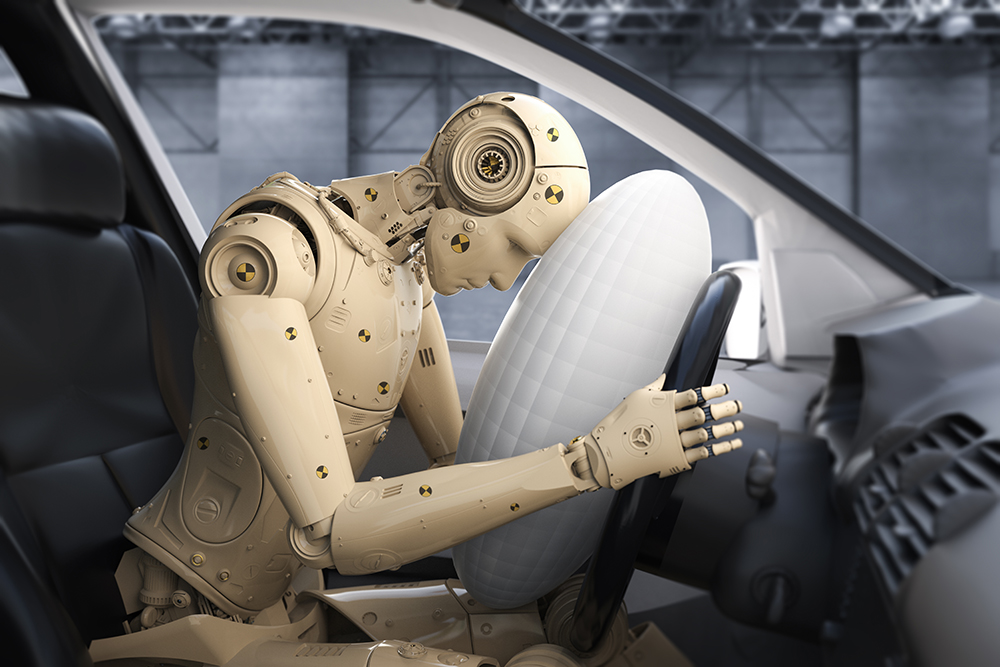
Companies like Mercedes-Benz use these integration-based calculations to design safer vehicles with improved airbags, crumple zones, and other protective features that save lives in accidents.
Technology optimisation
Major technology companies like Google use integration to optimise internet performance. Google calculates a "speed index" using integration to measure how quickly web pages load, then uses this data to minimise page loading times and improve user experience across the internet.
Military communication systems
Integration is useful for designing digital philtres that control radio frequencies in military communications. These philtres can allow or block specific frequencies, creating secure communication channels that are essential for military operations.
Important
Secure communication systems are vital for national security. The mathematical precision provided by integration ensures that military communications remain protected from interference and interception.
Applications of difference equations
Difference equations originated with Isaac Newton and were further developed by George Boole in the 1600s and 1870s respectively. These equations are particularly useful for modelling situations with steady increases or decreases at regular intervals, making calculations much easier than using traditional differential equations.
Population and wildlife management
Difference equations are essential for studying predator-prey relationships in wildlife management. Scientists use these equations to calculate culling numbers needed to maintain or control populations of particular species.
The same mathematical principles apply to managing plant and tree populations in forestry and conservation efforts.
Note
Wildlife management requires careful balance. Too much culling can endanger species, while too little can lead to overpopulation and ecosystem damage. Difference equations provide the mathematical framework for making these crucial conservation decisions.
Engineering systems
In mechanical engineering, difference equations model systems with recurring identical components. Examples include acoustic philtres in sound systems and crankshaft designs in multi-cylinder engines.

These applications help engineers optimise performance and reduce mechanical failures in complex systems.
Pharmaceutical dosage calculations
Medical professionals use difference equations to determine safe and effective dosages for common medications like Aspirin, Gaviscon, and Tylenol (Panadol).
This mathematical approach ensures patients receive effective treatment while minimising side effects and preventing dangerous overdoses.
Important
Medication dosage calculations are critical for patient safety. The wrong dosage can be ineffective or potentially fatal. Difference equations provide the mathematical precision needed to ensure medications work properly while keeping patients safe.
Financial calculations
Banks and financial institutions rely on difference equations to calculate fixed loan and mortgage repayments. These equations help determine regular payment amounts for any situation involving consistent interest payments over time.
This application is crucial for helping people plan their finances and understand long-term financial commitments.
Remember!
Summary
Key Points to Remember:
-
Calculus combines differentiation and integration - two powerful mathematical tools developed by Newton and Leibniz in the 17th century for analysing non-linear changes.
-
Differentiation finds rates of change - essential for optimisation problems in renewable energy, population biology, speed measurement, and forensic science investigations.
-
Integration calculates areas and accumulation - crucial for irregular shape calculations, safety engineering, technology optimisation, and communication system design.
-
Difference equations model regular patterns - particularly useful for population management, engineering systems with recurring components, pharmaceutical dosages, and financial calculations.
-
Real-world applications are everywhere - from the solar panels generating clean energy to the safety features in your car, calculus shapes the technology and systems that improve our daily lives.