Critical Paths / Activities (Leaving Cert Applied Maths): Revision Notes
📚Revision Notes
Critical Paths / Activities
Understanding early and late times
In project management, we need to understand two important timing concepts that help us schedule activities effectively.
Note
Fundamental Timing Concepts
Early time refers to the earliest possible moment when an event can occur, assuming all previous activities have been completed. This represents the fastest we can reach that point in our project.
Late time represents the latest moment an event can occur without causing delays to the overall project completion. This gives us the deadline we must meet to keep the project on track.
The forwards and backwards pass method
To calculate these times in an activity network, we use a systematic two-step approach:
- Forwards pass: We work our way through the network from start to finish, calculating early times as we go
- Backwards pass: We work backwards from the end of the project, determining late times for each event
Let's see how this works with a practical example.
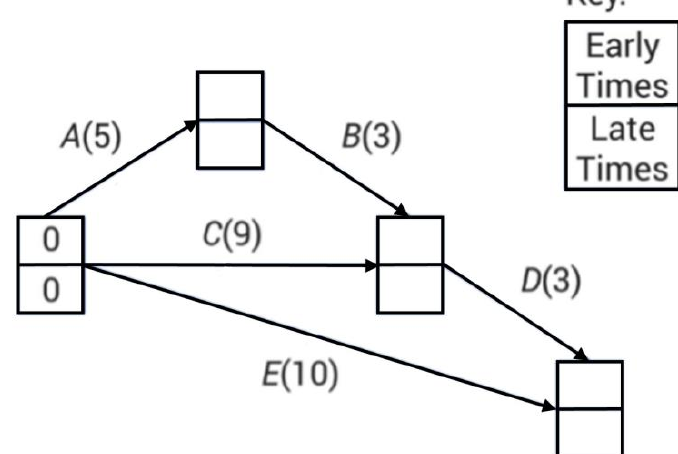
When we start our forwards pass, we begin at the source node (the starting point) and work through each activity systematically.
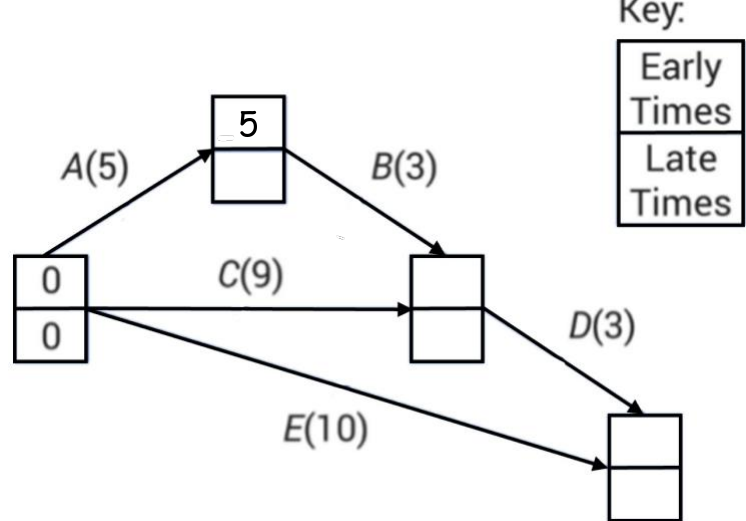
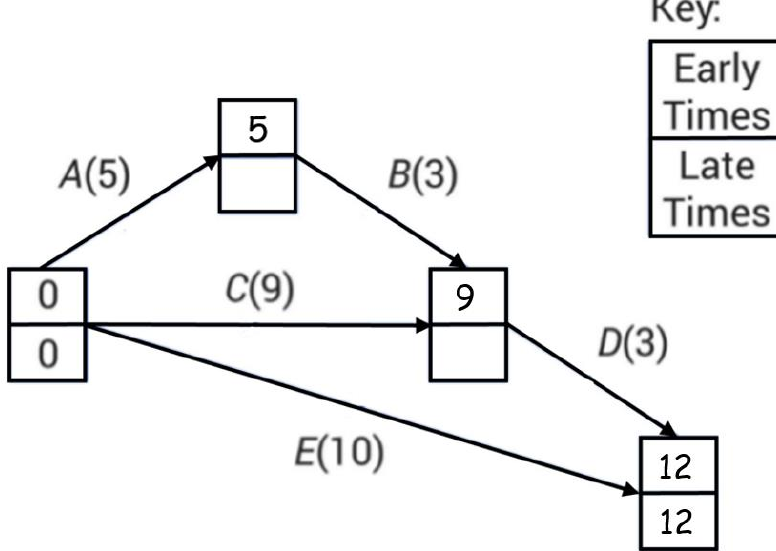
Calculating early times (forwards pass)
During the forwards pass, we follow these steps:
- Start at the source node with an early time of 0
- For each activity, add its duration to the early time of the preceding event
- When multiple activities converge at a node, take the largest early time value (this ensures all preceding activities are genuinely finished)
Important
Critical Rule for Convergence
When multiple activities converge at a node, always take the largest early time value. This ensures that all preceding activities are genuinely finished before proceeding.
For example, if activities B and C both lead to the same event, and they give early times of 8 and 9 respectively, we choose 9 because this is when both activities will definitely be complete.
Calculating late times (backwards pass)
After completing our forwards pass, we work backwards to find late times:
- Start at the sink node (project end) where late time equals early time
- Work backwards, subtracting activity durations
- When multiple activities diverge from a node, take the smallest late time value to prevent project delays
Important
Critical Rule for Divergence
When multiple activities diverge from a node, always take the smallest late time value. This represents the most restrictive deadline needed to ensure the project stays on schedule.
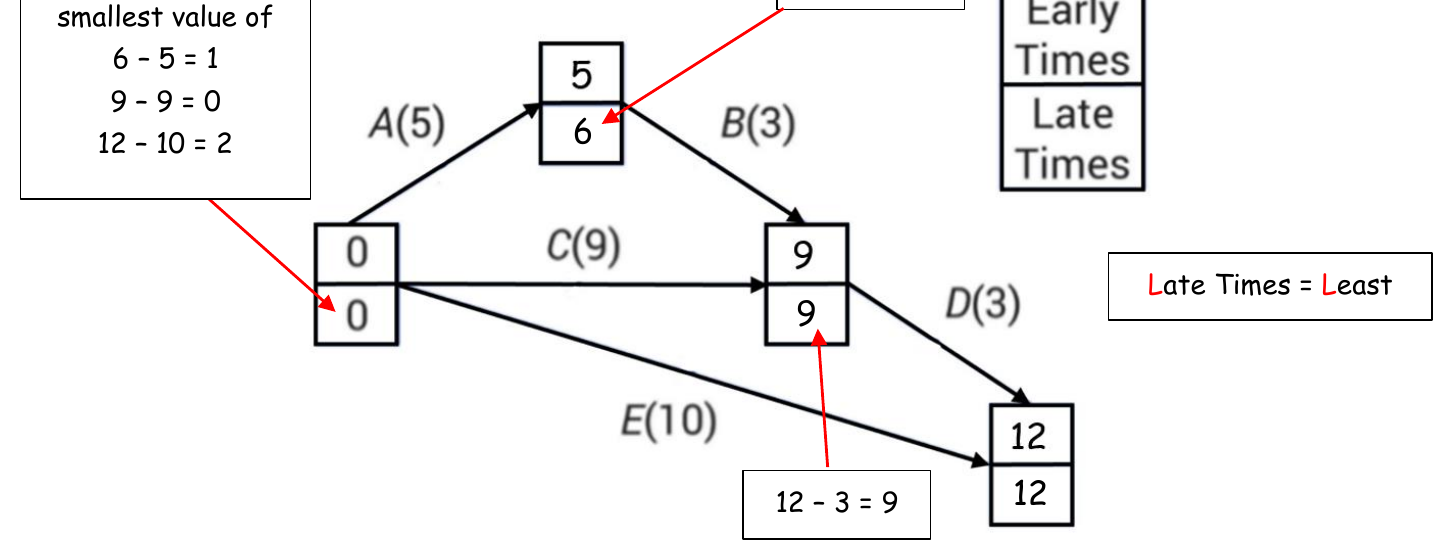
The key principle is that late times represent deadlines - we must choose the most restrictive deadline to ensure the project stays on schedule.
Understanding total float
Total float measures how much an activity can be delayed without affecting the project's completion date. It represents the flexibility we have in scheduling that particular activity.
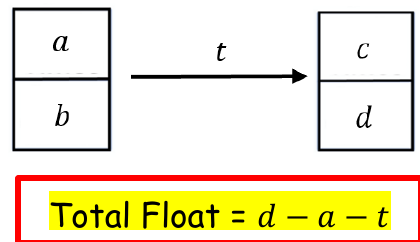
The formula for calculating total float is:
Where:
- = late time of the ending event
- = early time of the starting event
- = duration of the activity
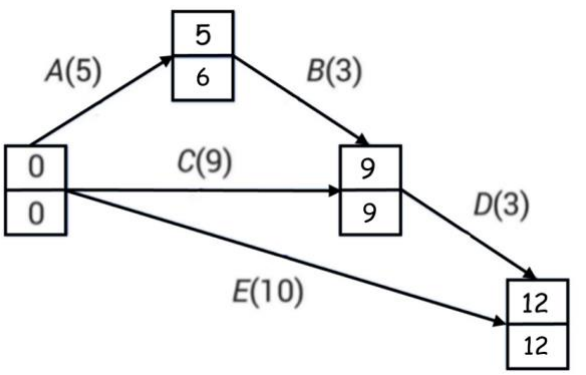
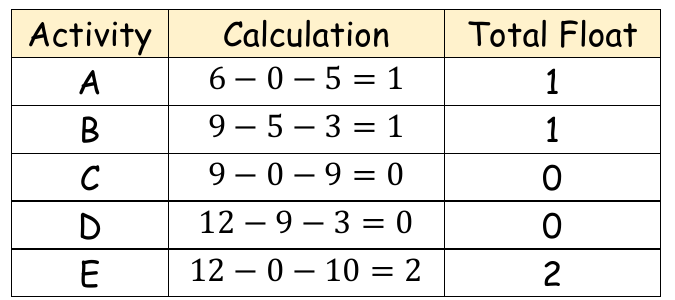
Let's apply this formula to calculate the total float for each activity in our example:
Identifying critical activities and paths
A critical activity is any activity with a total float of zero. This means there is no flexibility in its timing - any delay to a critical activity will delay the entire project.
A critical path is a continuous sequence of critical activities that runs from the project start to finish. This path determines the minimum project duration.
Example
Worked Example: Identifying Critical Activities
In our example:
- Activities C and D both have zero float, making them critical activities
- The critical path is C→D
- The minimum project completion time is 12 time units
Activities A, B, and E have some float, meaning they can be delayed by 1, 1, and 2 time units respectively without affecting the project completion date.
Practical applications
Understanding critical paths helps project managers:
- Focus attention on activities that could delay the project
- Allocate resources more effectively
- Identify where schedule compression efforts should be concentrated
- Plan for contingencies by knowing which activities have flexibility
Remember that if any critical activity is delayed, the entire project timeline shifts unless other adjustments are made elsewhere.
Summary
Key Points to Remember:
- Early times show the earliest possible completion using forwards pass calculations (take the largest value when activities converge)
- Late times show the latest acceptable completion using backwards pass calculations (take the smallest value when activities diverge)
- Total float = , representing scheduling flexibility for each activity
- Critical activities have zero float and cannot be delayed without affecting project completion
- The critical path connects all critical activities and determines minimum project duration