Minerals (Leaving Cert Biology): Revision Notes
📚Revision Notes
Minerals
What are minerals?
Minerals are inorganic nutrients that both plants and animals need in relatively small amounts to maintain proper biological functions. Unlike organic compounds, minerals are simple chemical elements that cannot be made by living organisms and must be obtained from external sources.
Note
Understanding the distinction between organic and inorganic nutrients is crucial - while organic compounds like vitamins are complex molecules made by living organisms, minerals are simple elements that must come from the environment.
The main minerals essential for life include:
- Calcium and phosphorus (for bones and teeth)
- Sulphur (for proteins)
- Potassium, chlorine, and sodium (for nerve and muscle function)
- Magnesium (for enzymes and chlorophyll)
- Iron (for blood)
- Fluorine and iodine (for teeth and thyroid function)
The need for minerals
Minerals serve several crucial functions in living organisms:
Regulatory functions
- pH control: Minerals help maintain the correct pH levels in cells, organs, and body systems. Sodium, potassium, and chlorine are particularly important for this function
- Enzyme systems: Many minerals act as cofactors for enzymes, helping them work properly and maintaining their correct shape
- Nerve impulse transmission: Sodium and potassium are essential for sending electrical signals along nerve fibres
- Muscle contraction: Calcium and magnesium are needed for muscles to contract and relax properly
Important
The regulatory functions of minerals are interconnected - disruption in one area (like pH balance) can affect enzyme function, nerve transmission, and muscle contraction. This is why maintaining adequate mineral levels is so critical for overall health.
Structural functions
Minerals also provide structural support by forming:
- Rigid structures: Calcium and fluorine create strong bones and teeth, while calcium helps cement plant cell walls together
- Soft body parts: Sulphur and phosphorus are important components of muscles and other soft tissues
- Body fluids: Minerals like sodium and chlorine help maintain the composition of important fluids such as tears, saliva, and blood plasma
Specialised roles
- Haemoglobin formation: Iron is essential for making haemoglobin, the protein that carries oxygen in red blood cells
- Chlorophyll production: Magnesium is at the centre of every chlorophyll molecule in plants
- Hormone production: Iodine is needed to make thyroid hormones that regulate metabolism
Sources of minerals
How organisms obtain minerals
Most plants absorb the minerals they need directly from the soil through their root systems. Animals, including humans, must obtain their minerals by eating plants or other animals that have already absorbed these nutrients.
Note
This creates an important food chain relationship - the mineral content of our food depends on the mineral content of the soil where plants were grown. Poor soil quality can lead to mineral-deficient foods.
Dietary sources of key minerals
- Calcium: Dairy products like milk, cheese, and yoghurt; dark green vegetables
- Iron: Red meat, eggs, wholegrains, and green vegetables
- Sodium and chlorine: Table salt
- Magnesium: Wholegrains and green vegetables
- Potassium: Many fruits and vegetables
Effects of mineral deficiency
When organisms don't get enough essential minerals, various health problems can develop. For example, vitamin C deficiency (which affects how the body uses certain minerals) can cause a disease called scurvy.
Note
About the scurvy example:
This condition leads to symptoms like tiredness, aching joints, poor wound healing, skin problems, and bleeding gums with loose teeth. The photograph 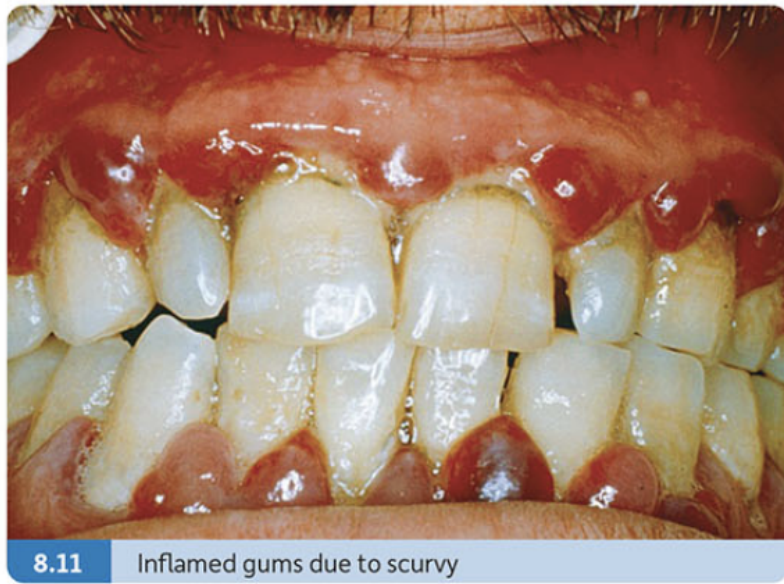 shows the characteristic inflamed and swollen gums that occur in scurvy patients.
While scurvy is primarily caused by vitamin C deficiency, it demonstrates how nutrients work together - vitamin C is essential for the body to properly use minerals like iron and maintain healthy connective tissues.
Important
Mineral deficiencies can have serious cascading effects throughout the body because minerals are involved in so many fundamental biological processes. Early detection and correction of deficiencies is crucial for maintaining good health.
Connection to other biomolecules
While minerals are distinct from vitamins (which are complex organic molecules), both work together as essential nutrients. Vitamins often help the body use minerals more effectively, and many biological processes require both types of nutrients to function properly.
Note
This interdependence between minerals and vitamins highlights why a balanced diet containing a variety of foods is so important - isolated supplements may not be as effective as obtaining nutrients from whole food sources where they naturally occur together.
Remember!
Summary
Key Points to Remember:
- Minerals are inorganic nutrients needed in small amounts for proper biological function
- Key minerals include calcium, phosphorus, iron, sodium, potassium, magnesium, and others
- Main functions are regulatory (pH, enzymes, nerves, muscles) and structural (bones, teeth, cell walls)
- Plants get minerals from soil, while animals obtain them through their diet
- Mineral deficiencies can cause serious health problems, affecting everything from bone strength to nerve function