Action and Specificity (Leaving Cert Biology): Revision Notes
📚Revision Notes
Action and Specificity
The active site of enzymes
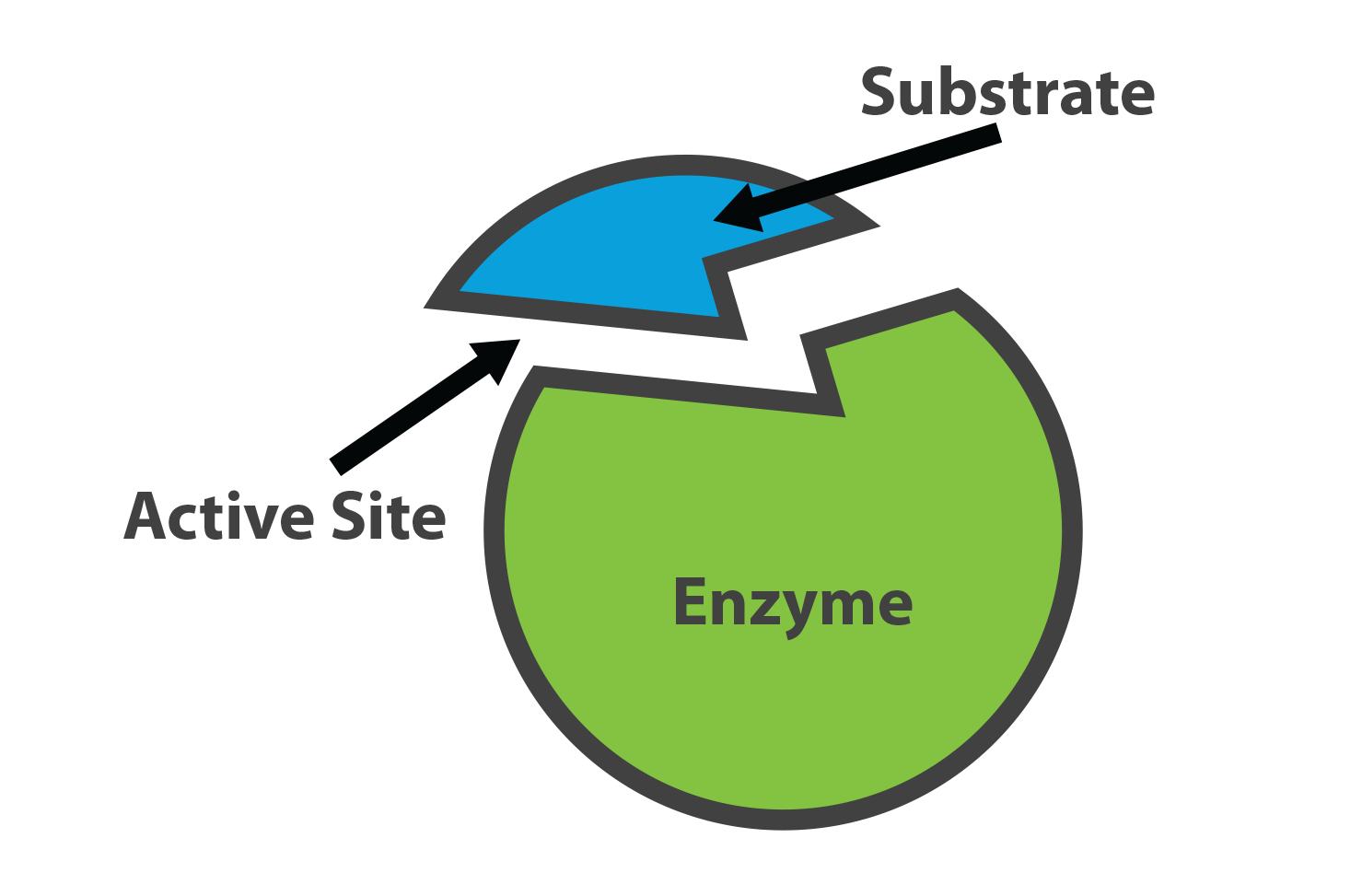
The active site is the crucial part of an enzyme where the magic happens - it's the specific region that binds with the substrate (the molecule the enzyme works on). Think of it as the enzyme's workspace where chemical reactions take place.
The shape of the active site is perfectly designed to match the substrate it works with. This isn't just any shape - it's a precise three-dimensional structure that complements the substrate's shape. The enzyme itself is a complex protein with a sophisticated 3D structure, and the active site represents just a small but vital portion of this larger molecule.
Note
The active site typically represents only about 10-20% of the total enzyme structure, yet this small region is responsible for the enzyme's entire catalytic function. The remaining portion of the enzyme helps maintain the proper shape and stability of the active site.
What makes the active site so special is its complementary shape to the substrate. This means the substrate fits into the active site like pieces of a puzzle, allowing them to combine effectively. The active site isn't just a rigid depression or pocket - it's a precisely shaped region that ensures only the correct substrate can bind successfully.
Induced fit model of enzyme action
The induced fit model helps us understand exactly how enzymes work with their substrates. When a substrate approaches an enzyme's active site, something remarkable happens - the substrate actually causes the active site to change its shape slightly. This creates an even more precise fit between the enzyme and substrate.
Here's how the process works:
- Initial contact: The substrate combines with the enzyme's active site, which has a complementary 3D shape
- Shape adjustment: The active site is induced (caused) to change shape slightly by the substrate's presence
- Perfect fit: The substrate and enzyme form an enzyme-substrate complex with bonds holding the substrate in place
- Product formation: The substrate changes into the product(s) due to the enzyme's action
- Release: The products leave the active site, and the enzyme returns to its original shape, ready to work with another substrate molecule
Example
Analogy: The Flexible Glove
The induced fit model can be compared to putting on a flexible glove:
- The glove (active site) adjusts slightly to fit your hand (substrate) perfectly
- This creates the ideal working conditions for the "task" to be performed
- Once you remove your hand, the glove returns to its original shape, ready for the next use
The beauty of this system is its speed and efficiency. These five steps happen incredibly quickly - some enzymes can process several thousand substrate molecules every second! Because the enzyme remains unchanged throughout the process, a small amount of enzyme can work with a large number of substrate molecules in a short time.
Enzyme specificity
Enzyme specificity means that each enzyme will only work with one particular type of substrate. This is like having a very specialised tool that can only do one specific job perfectly.
Most enzymes demonstrate remarkable specificity - they work with only one substrate type. This precision occurs because each enzyme's active site is shaped to accommodate only one particular substrate molecule. The reason behind this selectivity lies in the exact fit required between the active site and substrate shapes.
Important
If anything alters the shape of the active site, the enzyme loses its ability to work effectively. This change in shape means the active site no longer fits properly with its usual substrate, causing the enzyme to lose its catalytic function. This process, called denaturation, is typically permanent and represents a key vulnerability of enzymes.
Temperature provides a good example of this principle. While body temperature (around 37°C) helps enzymes work efficiently by providing energy for molecular movement, high temperatures above 40°C can cause permanent damage by changing the enzyme's shape and destroying its function.
Practical example: catalase in action
A perfect example of enzyme action and specificity can be seen with the enzyme catalase, which breaks down hydrogen peroxide. This demonstrates all the key principles we've discussed.
Example
Practical Demonstration: Catalase Breaking Down Hydrogen Peroxide
The reaction: Hydrogen peroxide (substrate) + Catalase (enzyme) → Water + Oxygen (products)
What you observe:
- Dramatic foaming as oxygen gas is released rapidly
- Visible bubbling and fizzing
- Quick conversion of hydrogen peroxide to harmless products
Where to find catalase: Radishes, celery, potatoes, and most living organisms
Catalase is found widely in living organisms, including radishes, celery, and potatoes. It serves the important function of converting the potentially harmful substance hydrogen peroxide into harmless water and oxygen.
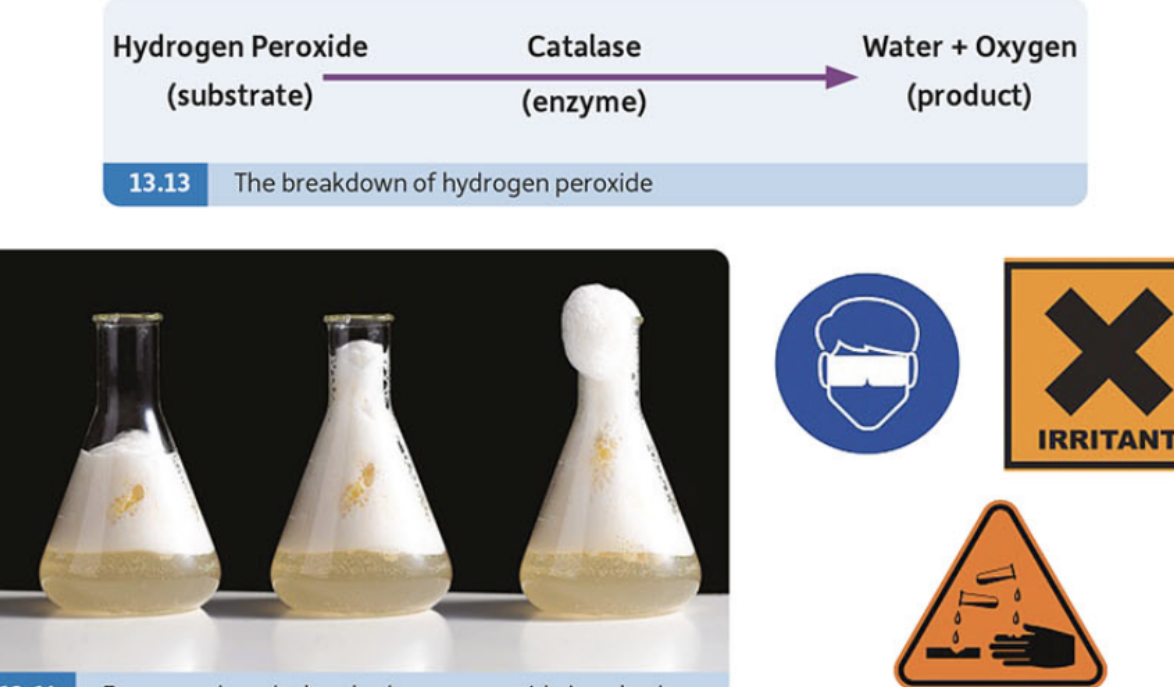
When catalase encounters hydrogen peroxide, you can observe dramatic results. The reaction produces visible foam as oxygen gas is released rapidly. This demonstrates both the enzyme's specificity (it only works with hydrogen peroxide) and its efficiency (the reaction happens very quickly with visible products).
This example perfectly illustrates enzyme specificity - catalase will only work with hydrogen peroxide, not with other similar molecules. The active site of catalase is precisely shaped to accommodate hydrogen peroxide molecules, demonstrating the lock-and-key precision we've discussed.
Remember!
Summary
Key Points to Remember:
- The active site is where enzymes bind with their specific substrates, featuring a complementary 3D shape
- The induced fit model explains how active sites adjust slightly when substrates bind, creating perfect working conditions
- Enzyme specificity means each enzyme works with only one type of substrate due to precise active site shapes
- Changes to active site shape (like from high temperatures) can permanently destroy enzyme function through denaturation
- Catalase provides an excellent example, specifically breaking down hydrogen peroxide into water and oxygen with visible, rapid results