Blood (Leaving Cert Biology): Revision Notes
📚Revision Notes
Blood
Blood is a vital connective tissue that circulates throughout your body, carrying essential substances and maintaining homeostasis. Understanding blood composition and function is crucial for Leaving Cert Biology.
Composition of blood
Blood consists of two main components that work together to keep you alive. These parts have very different roles but are equally important for proper body function.
Note
When blood is left to settle in a test tube, you can clearly see the separation between the liquid plasma at the top and the darker cellular components at the bottom. This natural separation demonstrates the two-phase nature of blood.
Blood has four main parts:
- Plasma (55% of blood volume)
- Red blood cells (corpuscles)
- White blood cells
- Platelets
Plasma
Plasma forms the liquid foundation of blood and makes up about 55% of total blood volume. This pale-gold liquid serves as the transport medium for everything your blood carries.
Plasma composition:
- 90% water
- 7% proteins
- 3% dissolved materials being transported
The main plasma proteins include antibodies (produced by white blood cells to fight infections) and clotting proteins (essential for forming blood clots when you're injured). These proteins are too large to pass easily through blood vessel walls, helping maintain proper blood concentration.
Key plasma functions:
- Transports dissolved nutrients, hormones, and waste products
- Carries heat throughout the body for temperature regulation
- Contains clotting factors to stop bleeding
- Maintains blood pressure and volume
Red blood cells
Red blood cells (erythrocytes) are the most numerous cells in your blood, with about 5 million found in every cubic millimetre. These specialised cells have unique features that make them perfect for their oxygen-carrying role.
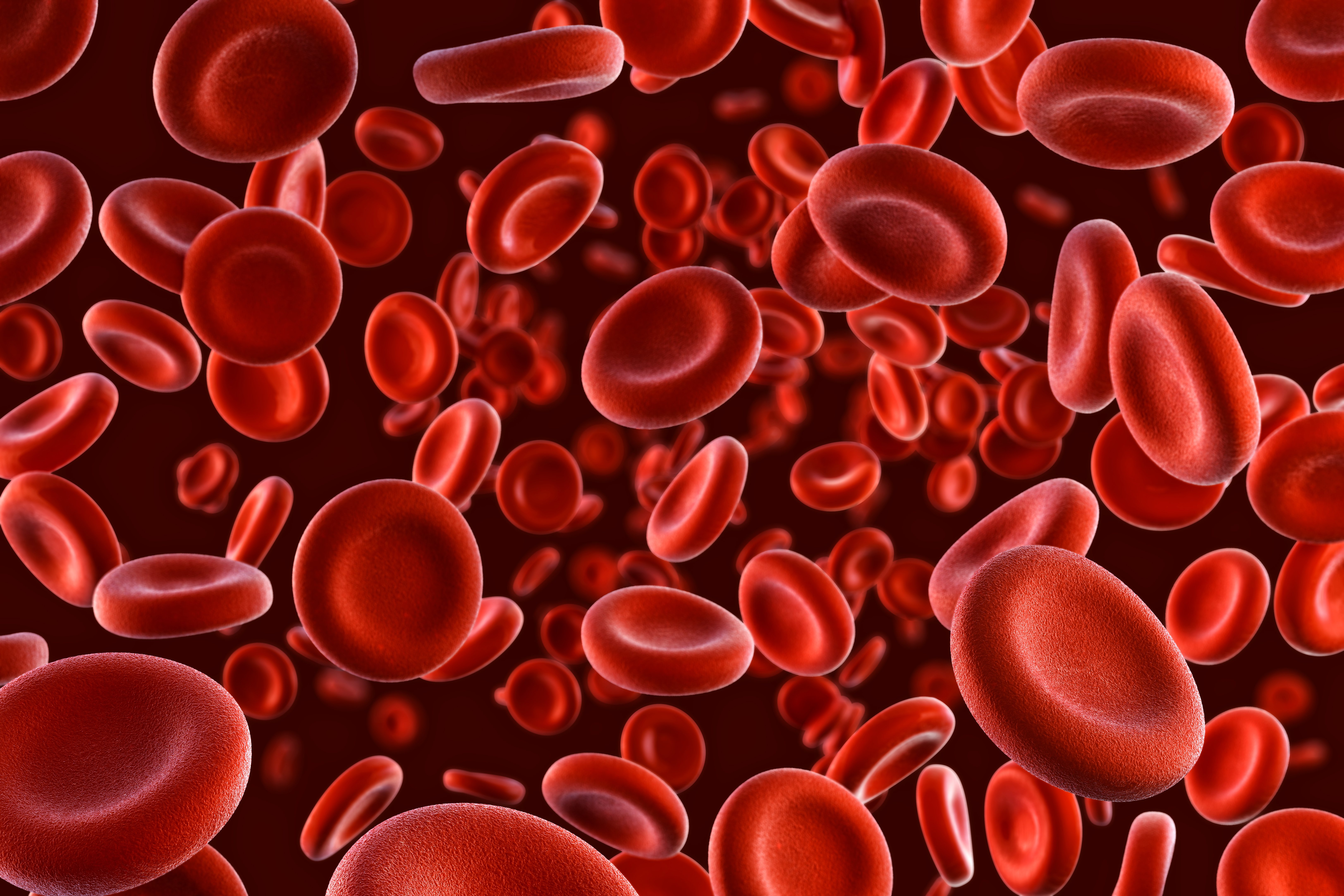
Key characteristics of red blood cells:
- Biconcave shape - curved inwards on both sides like a doughnut
- No nucleus when mature (lost during development)
- Flexible - can squeeze through tiny capillaries
- Small size - about 7 micrometres in diameter
Note
The biconcave shape is particularly important because it provides a larger surface area compared to a spherical cell, allowing more efficient oxygen exchange. This unique shape increases the surface area by approximately 30% compared to a sphere of the same volume.
Red blood cells contain haemoglobin, a red protein made from iron that gives blood its characteristic colour. Haemoglobin has a remarkable ability to form loose chemical bonds with oxygen.
Example
Worked Example: Oxygen Transport Process
Step 1: In the lungs (high oxygen concentration) haemoglobin + oxygen → oxyhaemoglobin (bright red)
Step 2: In body tissues (low oxygen concentration) oxyhaemoglobin → haemoglobin + oxygen (purple/darker red)
This reversible reaction allows haemoglobin to pick up oxygen where it's abundant (lungs) and release it where it's needed (body cells).
Red blood cell lifecycle:
- Live for about 120 days
- Broken down at 3 million cells per second
- Iron from haemoglobin is recycled in the liver
- New cells constantly produced in bone marrow
Important
Anaemia occurs when you don't have enough healthy red blood cells or haemoglobin, causing symptoms like pale skin colour and fatigue due to poor oxygen transport.
White blood cells
White blood cells (leucocytes) are your body's defence system against infections and disease. Although much less numerous than red blood cells (ratio of about 1:700), they play a crucial protective role.
Characteristics of white blood cells:
- Larger than red blood cells
- Have a nucleus throughout their life
- No definite shape
- Live for varying periods (some only days, others for years)
- Less numerous than red blood cells (700 red : 1 white)
Main function: Protect the body against infections, foreign substances, and abnormal cells like cancer cells.
Types of white blood cells include:
- Phagocytes - engulf and digest harmful microorganisms
- Lymphocytes - produce antibodies and coordinate immune responses
White blood cells are produced in bone marrow, with some maturing in specialised organs like the thymus gland.
Important
Leukaemia is a form of cancer where white blood cells are produced too rapidly and remain immature, crowding out healthy blood cells and reducing the body's ability to fight infections and clot blood.
Platelets
Platelets are small cell fragments essential for preventing blood loss when blood vessels are damaged. Despite being the smallest blood components, they perform a vital protective function.
Platelet characteristics:
- Made in bone marrow from large cells that break apart
- Smaller than red blood cells
- No nucleus (they're cell fragments, not complete cells)
Role of platelets: Platelets are responsible for blood clotting, which serves two main purposes:
- Reduce blood loss from damaged vessels
- Prevent microorganism entry through wounds
Example
Worked Example: Blood Clotting Process
Step 1: Damaged body cells release chemicals
Step 2: These chemicals stimulate platelets to form a clot
Step 3: The clot blocks the damaged blood vessel
Step 4: This prevents further bleeding and blocks harmful microorganisms
Important
However, clots can be dangerous if they form inappropriately in healthy blood vessels, potentially causing strokes (brain) or heart attacks (heart vessels). This condition is called thrombosis.
People with haemophilia cannot produce proper clotting factors, making them unable to form blood clots effectively and prone to excessive bleeding from minor injuries.
Blood groups
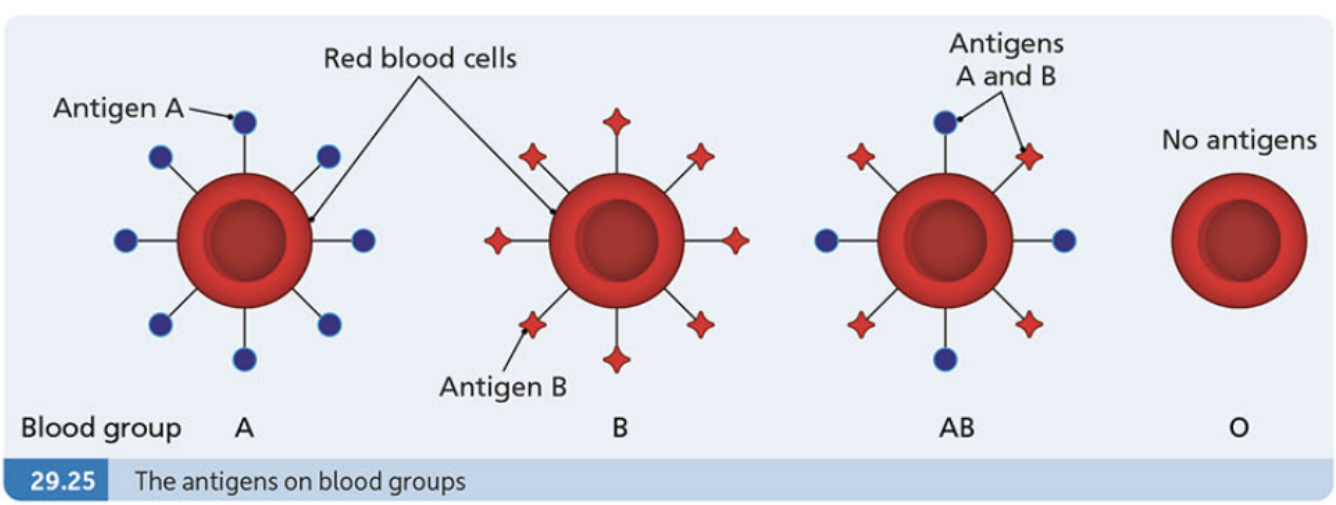
Blood groups are determined by specific chemicals called antigens found on the surface of red blood cell membranes. Understanding blood groups is essential for safe blood transfusions.
ABO blood group system
The ABO system classifies blood into four main groups based on which antigens are present:
Blood group A:
- Has antigen A on red blood cells
- Most common in Ireland (about 55%)
Blood group B:
- Has antigen B on red blood cells
Blood group AB:
- Has both antigens A and B
- Can receive blood from any ABO group (universal recipient)
Blood group O:
- Has no antigens on red blood cells
- Can donate to any ABO group (universal donor)
Important
Transfusion compatibility: Blood transfusions must match compatible groups. If incompatible blood is given, the recipient's immune system will attack the foreign blood cells, causing blood clumping and potentially fatal complications.
The Rhesus factor
Apart from ABO groups, there's another important blood classification system called the Rhesus factor, discovered by Karl Landsteiner in 1901.
Rhesus positive (Rh+): About 85% of Irish people have the Rhesus chemical on their red blood cells
Rhesus negative (Rh-): About 15% of the population lack the Rhesus chemical
Note
Clinical importance: The Rhesus factor is particularly important during pregnancy. If a Rhesus-negative mother carries a Rhesus-positive baby, complications can arise in subsequent pregnancies. The mother's immune system may attack future Rhesus-positive babies, but this can be prevented with anti-D injections.
Functions of blood
Blood performs multiple essential functions that maintain life and health:
Transport functions:
- Nutrients, waste products, and hormones via plasma
- Heat distribution from internal organs - helps maintain constant body temperature (homeostasis)
- Oxygen transport by red blood cells using haemoglobin
Defence functions:
- White blood cells (phagocytes) engulf and digest harmful bacteria
- White blood cells (lymphocytes) produce antibodies to destroy 'foreign bodies' like bacteria and viruses
- Platelets prevent blood loss and organism entry through clotting
These coordinated functions ensure your body maintains the right conditions for cellular activities while protecting against threats and maintaining proper circulation.
Summary
Key Points to Remember:
-
Blood composition: 55% plasma (liquid) and 45% cells (red blood cells, white blood cells, platelets)
-
Red blood cells are biconcave, contain haemoglobin for oxygen transport, and live about 120 days before being recycled
-
Haemoglobin reversibly binds with oxygen: picks up oxygen in lungs, releases it to body tissues
-
ABO blood groups (A, B, AB, O) and Rhesus factor (+/-) determine transfusion compatibility - mismatched transfusions can be fatal
-
Blood functions include transport (oxygen, nutrients, waste, heat), defence (white blood cells, antibodies), and protection (platelets for clotting)