Blood Vessels (Leaving Cert Biology): Revision Notes
📚Revision Notes
Blood Vessels
Blood vessels form the transport network of the circulatory system, carrying blood throughout your body. Understanding their structure and function is essential for grasping how your cardiovascular system works. There are three main types of blood vessels, each specially adapted for their role in circulation.
Overview of the blood vessel network
Your circulatory system contains thousands of miles of blood vessels that create a complete circuit. Blood flows from your heart through progressively smaller vessels, eventually reaching tiny capillaries where exchange occurs, before returning to your heart through larger vessels.
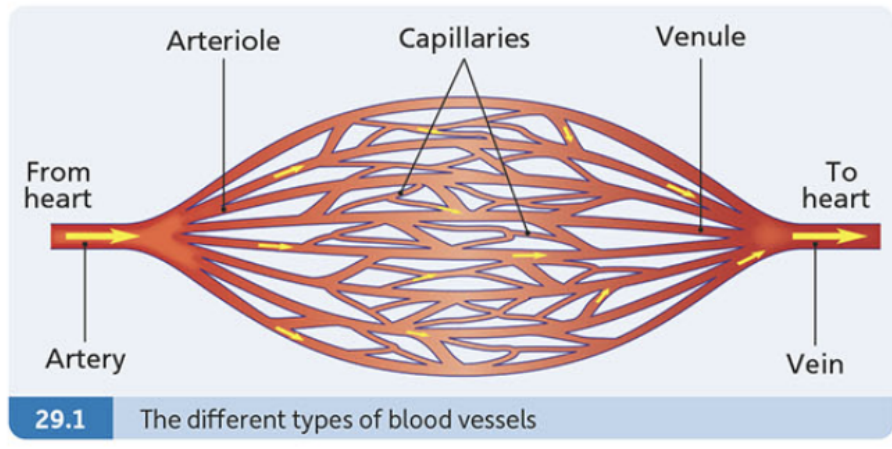
The pathway follows this sequence: your heart pumps blood into large arteries, which branch into smaller arterioles, then into microscopic capillaries. After exchange occurs, blood collects in venules, which join together to form veins that return blood to your heart.
Note
This circular pathway ensures that blood continuously flows through your body, delivering oxygen and nutrients while removing waste products. The entire circuit from heart to capillaries and back typically takes about 60 seconds to complete.
Types of blood vessels
Arteries and arterioles
Arteries are the vessels that carry blood away from your heart. They transport blood under high pressure, which is why they need thick, strong walls. As arteries travel further from your heart, they branch repeatedly and become smaller, eventually forming tiny vessels called arterioles.
The high pressure in arteries serves an important purpose - it provides the force needed to push blood through your entire circulatory system. This pressure is created each time your heart contracts, sending a wave of blood through the arterial system.
Important
The high pressure in arteries is essential for circulation, but it also means these vessels must be incredibly strong. Damage to arterial walls can lead to serious conditions like aneurysms or arterial rupture.
Veins and venules
Veins carry blood back to your heart from all parts of your body. They collect blood from the smallest vessels (capillaries) and gradually increase in size as they approach your heart. Small veins are called venules, which merge together to form larger veins.
Unlike arteries, veins operate under much lower pressure since the blood has travelled far from the heart. This lower pressure means veins have thinner walls compared to arteries, but they face the challenge of moving blood back to the heart, often against gravity.
Capillaries
Capillaries are the tiniest blood vessels in your body, connecting the arterial and venous systems. Despite their small size, they have the most important job in circulation - allowing the exchange of materials between your blood and body cells.
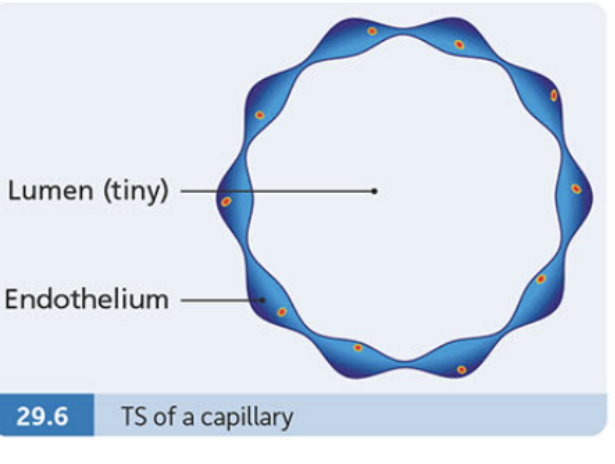
Capillaries have extremely thin walls made of just a single layer of cells called endothelium. This thin barrier allows oxygen, nutrients, and waste products to easily pass between your blood and surrounding tissues.
Note
Although capillaries are microscopic, they have an enormous total surface area in your body - roughly equivalent to the size of a football field. This massive surface area is what makes efficient exchange possible.
Structure of blood vessels
Arterial structure
Arteries have thick, muscular walls consisting of three distinct layers. The outer layer contains tough, inelastic protein fibres called collagen that provide strength. The middle layer contains both muscle and elastic fibres that allow the artery to expand when blood is pumped from the heart and recoil to help push blood forwards.
The innermost layer is the endothelium - a smooth lining that reduces friction as blood flows through. Arteries have a relatively small internal space (lumen) compared to their wall thickness, which helps them withstand high blood pressure.
Venous structure and valves
Veins have thinner walls than arteries because they don't need to withstand high pressure. However, they face a unique challenge - preventing blood from flowing backwards due to gravity, especially in your legs.
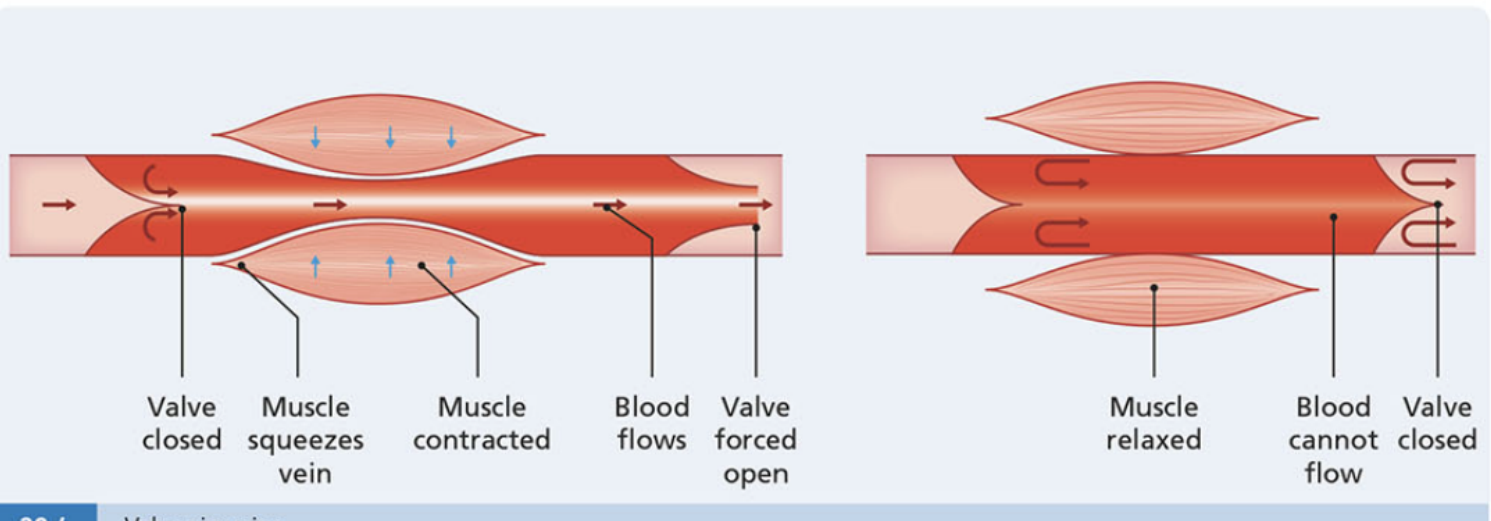
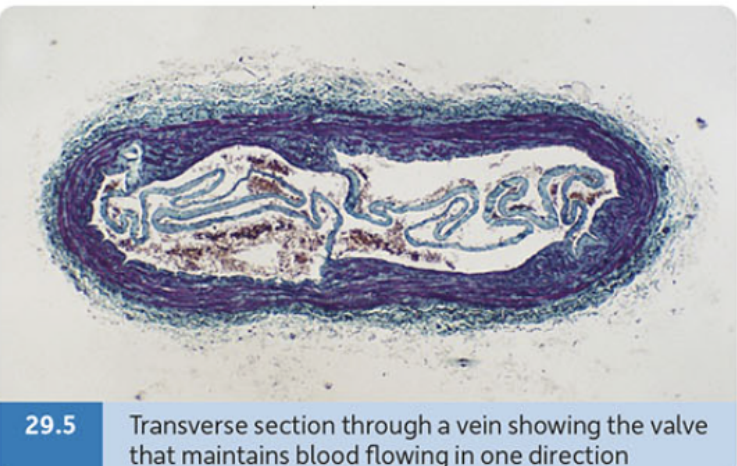
To solve this problem, many veins contain one-way valves that act like gates. These valves open to allow blood to flow towards your heart but close immediately if blood tries to flow backwards. The valves work together with your muscle contractions to create a 'muscle pump' system that helps push blood back to your heart.
Important
Valve failure in veins can lead to varicose veins, where blood pools and causes the vessels to become enlarged and twisted. This is why regular movement and exercise are important for maintaining healthy circulation.
Capillary structure
Capillaries have the simplest structure of all blood vessels. Their walls consist of just a single layer of endothelial cells arranged in a tiny tube. This minimal barrier allows for efficient exchange of substances between blood and tissues.
The capillary lumen (internal space) is so narrow that red blood cells must squeeze through in single file. This slow movement gives plenty of time for oxygen and nutrients to diffuse out of the blood and for waste products to enter the bloodstream.
Key differences between arteries and veins
Understanding the differences between arteries and veins helps explain how each type is adapted for its specific function in circulation.
Direction of blood flow: Arteries always carry blood away from your heart, while veins always carry blood towards your heart. This is true regardless of whether the blood is oxygen-rich or oxygen-poor.
Blood pressure: Arteries operate under high pressure (you can feel your pulse in arteries), while veins work under low pressure. This pressure difference explains many of the structural differences between these vessel types.
Note
You can feel your pulse in arteries because the high pressure causes them to expand with each heartbeat. Veins don't have a pulse because the pressure is too low to cause noticeable expansion.
Wall structure: Arteries have thick, muscular walls to handle high pressure, while veins have thinner walls since pressure is lower. The thick arterial walls also contain more elastic fibres to accommodate pressure changes.
Internal diameter: Arteries have a smaller lumen relative to their wall thickness, while veins have a larger lumen. This difference helps veins act as blood reservoirs, storing blood that can be mobilised when needed.
Valves: Most arteries don't need valves because high pressure keeps blood moving forwards. Veins contain numerous valves to prevent backflow, especially important in vessels working against gravity.
Blood pressure and circulation
Blood pressure represents the force that blood exerts against vessel walls. This pressure is highest in arteries nearest to your heart and gradually decreases as blood travels through smaller vessels.
The high pressure in arteries causes them to expand slightly each time your heart beats - this expansion is what you feel as your pulse. The elastic fibres in arterial walls store energy during expansion and release it to help maintain blood flow between heartbeats.
In veins, pressure is much lower, which is why physical activity helps blood return to your heart. When your muscles contract during movement, they squeeze nearby veins and push blood towards your heart, with valves ensuring it can't flow backwards.
Note
This is why long periods of inactivity, like sitting on a long flight, can cause blood to pool in your legs. Regular movement helps activate the muscle pump system and maintain healthy circulation.
Remember!
Summary
Key Points to Remember:
-
Three vessel types: Arteries carry blood away from the heart, veins return blood to the heart, and capillaries allow exchange between blood and tissues
-
Structural adaptations: Arteries have thick muscular walls for high pressure, veins have valves to prevent backflow, and capillaries have thin walls for easy exchange
-
Blood flow pathway: Blood flows from arteries → arterioles → capillaries → venules → veins in a complete circuit
-
Pressure differences: High pressure in arteries pushes blood forwards, while low pressure in veins requires valves and muscle pumps to return blood to the heart
-
Exchange function: All the actual exchange of oxygen, nutrients and waste occurs in capillaries due to their thin walls and slow blood flow