Cell Division and Cancer (LC 2027) (Leaving Cert Biology): Revision Notes
📚Revision Notes
The Roles of Mitosis and Meiosis
Cell division is fundamental to life, allowing organisms to grow, reproduce, and maintain themselves. There are two main types of cell division - mitosis and meiosis - each serving distinct and crucial roles in different organisms and life processes.
DNA replication and the cell cycle
Before any cell division can occur, the genetic material must be duplicated through a process called DNA replication. This ensures that each new cell receives a complete copy of the organism's genetic information.
During DNA replication, each strand of the double helix serves as a template to create an exact copy. This process is described as making "exact copies" because each new DNA strand contains precisely the same sequence of bases as the original.
Important
Critical for Life: The accuracy of DNA replication is essential for maintaining genetic information across generations of cells. Any errors in this process can lead to mutations that may affect cell function or cause disease.
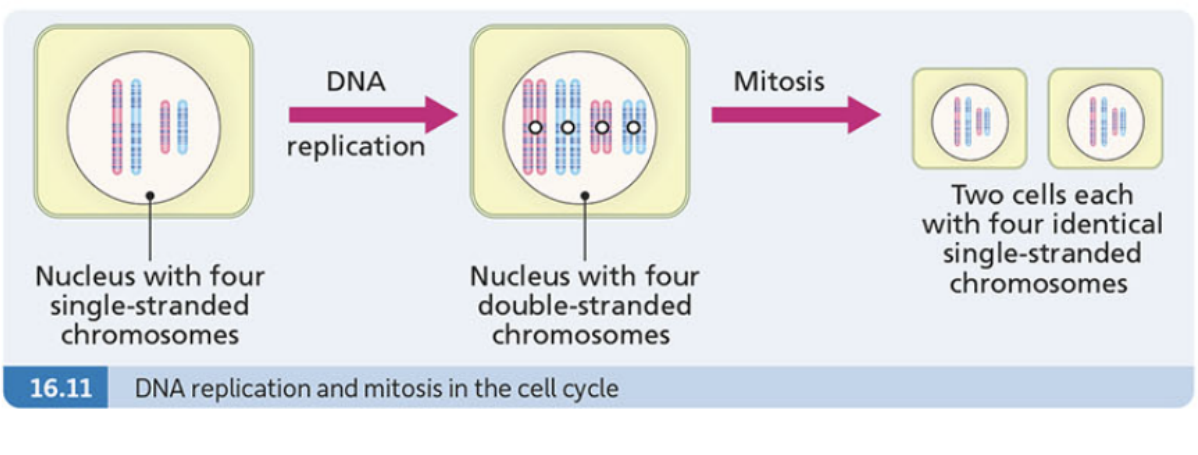
The cell cycle coordinates DNA replication with cell division. After replication, the cell contains twice the normal amount of genetic material, which is then equally distributed during cell division to produce two daughter cells with identical genetic content.
Mitosis
Mitosis is a type of nuclear division that maintains the chromosome number from parent to daughter cells. It plays two key roles depending on the type of organism.
Single-celled organisms
In unicellular organisms like yeast and bacteria, mitosis serves as the primary method of reproduction. When a single-celled organism divides by mitosis, it creates two identical individuals, effectively doubling the population. This type of reproduction, which doesn't involve the joining of two cells, is called asexual reproduction.
Note
Rapid Population Growth: The key advantage of asexual reproduction through mitosis is that it allows rapid population growth when conditions are favourable. Each individual can reproduce independently without needing to find a mate.
Multicellular organisms
In organisms with many cells, mitosis serves two essential functions:
Growth and repair: As multicellular organisms develop from a single fertilised egg into complex adults, they need to produce millions of new cells. Mitosis provides the mechanism for this growth by creating identical cells that can specialise into different tissues and organs.
Mitosis also enables repair and replacement of damaged or worn-out cells throughout an organism's lifetime.
Example
Everyday Example: Wound Healing
When you cut your skin, here's what happens:
- Damaged skin cells trigger nearby healthy cells to begin dividing
- New skin cells are produced through mitosis
- These identical cells multiply to fill the gap
- The wound heals as new tissue forms
Similarly, old blood cells are constantly replaced by new ones produced in the bone marrow through mitotic division.
The mitosis process
During mitosis, a diploid cell (containing two sets of chromosomes) divides to produce two daughter cells that are:
- Genetically identical to each other
- Genetically identical to the parent cell
- Diploid (containing the same chromosome number as the parent)
Important
Perfect Copying: This precise copying ensures that all cells in a multicellular organism contain the same genetic instructions, even though they may develop into very different cell types.
Meiosis
Meiosis is a specialised form of nuclear division that reduces the chromosome number by half. Unlike mitosis, meiosis produces four daughter cells that each contain half the chromosome number of the parent cell.
Sexual reproduction
The primary role of meiosis is to produce gametes (sex cells) for sexual reproduction. In animals, these gametes are sperm cells in males and egg cells in females. In plants, they are pollen and ovules.
During sexual reproduction, two gametes fuse together in a process called fertilisation. Since each gamete contains half the normal chromosome number (haploid), their fusion restores the full chromosome number (diploid) in the offspring.
Example
Human Fertilisation Process
In humans:
- Each gamete (sperm or egg) contains 23 chromosomes (haploid)
- During fertilisation, sperm and egg combine
- The resulting zygote has 46 chromosomes (diploid)
- This restores the full genetic complement for the new individual
Genetic variation
Meiosis provides a crucial source of genetic variation among organisms. Unlike mitosis, which produces identical cells, meiosis creates gametes that are genetically different from each other. This happens because:
- Chromosomes exchange genetic material during meiosis
- Different combinations of maternal and paternal chromosomes end up in different gametes
Important
Essential for Evolution: This genetic variation is essential for evolution and helps species adapt to changing environments. It also explains why offspring from the same parents can look quite different from each other (except for identical twins).
The meiosis process
Meiosis involves two rounds of division and produces four haploid cells from one diploid parent cell. The key features are:
- Chromosome number is halved (diploid to haploid)
- Four genetically different cells are produced
- Essential for sexual reproduction in most organisms
Key differences between mitosis and meiosis
| Feature | Mitosis | Meiosis |
|---|---|---|
| Number of daughter cells | Two cells | Four cells |
| Chromosome number | Same as parent (diploid) | Half of parent (haploid) |
| Genetic identity | Identical to parent | Different from parent |
| Function | Growth, repair, asexual reproduction | Sexual reproduction, genetic variation |
Summary
Key Points to Remember:
- Mitosis maintains chromosome number and produces identical cells for growth, repair, and asexual reproduction
- Meiosis halves chromosome number and creates genetically diverse gametes for sexual reproduction
- DNA replication must occur before any cell division to ensure each daughter cell gets a complete genetic copy
- Genetic variation from meiosis is essential for species survival and evolution