The Cell Cycle (Leaving Cert Biology): Revision Notes
📚Revision Notes
The Cell Cycle
Cells follow a natural life cycle. Most cells are formed, grow bigger, and then divide. This process is known as the cell cycle and it has two main phases:
- Interphase (Growing phase, 90%)
- Mitosis (Dividing phase, 10%)
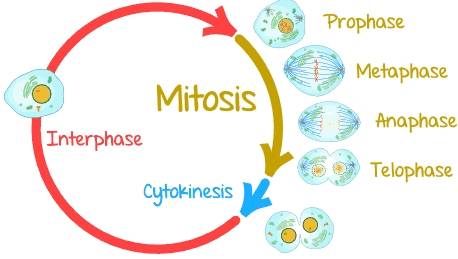
The cell cycle describes the stages a cell goes through from when it is created to when it divides again.
It covers both the growing phase (interphase) and the dividing phase (mitosis).
1. Interphase
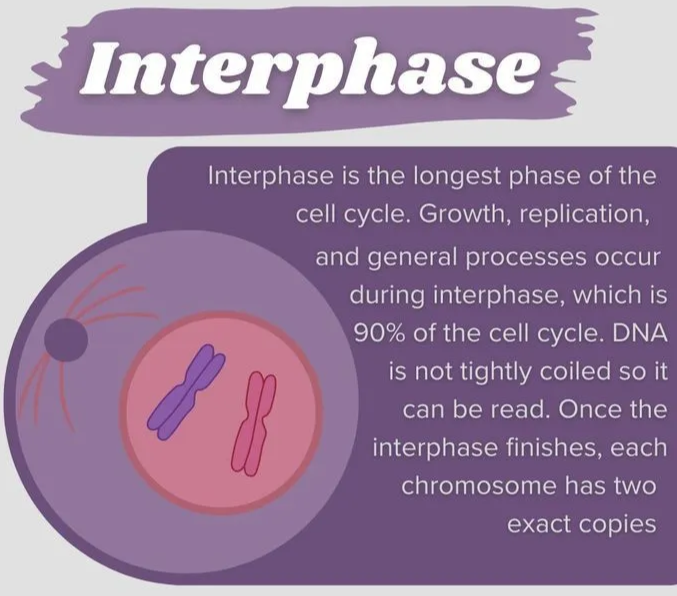
- Interphase is the phase when the cell is not dividing, and it makes up about 90% of the cell cycle.
- During this time, the cell:
- Grows and carries out its normal functions.
- Prepares for division by copying its DNA.
- Towards the end of interphase, the chromosomes become visible under a microscope.
- Each chromosome makes an exact copy of itself, forming double-stranded chromosomes (also called sister chromatids).
2. Mitosis
- Mitosis is the phase when the cell actually divides, making up about 10% of the cell cycle.
Note
Mitosis is a form of nuclear division in which one nucleus divides to form 2 nuclei, each with the same number of chromosomes as the parent nucleus.
Mitosis can be broken down into four stages:
- Prophase
- Metaphase
- Anaphase
- Telophase
Note
An easy way to remember these stages is: Party on Mondays And Tuesdays – for Prophase, Metaphase, Anaphase, and Telophase.
Mitosis will be explored in much greater detail in the next note.