Animal Tissue (Leaving Cert Biology): Revision Notes
📚Revision Notes
Animal Tissue
Note
Tissue: a group of similar cells that have a similar function.
There are four main types of animal tissue:
- Epithelial
- Connective
- Muscular
- Nervous
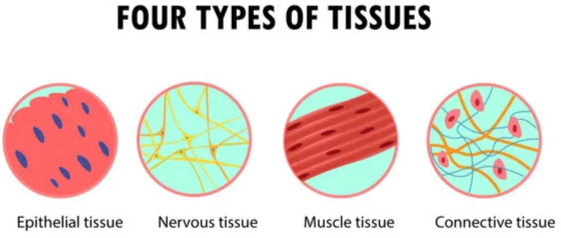
1. Epithelial Tissue
- Function: To protect other tissues.
- Epithelial tissue is made up of one (or more) layers of cells that cover the outer and inner surfaces of the body.
- Examples:
- Human skin
- The inner lining of the respiratory system
- The inner lining of blood vessels
2. Connective Tissue
- Function: To bind other tissues together.
- It supports and cushions other tissues.
- Examples:
- Bone
- Tendons
- Ligaments
Note
Vitamin C is essential for connective tissue formation.
Note
Ligaments connect bones to bones. Tendons connect muscles to bones.
3. Muscular Tissue
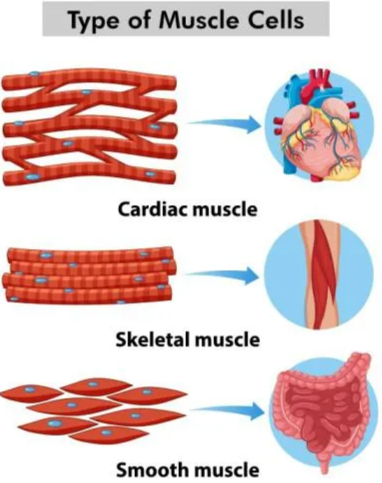
There are three types of muscular tissue:
- Skeletal
- Smooth
- Cardiac
- Cardiac muscle: Found in the heart. It does NOT tyre, making it different from other muscles.
- Skeletal muscle: Voluntary muscle that allows bones to move. Voluntary muscle can be controlled.
- Smooth muscle: Involuntary muscle found in arteries, veins and the digestive system.
4. Nervous Tissue
- Nervous tissue transmits electrical impulses.
- Neurons are nerve cells. They are bundled together and wrapped in connective tissue to form nerves.
Note
Exam Focus: Name a type of animal tissue and how it is adapted to perform its function.
Muscular tissue can contract**.**