How to Investiagte an Ecosystem (Leaving Cert Biology): Revision Notes
📚Revision Notes
How to Investiagte an Ecosystem
Introduction to ecosystem investigation
Studying ecosystems helps us understand how living things interact with each other and their environment. When investigating an ecosystem, scientists collect primary data by observing and measuring what they find in real habitats. This involves looking at both the living parts (biotic factors) like plants and animals, and the non-living parts (abiotic factors) like temperature, light, and soil conditions.
The main goals when investigating any ecosystem are to:
- Create a model of the habitat including its size and the species found there
- Identify all the organisms present in the ecosystem
- Understand feeding relationships and competition between species
- Measure how environmental factors affect the distribution and numbers of different species
Note
Understanding both biotic and abiotic factors is essential because they work together to determine which organisms can survive in a particular habitat and how abundant they will be.
Choosing an ecosystem to study
Ireland offers many different types of ecosystems that you can investigate, depending on your location and the questions you want to answer.
Note
Common ecosystems suitable for study include:
- Grasslands - meadows and fields
- Hedgerows - boundaries between fields
- Rocky shores - coastal areas with rock pools
- Streams and ponds - freshwater habitats
- Woodlands - forested areas
- Peatlands - bog and wetland areas
Each ecosystem type has its own unique characteristics and challenges for investigation, so choose one that matches your research questions and practical constraints.
Understanding grassland ecosystems
What is a grassland ecosystem?
A grassland is typically an artificial ecosystem created and maintained by human activities and livestock management. Unlike natural wilderness areas, grasslands are shaped by activities such as fertilising, cutting, draining, applying weedkillers, trampling, and grazing animals.

Because grasslands are actively managed, they often don't support as wide a variety of natural plants and animals as untouched habitats would. Many grasslands are maintained as monocultures, meaning only one species of plant (usually grass) is encouraged to grow, while natural meadows support a much broader range of living organisms.
Flora (plants) found in grasslands
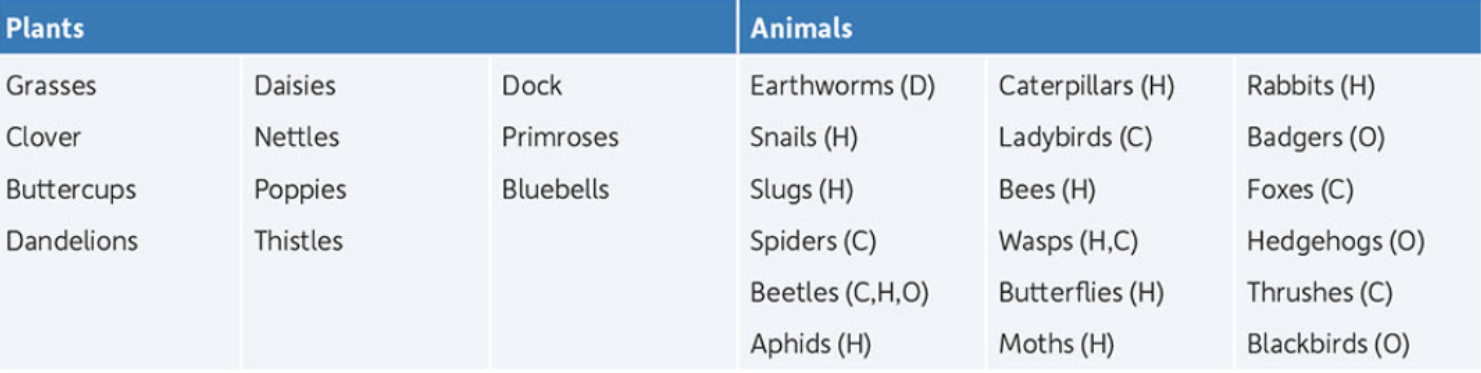
The plant life in grasslands forms the foundation of the entire ecosystem. Grasses are usually the dominant species, but depending on management practices, you may find various other plants:
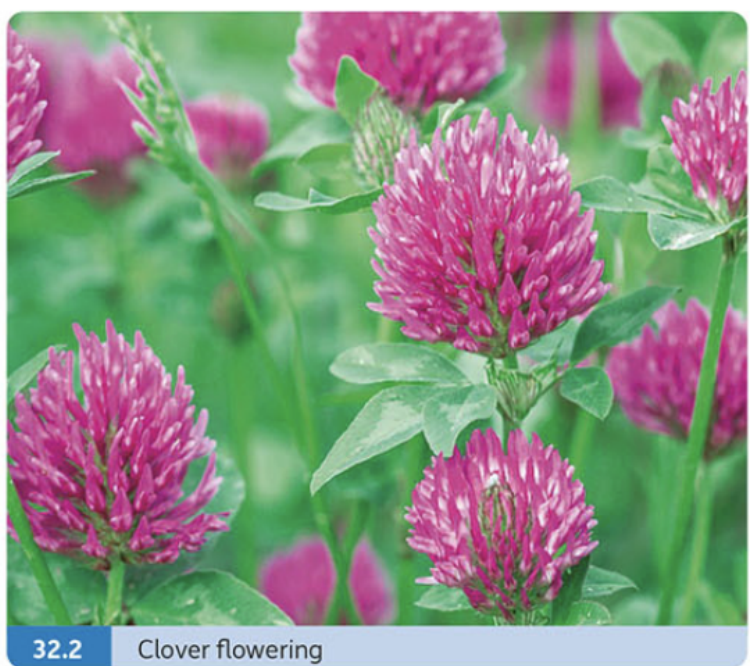
Common grassland plants include:
- Various grass species (the defining plants of the habitat)
- Clover - important because it contains nitrogen-fixing bacteria that enrich the soil
- Buttercups, dandelions, daisies - common wildflowers
- Nettles - often found in disturbed areas
- Poppies, thistles, dock - may appear in disturbed ground
- Primroses and bluebells - found near hedgerows and edges
The presence of different plant species depends on factors like soil fertility, moisture levels, grazing pressure, and management practices.
Fauna (animals) found in grasslands
Grassland animals have adapted to live in this open habitat with relatively low plant diversity. The animal community includes organisms at different trophic levels:
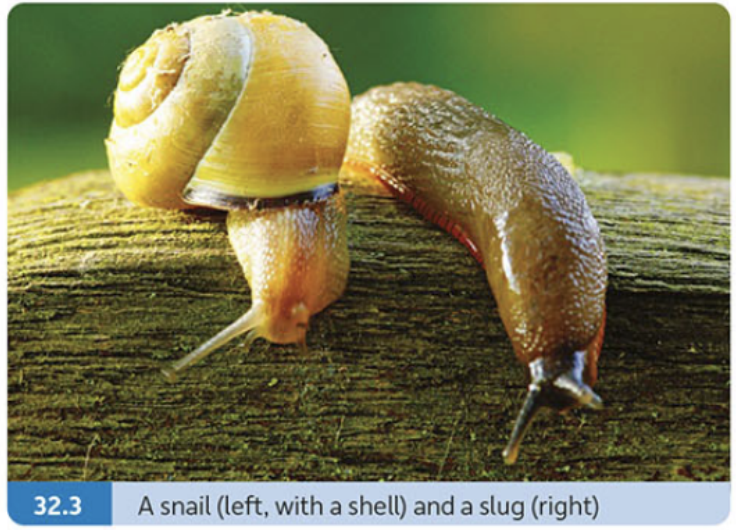
Typical grassland animals include:
- Soil dwellers: earthworms, slugs, snails, and various beetles
- Plant-feeders: aphids (greenflies), caterpillars, grasshoppers, and rabbits
- Pollinators: bees, butterflies, and moths that visit flowers
- Predators: spiders, ladybirds, and ground beetles that hunt smaller animals
- Larger animals: hedgehogs, foxes, badgers, and various birds like thrushes and blackbirds
Food webs and feeding relationships
Understanding who eats what is crucial for ecosystem investigation. A food web shows the complex feeding relationships between different organisms in the habitat.
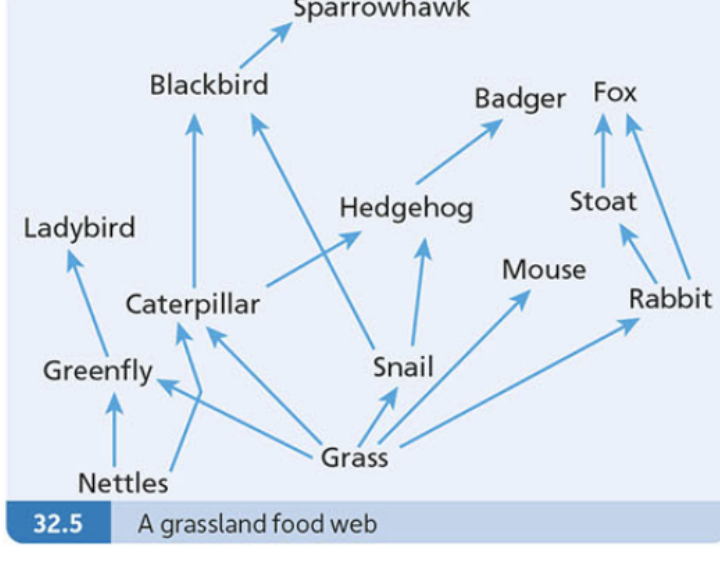
In grassland food webs:
- Producers (plants) convert sunlight into energy through photosynthesis
- Primary consumers (herbivores) feed directly on plants
- Secondary consumers (carnivores) hunt and eat the herbivores
- Tertiary consumers (top predators) feed on other carnivores
- Decomposers break down dead material and return nutrients to the soil
Important
The arrows in food web diagrams show the direction of energy flow from prey to predator, illustrating how energy moves through the ecosystem. This is a common source of confusion - the arrows point towards the organism that receives the energy, not away from it.
Adaptations in ecosystems
Adaptations are special features that help organisms survive and reproduce successfully in their particular environment. These can be physical structures, behaviours, or physiological processes.
Animal adaptations
Animals in grassland ecosystems have evolved various survival strategies:
Physical adaptations:
- Badgers have strong, sharp claws for digging burrows and finding food underground
- Blackbirds have pointed beaks that help them catch earthworms and probe soil
- Mice and rats are nocturnal, avoiding daytime predators by being active at night
Feeding adaptations:
- Aphids (greenflies) have needle-shaped mouthparts for piercing plant stems and drinking sap
- Hedgehogs have spines for protection and strong jaws for eating various small prey
Plant adaptations
Plants also show adaptations to grassland conditions:
- Low-growing shoots help grass avoid being damaged by grazing animals
- Dark green leaves maximise photosynthesis efficiency in competitive conditions
- Large seed production by dandelions increases their chances of successful reproduction
- Stinging chemicals in nettles discourage herbivores from eating them
Note
Every feature you observe in an organism likely serves a purpose in helping it survive in its environment. When investigating ecosystems, always ask yourself: "How does this feature help the organism live here?"
Methods for investigating ecosystems
Selecting habitats to study
Because entire ecosystems are too large to study completely, scientists select smaller representative areas called habitats. A habitat is the specific place where a plant or animal lives, and studying multiple habitats gives a fair representation of the whole ecosystem's ecology.
When choosing habitats, consider selecting 5 to 10 different sample areas to get reliable results that represent the ecosystem accurately.
Using quadrats for sampling
Quadrats are square sampling frames used to study the distribution of organisms systematically. They provide a standardised way to count and measure what's found in specific areas.

Most quadrats are square frames, though some are divided into smaller grid sections with crosswires or string to make counting easier and more accurate.
Quadrat sizes vary depending on what you're studying:
- Small quadrats (0.25m²) for detailed plant studies
- Medium quadrats (1m²) for general vegetation surveys
- Large quadrats for studying bigger organisms or sparse populations
Positioning quadrats
The location of your quadrats affects the reliability of your results. There are several approaches:
Example
Worked Example: Quadrat Placement Methods
Random placement:
- Throw an object over your shoulder and place the quadrat wherever it lands
- This method reduces bias in your sample selection
Systematic placement:
- Place quadrats in a line (forming a transect) across the ecosystem
- This method shows how organisms change from one area to another (for example, from the base of a hedge to an open field)
Limitations of quadrat sampling
Understanding the limitations helps you interpret results correctly:
Important
Movement issues:
- Fast-moving animals won't stay in the quadrat long enough to count accurately
- Mobile organisms may move between quadrats, causing double-counting errors
Size considerations:
- Small quadrats might miss larger, less common species
- The quadrat size must match the scale of what you're studying
Types of ecological studies
Understanding the difference between qualitative and quantitative approaches is essential for ecosystem investigation.
Qualitative studies
Qualitative studies focus on recording which species are present or absent in the habitat. This approach involves identifying and naming organisms directly in the field or collecting specimens for later identification.
Advantages of qualitative studies:
- Provides a comprehensive species list for the ecosystem
- Relatively quick to carry out
- Helps identify rare or unusual species
- Good for initial surveys of unknown habitats
Methods include:
- Visual identification of organisms
- Photography for later identification
- Collection of specimens (where permitted)
- Recording presence/absence data
Quantitative studies
Quantitative studies go beyond just listing species - they record the actual numbers of each organism found. This provides much more detailed information than qualitative studies alone.
Advantages of quantitative studies:
- Shows population sizes and relative abundance
- Allows mathematical analysis and statistical comparisons
- Can detect changes in population numbers over time
- Provides data for calculating biodiversity indices
Quantitative measurements can include:
- Counting individual organisms
- Measuring percentage coverage of plants
- Recording frequency of occurrence across multiple samples
Note
Many successful ecosystem investigations combine both qualitative and quantitative approaches to get the most complete picture of the habitat being studied.
Steps in ecosystem investigation
A systematic approach ensures thorough and reliable results:
Example
Worked Example: Complete Investigation Process
- Collecting organisms - Safely gather specimens or record observations
- Identifying flora and fauna - Use identification keys and guides to name species correctly
- Carrying out qualitative studies - Record which species are present in the habitat
- Measuring abiotic factors - Take measurements of environmental conditions like temperature, pH, and light levels
- Investigating quantitative relationships - Study how changes in environmental factors affect organism distribution and abundance
- Presenting findings - Organise and display your data using tables, graphs, and written summaries
Each step builds on the previous ones, creating a comprehensive picture of how the ecosystem functions.
Remember!
Summary
Key Points to Remember:
-
Choose appropriate ecosystems for investigation based on your location and research questions - grasslands, hedgerows, and ponds are all suitable options
-
Use quadrats systematically for reliable sampling - random or transect placement both have advantages depending on your study aims
-
Understand the difference between qualitative studies (presence/absence) and quantitative studies (actual numbers) - both approaches provide valuable but different types of information
-
Recognise adaptations in the organisms you find - every feature you observe helps species survive in their particular environment
-
Follow systematic investigation steps from organism collection through to data presentation for thorough and scientifically valid results