The Kidneys (Leaving Cert Biology): Revision Notes
📚Revision Notes
The Kidneys
- The right kidney is positioned lower than the left kidney because the liver sits above it and pushes it down.
- Sitting on top of the kidneys are the adrenal glands. They release adrenaline, the fight or flight hormone.
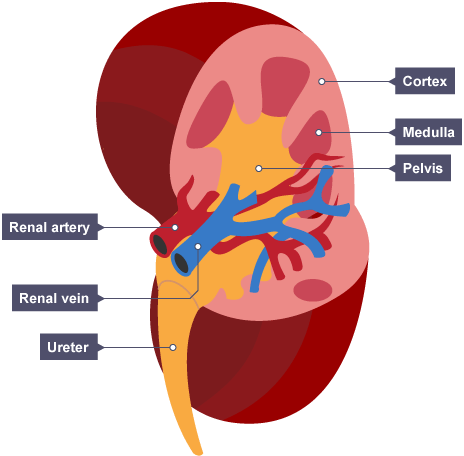
Kidney Structure:
-
The outer layer of the kidney is called the cortex.
-
The inner layer of the kidney is called the medulla.
-
The kidneys are not protected by the ribcage. They are surrounded by a thick layer of fat for protection.
- Renal artery: supplies blood to the kidneys.
- Renal vein: carries blood from the kidney to the heart.
Functions of the Kidneys
- Excretion is the main function of the kidneys. They filter waste (urea, salts, water) from the blood to form urine.
- Osmoregulation: the kidneys balance water and salt content in the body.
- pH control, by making urine more acidic or alkaline as needed.
- Hormone production: the kidneys produce erythropoietin (EPO), a hormone that stimulates the production of red blood cells in the bone marrow.
Note
A high-protein diet results in more acidic urine. A diet rich in vegetables results in more alkaline urine.
Note
Osmoregulation is the process of balancing water and salts in the body to keep fluid levels stable. The kidneys control this by adjusting how much water and salts are reabsorbed into the blood or excreted in urine. This balance is essential for keeping the body's internal environment stable and healthy.
Kidney Failure
- If the kidneys fail to produce urine properly, it can lead to kidney failure. In such cases, dialysis may be necessary.
- Dialysis involves using a machine to filter the blood outside the body.
- Blood is removed from the body and passed through a dialysis machine which filters out waste products and excess water.
- The clean blood is then returned to the body.
- This process is called haemodialysis and is time-consuming — it must be done at least three times a week, with each session lasting around 4 hours.
- An alternative is peritoneal dialysis, which uses the lining of the abdomen (the peritoneum) as a natural filter and can be done daily at home.