Bacteria (LC 2026) (Leaving Cert Biology): Revision Notes
📚Revision Notes
Bioprocessing
Note
Bioprocessing: the use of enzyme-controlled reactions to make a product.
Note
Bioreactor: a metal vat in which bioprocessing/enzyme-controlled reactions occur.
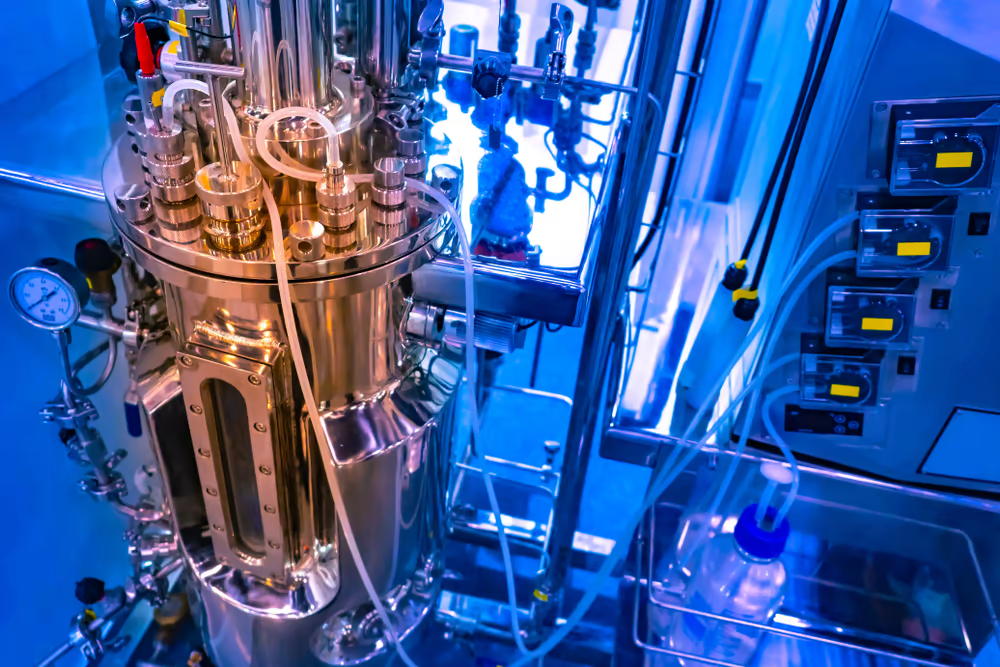
- Modern bioprocessing uses bacteria and other organisms to produce food products such as cheese, yoghurts, vitamins and alcohols.
- There are two main types of bioprocessing:
- Batch processing
- Continuous flow processing
Batch Food Processing
- A bioreactor is sterilised.
- A batch of nutrients is added to a small sample of the micro-organism in the bioreactor.
- The correct conditions are applied e.g. temperature, pH.
- Microorganisms grow, going through the lag, log, and stationary phases of the growth curve.
- The product is formed during the log and stationary phases.
- The process is stopped before the decline phase to prevent cell death.
- The product is removed, separated from the microorganisms and purified.
- The bioreactor is sterilised and the process is repeated.
Advantages
- Easy to control.
- Allows small volumes of product to be formed.
- Suitable if a product is needed only at a particular time.
- Only one batch is spoiled if contamination occurs.
Disadvantages
- The bioreactors must be sterilised often which is time consuming.
Note
Sterile: free from all microorganisms.
Continuous Flow Food Processing
- Nutrients are added continuously at the same rate that the product is withdrawn.
- Bacteria are maintained in the log growth phase.
- Conditions in the bioreactor are kept constant.
- The volume of material in the bioreactor stays the same.
Advantages
- This is a method of continuous production with product constantly being produced. No time is wasted.
- Fewer lag phases compared to batch processing, leading to faster product formation.
- The reactor requires less frequent sterilisation.
Disadvantages
- Requires constant monitoring to maintain optimal conditions.
Note
Batch food processing: a fixed amount of sterile nutrient is added to the microorganisms in a sterile bioreactor at the start of production. The product is formed during the log and stationary growth phases and removed at the end of the production. In continuous flow flood processing, nutrients are added at the same rate as the product is withdrawn. Bacteria are maintained in the log growth phase, with constant conditions in the bioreactor and a stable volume of material.