Common Bread Mould (Rhizopus) (Leaving Cert Biology): Revision Notes
📚Revision Notes
Common Bread Mould (Rhizopus)
- Rhizopus is saprophytic.
- It lives on bread and fruit.
- It secretes enzymes that digest the food.
- It has rhizoids and hyphae that absorb the digested food.
Note
Saprophyte: an organism that lives on dead organic matter.
Structure of Rhizopus
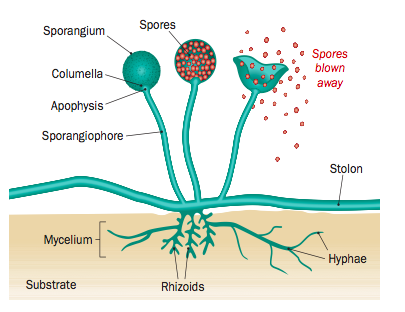
| Sporangium | • The sporangium contains the spores. • Spores are a method of asexual reproduction. |
|---|---|
| Sporangiophore | • The sporangiophore holds up the sporangium. • It allows the spores to be easily dispersed. |
| Hyphae (hypha singular) | • Hyphae are thread like structures. • They are aseptate (have no cross walls). • They are multinucleate. |
| Mycelium | • A mycelium is a mass of hyphae. • All cells in a mycelium are haploid (one set of chromosomes). |
| Stolon | • A stolon is a hypha that grows over the surface of the food. • It allows new mycelium to develop. • It is a method of asexual reproduction. |
| Rhizoids | • Rhizoids create a larger surface area for food absorption. • They release digestive enzymes into the substrate and absorb nutrients. • They are hyphae that anchor the fungus to the substrate. |
Life Cycle of Rhizopus
Rhizopus can reproduce asexually or sexually.
- Asexual Reproduction
- Primary method of reproduction for Rhizopus.
- Occurs by the production of spores in the sporangium.
- Sexual Reproduction
- Happens in unfavourable conditions as a method of survival.