Amoeba (Leaving Cert Biology): Revision Notes
📚Revision Notes
Amoeba
- All protista are eukaryotic.
- Most protista are single-celled organisms.
Note
Eukaryotic cells have a nucleus and membrane-bound organelle e.g. animals, plants.
Amoeba Characteristics
- Single-celled organisms.
- Habitat: freshwater rivers, streams, lakes, ponds, seas, and oceans.
- Reproduce asexually through mitosis.
- They are heterotrophic**.** They feed on other protists (e.g. algae), bacteria and single-celled fungi.
- Reproduce asexually through mitosis.
Note
Heterotrophic: organisms that cannot make food and must use food made by other organisms, e.g. animals, fungi.
Note
Mitosis is a form of nuclear division in which one nucleus divides to form 2 nuclei, each with the same number of chromosomes as the parent nucleus.
Structure of Amoeba
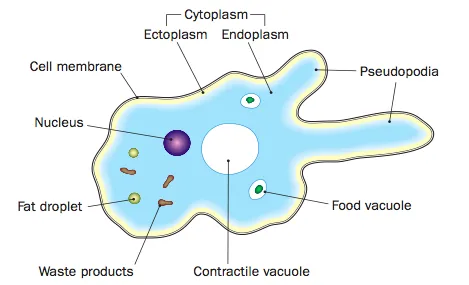
- Nucleus: controls all cell activities.
- The cytoplasm is made up of two layers:
- Ectoplasm: thin outer layer.
- Endoplasm: fluid inner layer.
- Amoeba do not have a definite shape as the cytoplasm is constantly flowing.
- The cytoplasm can push out at any point on its surface to form pseudopodia ('false feet').
- Pseudopodia
- Used for movement and feeding.
- Feeding: The prey is surrounded by pseudopodia and pulled into the cytoplasm.
- The cell membrane allows for diffusion of oxygen into the cell and diffusion of carbon dioxide out of the cell.
- Fat droplets store fat as an energy reserve.
- Food vacuole secretes acid and digestive enzymes to kill and digest prey.
- The contractile vacuole allows for osmoregulation.
- The contractile vacuole collects excess water, expands, moves to the cell surface and squeezes out the water.
- Amoeba reproduce asexually by mitosis.