Muscle Pairs, Joints, Cartilage, Ligaments, and Tendons (Leaving Cert Biology): Revision Notes
📚Revision Notes
Muscle Pairs, Joints, Cartilage, Ligaments, and Tendons
How muscles work together
Muscles create movement in your body through a process called muscular contraction. This is an active process that requires energy in the form of ATP. When a muscle contracts, it becomes shorter and pulls on the bone it's attached to, causing movement.
Important
Critical Concept: Muscles Can Only Pull
Muscles can only pull - they cannot push. This means that to create movement in both directions (like bending and straightening your arm), you need muscles working in pairs.
Antagonistic muscle pairs
An antagonistic muscle pair consists of two muscles that have opposite effects to each other. When one muscle contracts to create movement, the other muscle relaxes to allow that movement to happen.
The biceps and triceps example
Example
Worked Example: How Biceps and Triceps Work Together
The best example of antagonistic muscle pairs is found in your upper arm:
Step 1: Bending your arm (flexion)
- Your biceps muscle contracts and shortens
- Your triceps muscle relaxes
- Result: Your arm bends at the elbow
Step 2: Straightening your arm (extension)
- Your triceps muscle contracts and shortens
- Your biceps muscle relaxes
- Result: Your arm straightens at the elbow

- Biceps muscle: This is the larger muscle at the front of your upper arm. It acts as a flexor muscle, which means it contracts to bend (flex) your arm at the elbow joint
- Triceps muscle: This is the smaller muscle at the back of your upper arm. It acts as an extensor muscle, which means it contracts to straighten (extend) your arm at the elbow joint
Note
Why Flexors Are Stronger
Flexor muscles are generally stronger than extensor muscles because we use them more frequently in daily activities like lifting, pulling, and carrying objects.
Types of joints
A joint is where two or more bones meet. Joints can be classified according to how much movement they allow:
Immovable joints (fixed joints)
These joints provide strength, support and protection but allow no movement. Examples include:
- Joints in the skull
- Joints in the pelvic girdle
Slightly movable joints
The joints between vertebrae in your spine are slightly movable. The bones are separated by discs of cartilage, and ligaments hold the bones in place while limiting movement. This protects the delicate nerves of the spinal cord.
Note
Spinal Protection Mechanism
The slightly movable joints in your spine create the perfect balance - they allow enough flexibility for you to bend and twist, but prevent excessive movement that could damage your spinal cord.
Synovial joints
Synovial joints are freely movable joints that allow the greatest range of movement in your body.

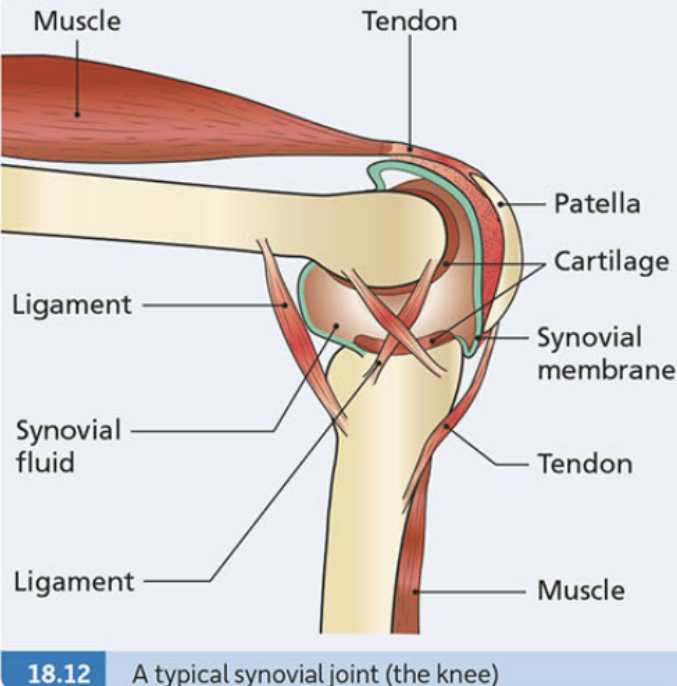
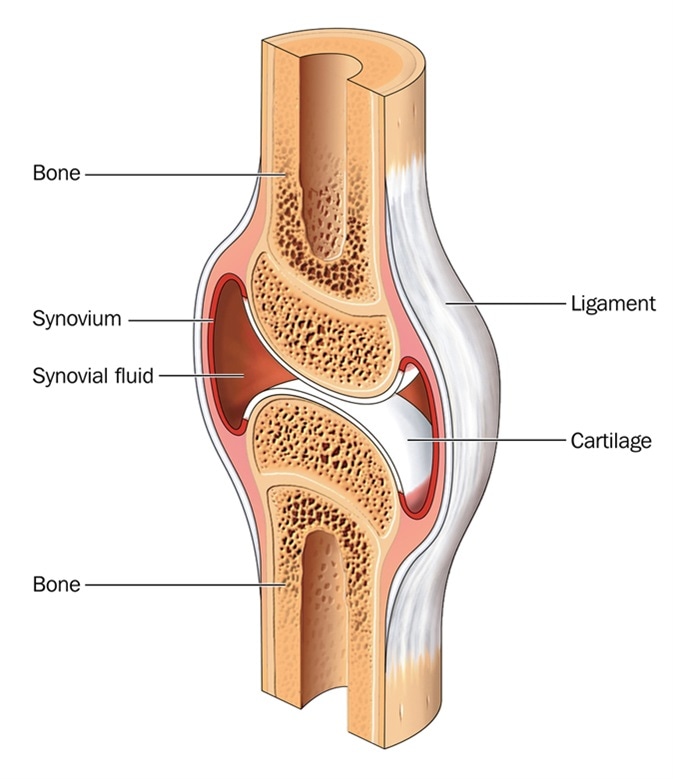
In synovial joints, the ends of bones are covered with cartilage and the bones are held in place by ligaments. A special membrane called the synovial membrane surrounds the joint and produces synovial fluid - a clear, sticky liquid that lubricates the joint and reduces friction during movement.
Note
Synovial Fluid Function
Think of synovial fluid like oil in a car engine - it keeps all the moving parts working smoothly by reducing friction and preventing wear and tear.
Examples of synovial joints include your shoulders, hips, elbows, and knees.
Cartilage
Cartilage is a type of connective tissue that consists of cells embedded in a firm but flexible fibrous protein called collagen. Unlike bone tissue, cartilage lacks blood vessels and nerves, which means it depends on materials diffusing through to the cells that form it.
Important
Why Cartilage Heals Slowly
Because cartilage has no blood vessels, nutrients and oxygen must slowly diffuse through the tissue to reach the cells. This is why cartilage injuries take much longer to heal than bone fractures.
Functions of cartilage
Cartilage serves several important functions in your body:
- Protects bones: Acts as a shock absorber to prevent bones from grinding against each other
- Allows friction-free movement: The smooth surface reduces wear and tear during joint movement
- Provides structure: Forms parts of your ear, nose, trachea, and the discs between vertebrae in your spine
In synovial joints, cartilage covers the ends of bones to create smooth surfaces that can move against each other without damage.
Ligaments
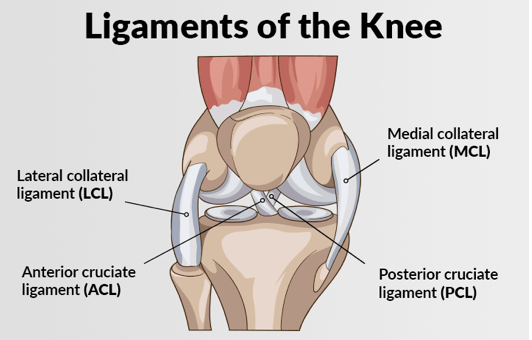
Ligaments are strong, fibrous, slightly elastic tissues that connect bone to bone. They are more flexible when warm, which is why warming up before physical activities is important to prevent ligament damage.
Note
Warming Up Prevents Injury
Ligaments become more flexible when your body temperature rises during warm-up exercises. This increased flexibility reduces the risk of tears and sprains during physical activity.
Functions of ligaments
- Attach bones together: Hold the bones of a joint in proper position
- Strengthen joints: Provide stability and prevent excessive movement that could damage the joint
- Allow controlled movement: Permit normal joint movement while preventing harmful overextension
Ligaments are tough structures, but they can be injured through overstretching or tearing, especially during sports activities.
Tendons
Tendons are strong, flexible, inelastic fibres that connect muscle to bone. They are mainly composed of collagen and contain some blood vessels, unlike cartilage.

Functions of tendons
- Transfer force: When a muscle contracts, the tendon transfers that pulling force to the bone
- Enable movement: Allow muscles to move bones and create body movement
- Provide strength: Can withstand the powerful forces generated by muscle contractions
Note
Tendons vs Ligaments
Remember the difference:
- Ligaments = bone to bone (provide joint stability)
- Tendons = muscle to bone (enable movement)
Tendons are essential for all voluntary movement in your body. Without tendons, muscle contractions would not be able to move your bones.
Summary
Summary
Key Points to Remember:
- Antagonistic muscle pairs work in opposition - when one contracts, the other relaxes (like biceps and triceps)
- Synovial joints are the most mobile joints in your body and are lubricated by synovial fluid
- Cartilage protects bones and allows smooth, friction-free movement at joints
- Ligaments connect bone to bone and provide joint stability and strength
- Tendons connect muscle to bone and transfer the force of muscle contractions to create movement