Gamete Formation (Leaving Cert Biology): Revision Notes
📚Revision Notes
Gamete Formation
Note
A gamete is a haploid sex cell capable of fertilisation.
Note
A haploid cell has one set of chromosomes.
Note
A diploid cell has two sets of chromosomes.
Note
Mitosis is a form of nuclear division in which one nucleus divides to form 2 nuclei, each with the same number of chromosomes as the parent nuclei.
Note
Meiosis is a form of nuclear division where a parent cell divides to produce daughter cells which contain half the number of chromosomes of the parent cell.
Sexual Reproduction in a Flowering Plant
- Flowers are the reproductive organs of flowering plants.
- Male and female structures are required for reproduction:
- Stamen: Male part of the flower, which produces pollen grains (male gametes).
- Carpel: Female part of the flower, which produces ovules (female gametes).
- Pollination: The process of transferring pollen from the anther (male part) to the stigma (female part) of a flower from the same species.
Male Gamete Formation
1. Where It Occurs:
- Male gametes are formed in the anther, which is part of the stamen (the male structure of the flower).
2. Structure of the Anther:
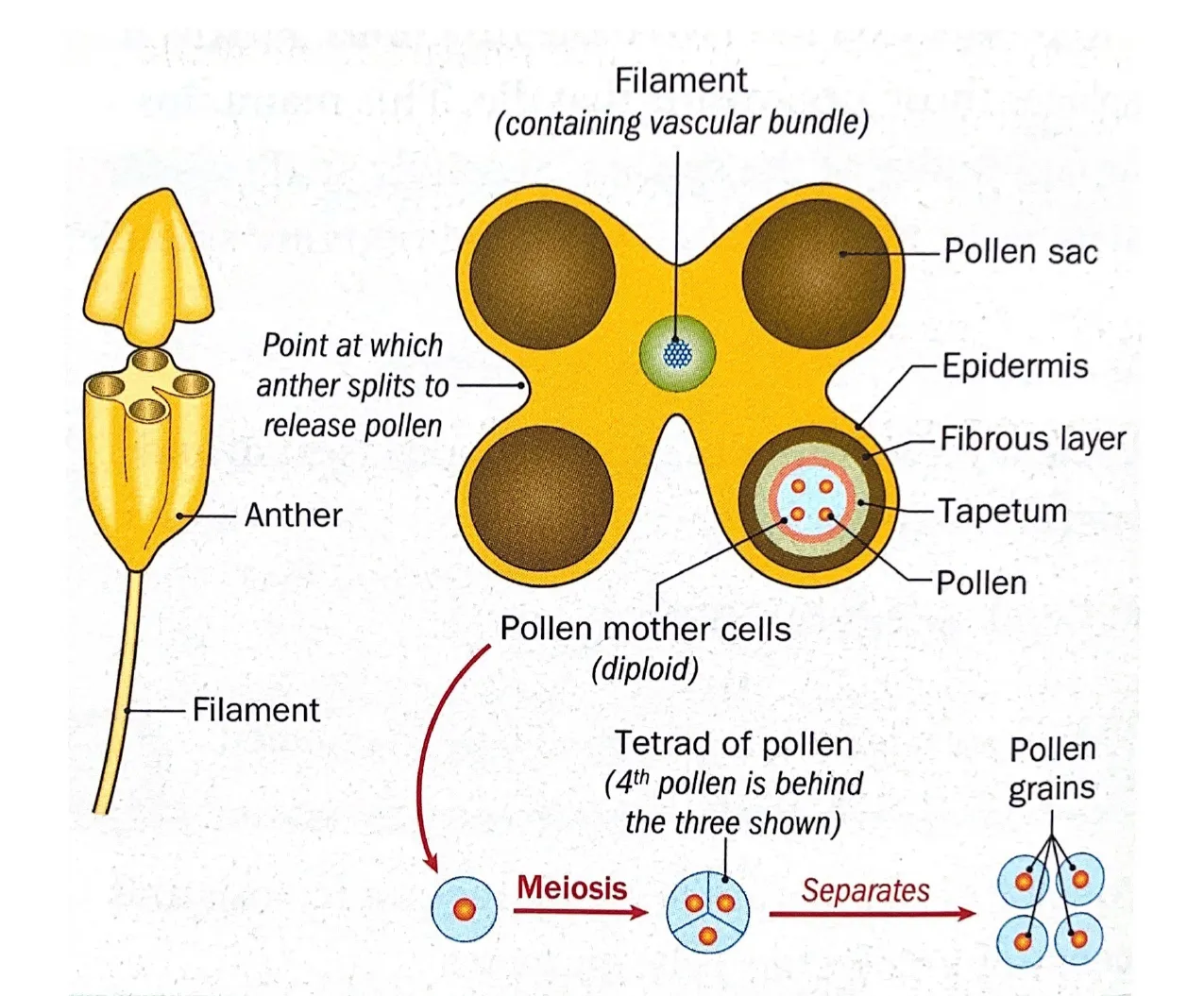
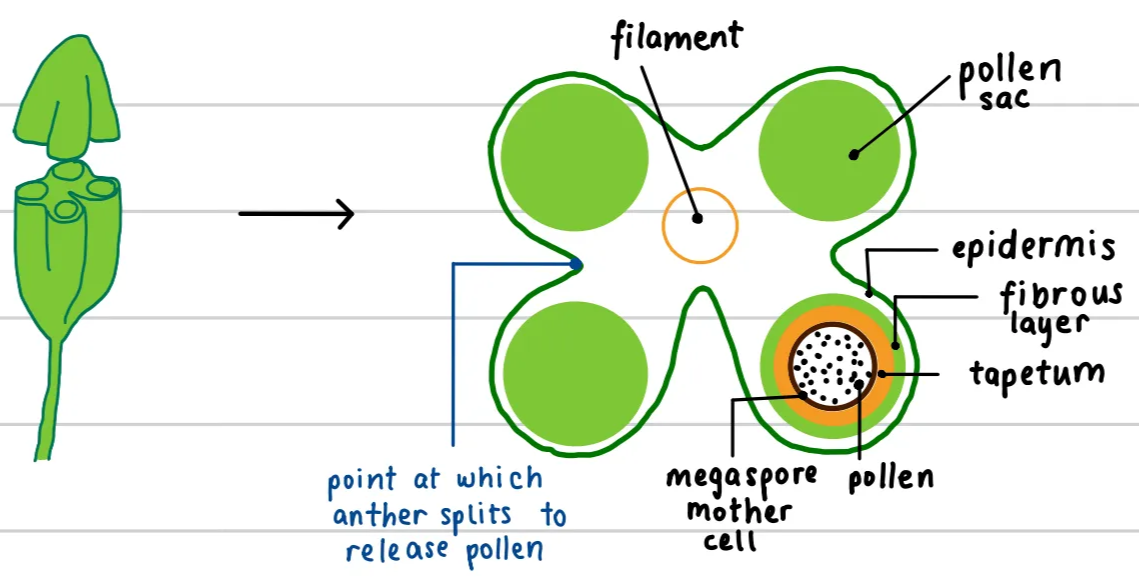
- Each anther has four pollen sacs.
- Inside the pollen sacs are microspore mother cells (diploid).
- Layers of the anther (from the inside out):
- Pollen sac: Where pollen grains develop.
- Tapetum: Provides nutrients for developing pollen grains.
- Fibrous layer: For protection.
- Epidermis: The outermost protective layer.
3. Process of Male Gamete Formation:
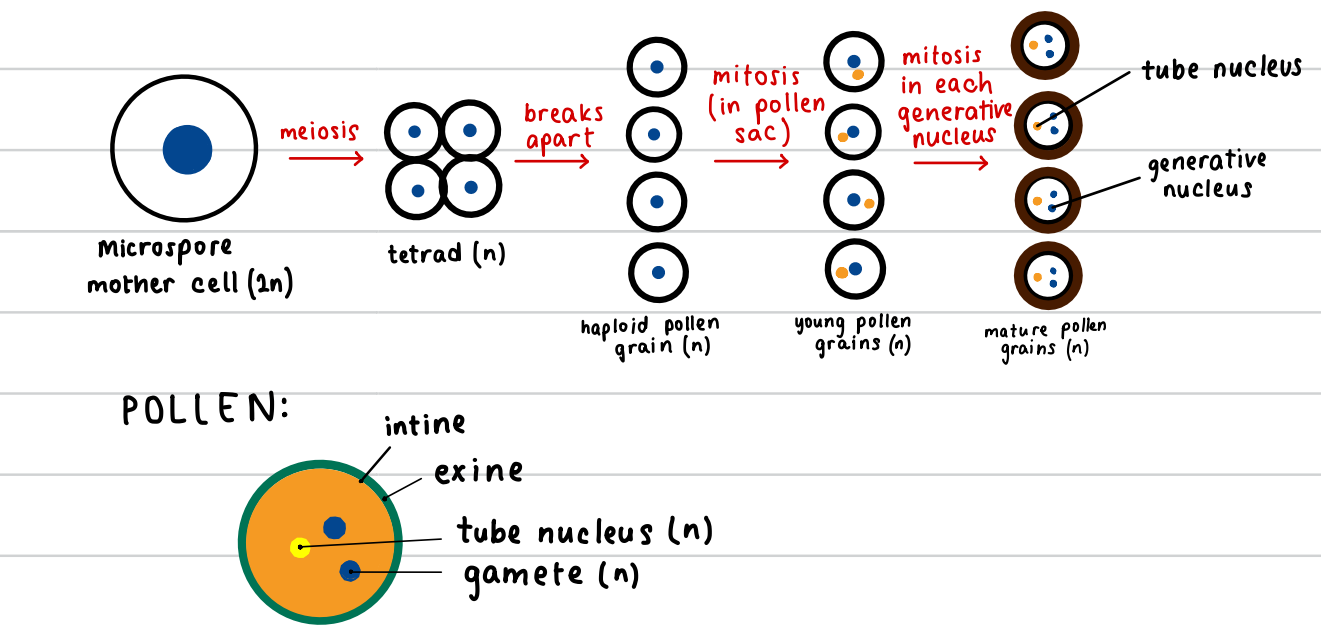
- Cells inside the anther are diploid. They are called microspore mother cells.
- Each microspore mother cell undergoes meiosis to produce four haploid daughter cells called a tetrad.
- The tetrad separates into four individual haploid pollen grains.
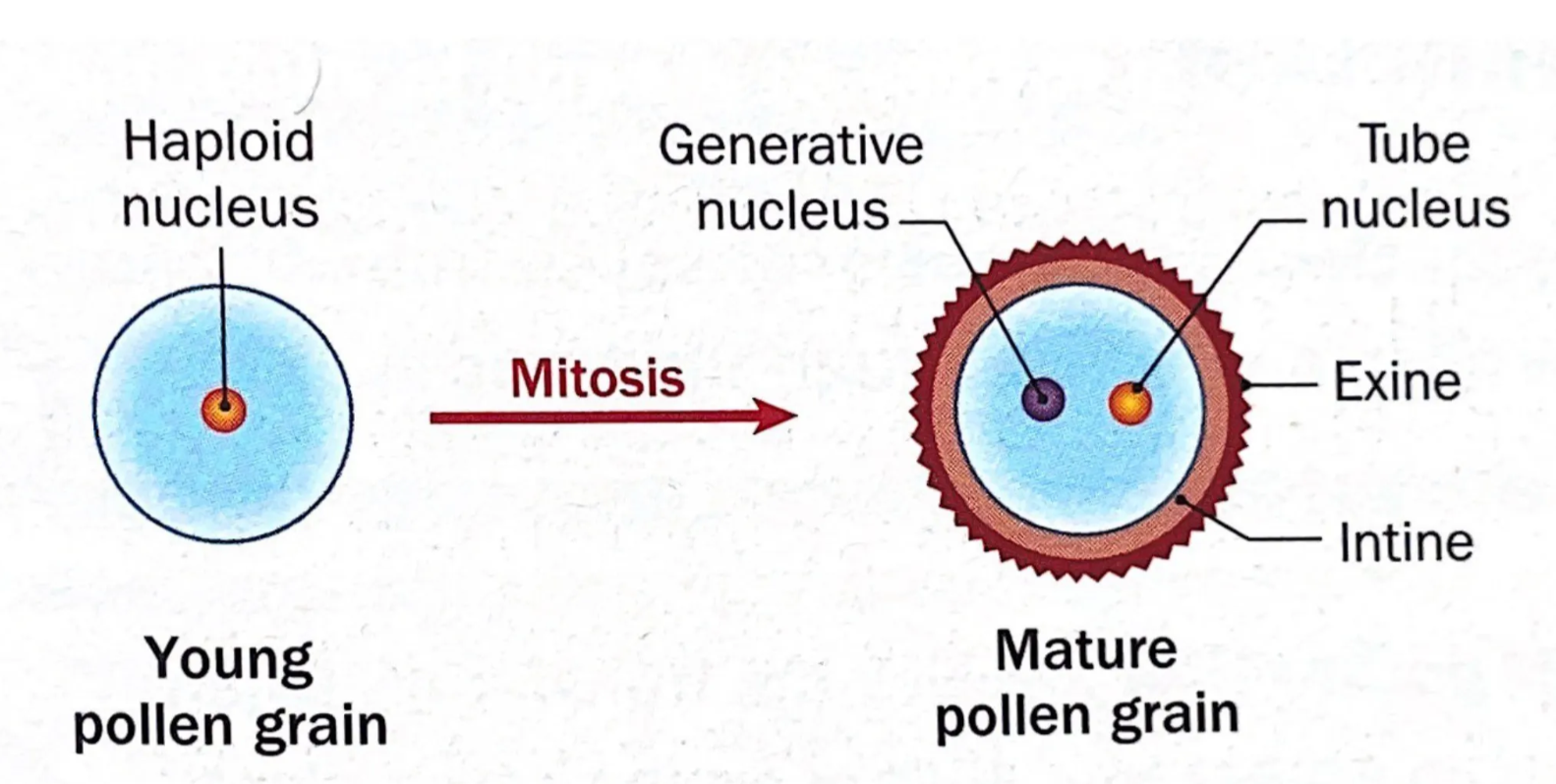
- Each haploid cell (pollen grain) divides by mitosis to form 2 haploid nuclei. One of these is called the tube nucleus, and the other is called the generative nucleus.
- The mature pollen grain forms a tough outer wall called the exine. The inner wall of the pollen grain is called the intine.
- When the pollen grains have matured, the walls of the anther become dry and shrivel. This results in the splitting of the anther walls. The pollen grains are then exposed to the outside of the anther.
Female Gamete Formation
1. Where It Occurs:
- Female gametes are formed in the ovule, which is inside the ovary (part of the carpel, the female structure of the flower).
2. Structure of the Ovule:
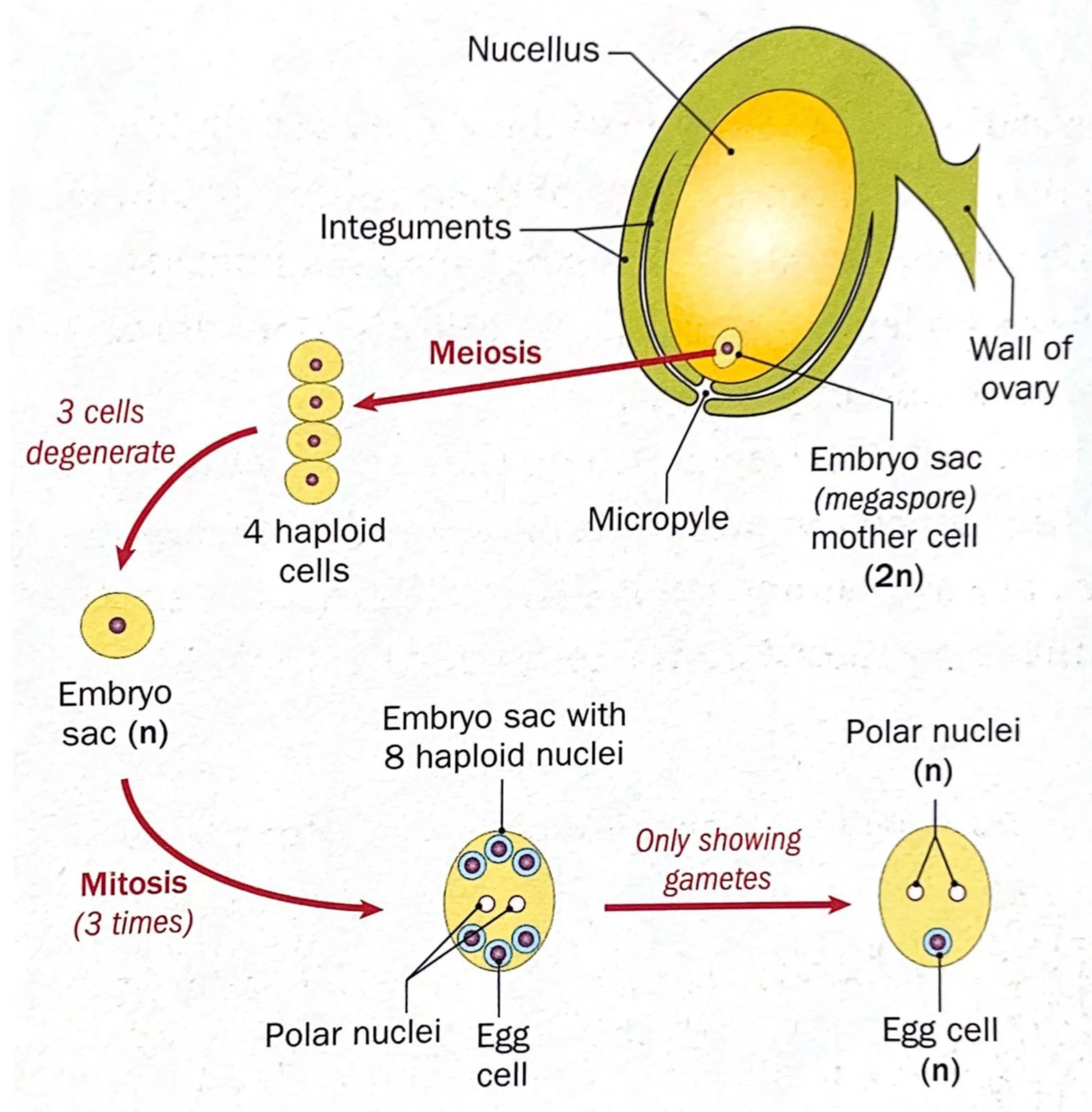
- Each ovule has two walls called integuments (protective layers) with a small opening called the micropyle.
3. Process of Female Gamete Formation
- Each ovule is composed of a number of diploid cells.
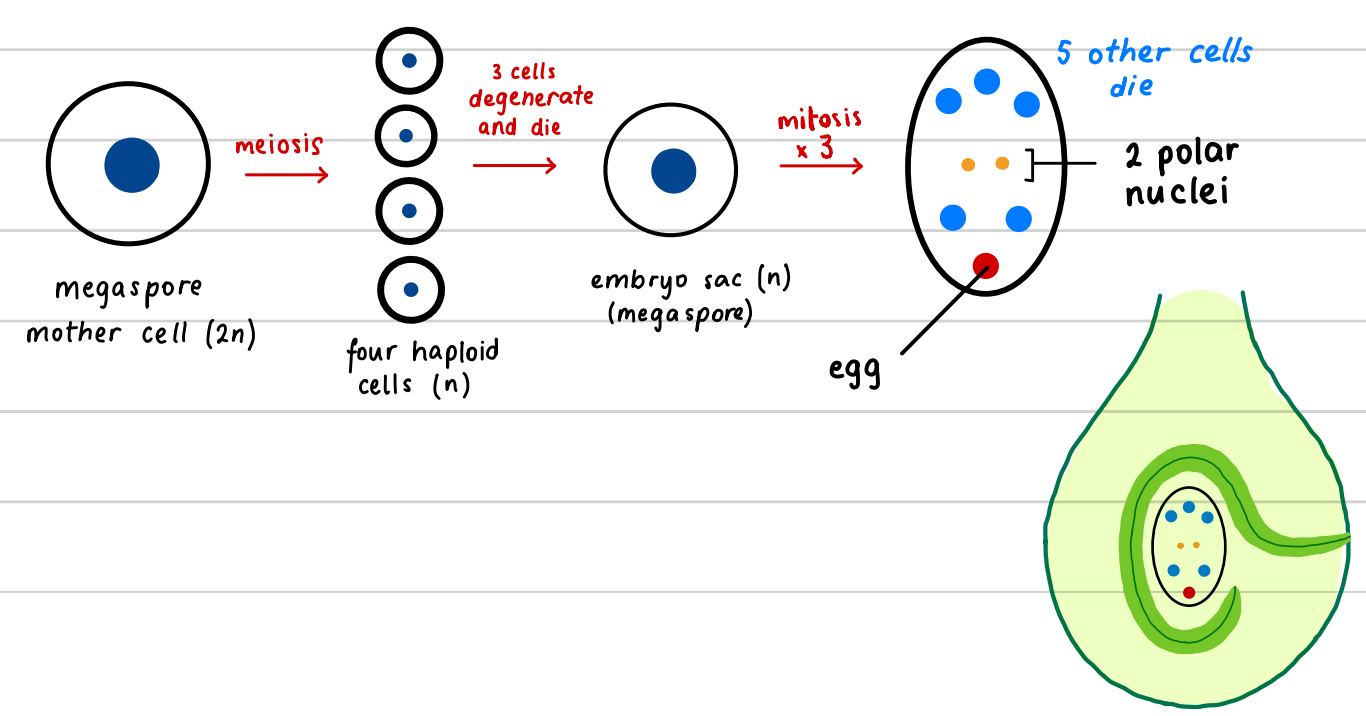
- One of these cells divides by meiosis to form 4 haploid nuclei.
- 3 of these die.
- The fourth haploid nucleus undergoes mitosis 3 times to form a single large cell called the embryo sac containing 8 haploid nuclei.
- These eight nuclei arrange themselves within the embryo sac:
- One of these nuclei becomes the egg nucleus, which forms the egg cell (female gamete).
- 2 nuclei form the polar nuclei.
- The remaining 5 nuclei play no part in reproduction.
- The egg cell and the polar nuclei are the female gametes.

Mature embryo sac
Comparison of Male and Female Gamete Formation
| Male Gamete Formation | Female Gamete Formation |
|---|---|
| Occurs in the anther (stamen). | Occurs in the ovule (carpel). |
| Produces pollen grains. | Produces the embryo sac. |
| Produces two sperm nuclei (male gametes). | Produces one egg cell (female gamete). |
| Involves meiosis followed by mitosis. | Involves meiosis followed by mitosis. |
Note
Summary
Male Gamete Formation
-
Anther consists of four pollen sacs which contain diploid microspore mother cells.
-
Microspore mother cell (2n) divides by meiosis in the cells lining the anther to produce four haploid pollen grans - tetrad.
-
The tetrad separates into 4 individual pollen grains -microspores.
-
The nucleus in each pollen grain divides by mitosis to produce two haploid nuclei:
-
Generative nucleus
-
Tube nucleus
Female Gamete Formation
- Megaspore mother cell (2n) in the ovule divides by meiosis to produce 4 haploid cells.
- Three die (degenerate), and the remaining cell becomes the embryo sac.
- The embryo sac undergoes mitosis three times, producing 8 haploid nuclei:
- Five degenerate,
- Two form polar nuclei,
- One becomes the egg cell (female gamete).