Plant Vascular Tissue (Leaving Cert Biology): Revision Notes
📚Revision Notes
Plant Vascular Tissue
Plant vascular tissue forms the transport system that moves water, minerals, and food throughout the plant body. Understanding the structure and function of these specialised tissues is essential for grasping how plants maintain themselves and grow effectively.
Plant tissues overview
Plants contain three main types of tissue that work together to support plant life. Dermal tissue forms the protective outer layer, ground tissue carries out photosynthesis and provides support, whilst vascular tissue handles the crucial job of transporting materials around the plant.
Note
Vascular tissue consists of two distinct types: xylem and phloem. These tissues are typically found together in structures called vascular bundles, which run through roots, stems, leaves, and flowers like a plant's circulatory system.
Xylem
Xylem tissue is responsible for transporting water and dissolved mineral salts from the roots up to all parts of the plant. This upward movement of water is essential for photosynthesis, maintaining plant structure, and cooling the plant through transpiration.
Structure and composition
Xylem is made up of two main types of cells: vessels and tracheids. Both cell types are dead when mature, forming hollow tubes that allow water to flow freely through them.
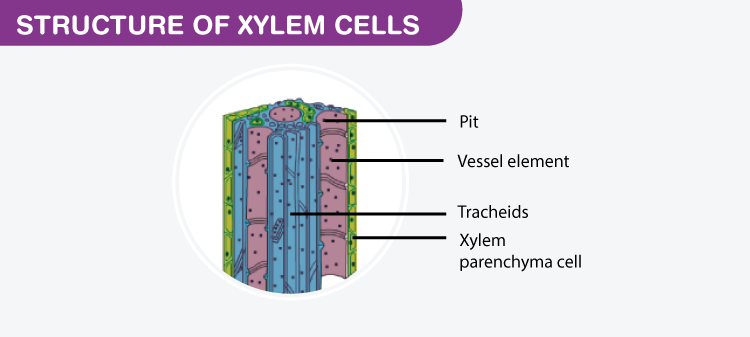
Xylem vessels are tubular structures that form when multiple cells join end-to-end. The end walls between these cells break down completely, creating continuous tubes that are wider than tracheids. These vessels are particularly efficient at transporting water and are commonly found in flowering plants.
Xylem tracheids are longer, narrower cells with tapered ends that overlap with neighbouring tracheids. Unlike vessels, tracheids retain their end walls, so water must pass through small openings called pits to move from one tracheid to the next.
Important
Both vessels and tracheids have thick, lignified cell walls. Lignin is a tough, waterproof substance that provides great strength and prevents the tubes from collapsing under the negative pressure created during water transport. The lignin is often deposited in spiral patterns, giving xylem its characteristic appearance.
Adaptations for water transport
Xylem has several key adaptations that make it perfectly suited for moving water efficiently:
- Narrow tube structure - creates strong capillary forces that help pull water upward
- Hollow interior (lumen) - provides an unobstructed pathway for water flow
- No end walls in vessels - allows continuous water movement without barriers
- Pit structures - enable horizontal water movement between adjacent cells
- Lignin reinforcement - prevents collapse under negative pressure and provides mechanical support
Function and location
The primary function of xylem is to transport water and mineral salts from the roots to the leaves, where they are needed for photosynthesis. Xylem also provides mechanical support to the plant due to its lignified structure.
Xylem tissue is found in roots, stems, leaves, and flowers, often grouped in vascular bundles alongside phloem tissue. This arrangement ensures efficient distribution of materials throughout the plant.
Phloem
Phloem tissue transports the products of photosynthesis (mainly sugars) from the leaves to all other parts of the plant where they are needed for growth, respiration, or storage.
Structure and composition
Note
Unlike xylem, phloem is composed of living tissue that remains active throughout the plant's life. The main components of phloem are sieve tube elements and companion cells.
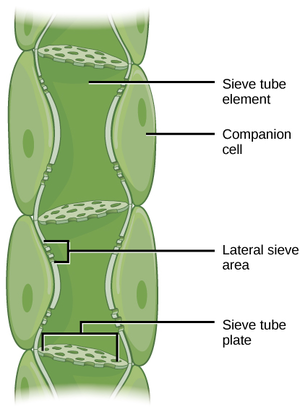
Sieve tube elements are long, tubular cells that join end-to-end to form continuous tubes called sieve tubes. The end walls between these cells, known as sieve plates, contain numerous perforations (holes) that allow materials to flow from one element to the next.
Companion cells are found alongside each sieve tube element and play a crucial role in maintaining the sieve tubes. Since sieve tube elements lose most of their cellular contents as they mature, including their nucleus, the companion cells provide the metabolic support needed to keep the sieve tubes functioning.
Appearance and key features
Sieve tubes are living structures that lack lignin, making them more flexible than xylem vessels. The cytoplasm of each sieve tube element remains intact, although the nucleus degenerates during maturation. The characteristic sieve plates with their numerous pores are clearly visible under microscopic examination and are essential for the transport function.
Function and location
The primary function of phloem is to transport food materials, particularly sugars produced during photosynthesis, from the leaves to other parts of the plant. This process, called translocation, can move materials both upward and downward depending on where they are needed.
Companion cells control the activities of the sieve tube elements, ensuring that transport occurs efficiently and that the sieve tubes remain functional despite lacking a nucleus.
Phloem is found in vascular bundles throughout the plant, typically positioned alongside xylem tissue in roots, stems, leaves, and flowers.
Key differences between xylem and phloem
Important
Understanding the contrasts between these two vascular tissues helps clarify their different roles:
What they transport:
- Xylem carries water and mineral salts upward from roots to leaves
- Phloem carries food (sugars) in multiple directions as needed
Cell condition:
- Xylem consists of dead cells when mature, forming hollow tubes
- Phloem contains living cells that remain active
Structural support:
- Xylem has lignin deposits that provide strength and rigidity
- Phloem lacks lignin, making it more flexible
Associated cells:
- Xylem has no companion cells as the cells are dead
- Phloem has companion cells that support sieve tube function
Transport mechanism:
- Xylem transport is driven by transpiration and root pressure
- Phloem transport is an active process requiring energy from companion cells
Summary
Key Points to Remember:
-
Xylem is the plant's water highway - it transports water and minerals from roots to leaves using dead, lignified tubes (vessels and tracheids)
-
Phloem is the plant's food delivery system - it moves sugars from leaves to other plant parts using living sieve tubes supported by companion cells
-
Lignin makes xylem strong and rigid, whilst phloem remains flexible without lignin
-
Sieve plates in phloem have holes that allow food materials to flow between cells, whilst xylem vessels have no end walls at all
-
Both tissues work together in vascular bundles to keep plants healthy and growing by ensuring all parts receive the water and food they need