Upward Movement of Water in Plants (Leaving Cert Biology): Revision Notes
📚Revision Notes
Upward Movement of Water in Plants
Plants need to move water from their roots to their leaves, sometimes over great distances. This remarkable process involves two main mechanisms working together: root pressure and the cohesion-tension theory.
Root pressure
Root pressure develops when water moves into plant roots through osmosis. As water builds up in root tissues, it creates pressure that pushes water upwards through the xylem vessels.
How root pressure works
When soil water contains dissolved minerals, water enters root cells by osmosis. This continuous influx creates pressure inside the root system, forcing water upwards through the xylem tubes towards the stems and leaves.
Note
Think of root pressure like a pump at the bottom of the plant - it pushes water upwards from the roots through the internal transport system.
Limitations of root pressure
However, root pressure has significant limitations:
- It cannot fully explain how water reaches the tops of very tall trees
- Measurements show root pressure is not strong enough to push water to great heights
- Root pressure is particularly weak during summer, yet this is when most water transport occurs
- It works better in shorter plants but fails to account for water movement in trees over 100 metres tall
Important
Critical Point: Root pressure alone cannot explain water transport in tall plants. This is why scientists needed to discover an additional mechanism - the cohesion-tension theory.
Evidence of root pressure
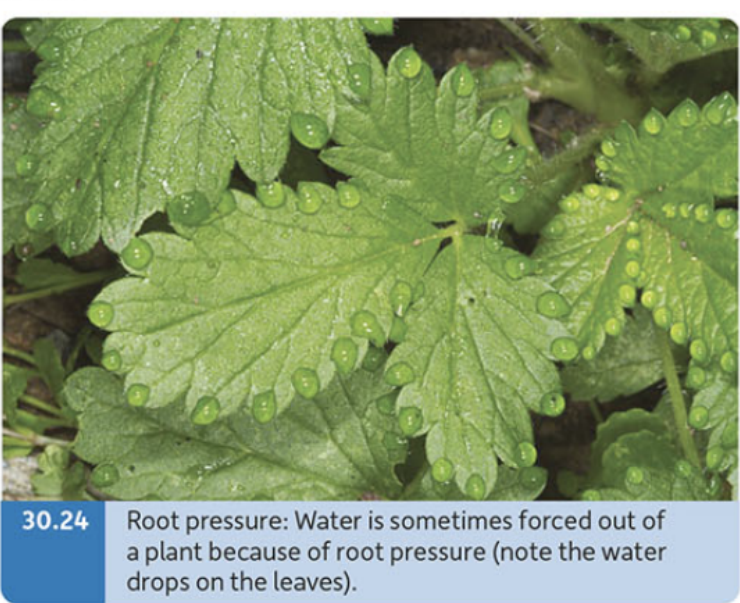
You can observe root pressure in action when water droplets appear on leaf edges, especially during humid conditions. This process, called guttation, occurs when excess water is forced out of the plant due to root pressure.
Cohesion-tension theory
Since root pressure alone cannot explain water transport in tall plants, scientists developed the cohesion-tension theory. This theory was first proposed in 1894 by two Irish scientists at Trinity College Dublin - Henry Dixon and John Joly. It is now considered the main mechanism for upward water movement in plants.
The mechanism explained
The cohesion-tension theory works through several interconnected processes:
Molecular forces
- Cohesion means water molecules stick together through hydrogen bonding
- Adhesion occurs when water molecules stick to the walls of xylem vessels
- These forces are strong enough to maintain a continuous column of water
Note
Key Definitions:
- Cohesion: Water molecules sticking to each other
- Adhesion: Water molecules sticking to xylem vessel walls
Remember: "Cohesion holds water together, adhesion sticks to walls"
Water movement through transpiration
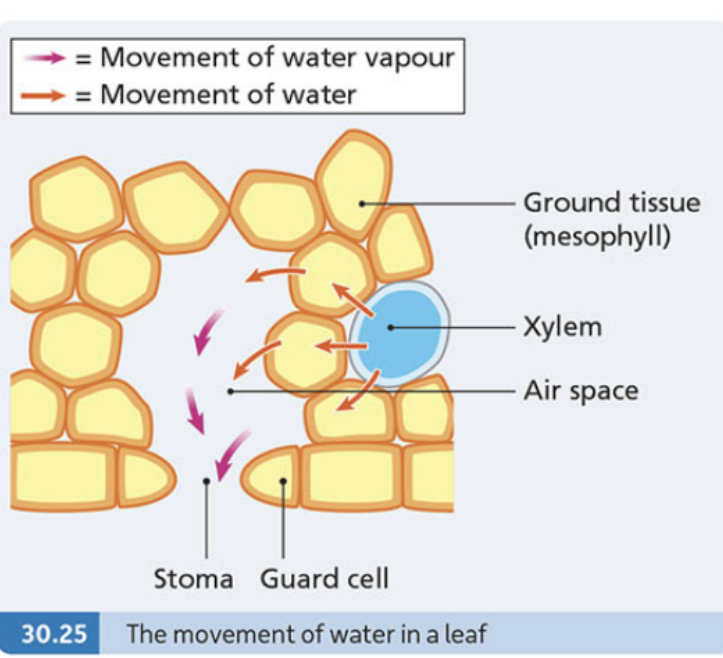
- Water evaporates from leaf cells into air spaces within the leaf
- This water vapour exits through stomata during transpiration
- As each water molecule leaves the xylem, the next molecule is pulled up due to cohesion
The pulling mechanism
- This creates a continuous pulling force from the top of the plant down to the roots
- The entire water column in the xylem is stretched under tension, like pulling on elastic
- Cohesion forces between water molecules prevent the column from breaking
- This pulling force is transmitted through the entire water column to the roots
Continuous column requirement
- An unbroken column of water must exist in the xylem tubes
- The tension created by transpiration pulls water up through this continuous column
- This mechanism easily explains water movement in plants up to 150 metres tall
Important
Why This Theory Works: Unlike root pressure, the cohesion-tension theory can explain water transport in the tallest trees. The key is that transpiration at the top creates a pulling force that travels down the entire water column.
Effects of transpiration on stem width
The cohesion-tension theory explains why plant stems change width during the day. When transpiration is active, the tension in water columns actually makes stems narrower.
Note
Daily Stem Changes:
- Daytime: Stomata open → transpiration increases → xylem tension increases → stems become slightly narrower
- Night-time: Stomata close → transpiration stops → tension decreases → stems return to normal width
This daily shrinking and expanding provides strong evidence supporting the cohesion-tension theory.
Stomatal opening and closing
Stomata are tiny pores on leaf surfaces that control gas exchange and water loss. Each stoma is surrounded by two kidney-shaped guard cells that change shape to open or close the pore.
Guard cell mechanism
Opening the stoma:
- Water enters guard cells by osmosis
- Guard cells become swollen and turgid
- Thickened cell walls cause cells to buckle outwards
- This creates a gap between guard cells (stoma opens)
Closing the stoma:
- Guard cells lose water and become flaccid
- Cells shrink and become less curved
- Gap between guard cells closes (stoma closes)
Control of stomatal opening and closing
The concentration of carbon dioxide in leaf air spaces is the main factor controlling stomatal behaviour.
High carbon dioxide concentration
When CO₂ levels are high in leaf air spaces:
- Stomata close
- This typically happens in evenings when photosynthesis slows down
- Plant respiration continues 24 hours daily, producing CO₂ in leaf cells
- Higher CO₂ levels trigger stomata to close
- This reduces water loss when photosynthesis isn't occurring
Low carbon dioxide concentration
When CO₂ levels are low in leaf air spaces:
- Stomata open
- This happens in mornings when photosynthesis resumes
- Photosynthesis uses up CO₂ from air spaces
- Lower CO₂ levels signal stomata to open
- This allows fresh CO₂ to enter for photosynthesis
Important
Simple Rule to Remember:
- High CO₂ concentration → stomata close
- Low CO₂ concentration → stomata open
This control mechanism ensures stomata open during the day for photosynthesis and close at night to conserve water.
Summary
Key Points to Remember:
- Root pressure pushes water upwards but is too weak for tall plants
- Cohesion-tension theory is the main mechanism - water molecules stick together and get pulled up by transpiration
- Daily stem width changes provide evidence for tension in the water column
- Stomata are controlled by CO₂ levels - high CO₂ closes them, low CO₂ opens them
- Guard cells change shape by gaining or losing water to control stoma opening