The Arrhenius Theory (Leaving Cert Chemistry): Revision Notes
📚Revision Notes
The Arrhenius Theory
Historical background
In 1884, a young Swedish chemistry student named Svante Arrhenius submitted his PhD thesis at the University of Uppsala, Sweden. His revolutionary ideas about how acids and bases behave in solution were initially met with scepticism - his examiners were so unimpressed that they awarded him the lowest possible passing grade!
However, Arrhenius wasn't discouraged. He moved to Stockholm University where his groundbreaking work was properly recognised. In 1903, he was awarded the Nobel Prize in Chemistry for developing what we now call the Arrhenius theory of acids and bases.
Note
The fact that Arrhenius received the lowest passing grade for work that later won him a Nobel Prize shows how revolutionary scientific ideas often face initial resistance from the established scientific community.
What are acids according to Arrhenius?
The Arrhenius theory provides a clear, water-based definition of acids. According to this theory:
An acid is a substance that dissociates in water to produce hydrogen ions (H⁺).
When acids dissolve in water, they break apart or dissociate to release H⁺ ions. Let's look at some examples:
- Hydrochloric acid:
- Nitric acid:
- Sulfuric acid:
Notice how sulfuric acid produces two H⁺ ions - this makes it a dibasic acid. Acids that produce only one H⁺ ion (like HCl and HNO₃) are called monobasic acids. Some acids, like phosphoric acid (H₃PO₄), can produce three H⁺ ions and are called tribasic acids.
The hydronium ion concept
Note
The Reality of H⁺ Ions in Water
In reality, bare H⁺ ions don't exist independently in water. Instead, they react with water molecules to form hydronium ions (H₃O⁺):
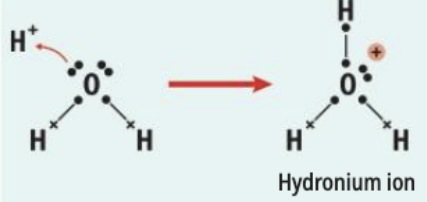
So a more accurate representation of acid behaviour would be:
However, for simplicity, we often still write H⁺ in equations, understanding that H₃O⁺ is what actually exists in solution.
What are bases according to Arrhenius?
The Arrhenius definition of bases is equally straightforward:
A base is a substance that dissociates in water to produce hydroxide ions (OH⁻).
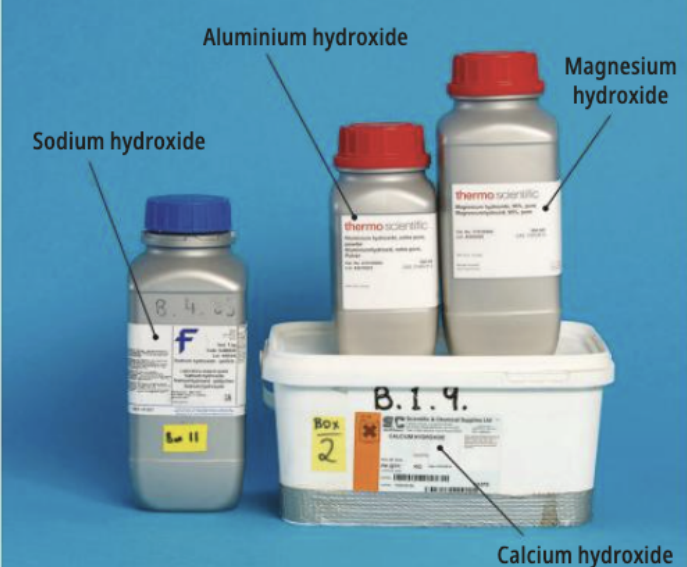
Common examples of bases include:
- Sodium hydroxide:
- Magnesium hydroxide:
- Calcium hydroxide:
Strong vs weak acids and bases
Not all acids and bases dissociate to the same extent in water. This leads to an important classification:
Strong acids and bases
- Strong acids almost completely dissociate in water to release H⁺ ions
- Strong bases almost completely dissociate in water to release OH⁻ ions
- Examples of strong acids: HCl, HNO₃, H₂SO₄
- Examples of strong bases: NaOH, Ca(OH)₂
Weak acids and bases
- Weak acids only slightly dissociate in water to release H⁺ ions
- Weak bases only slightly dissociate in water to release OH⁻ ions
- Most of the original molecules remain intact in solution
- Examples of weak acids: ethanoic acid, formic acid
Important
Exam tip: If you're asked whether HCl or ethanoic acid is stronger, answering simply "HCl" will not be accepted as a correct answer - you need to read the question carefully and specify which type of acid is required!
Shortcomings of the Arrhenius theory
Although the Arrhenius theory was revolutionary for its time, it does have several limitations:
Important
Limitation 1: Hydronium ions vs H⁺ ions
As mentioned earlier, H⁺ ions don't actually exist freely in solution - they form hydronium ions (H₃O⁺) instead. The theory oversimplifies this reality.
Important
Limitation 2: Limited to aqueous solutions
The Arrhenius theory only applies to reactions in water. This excludes many important acid-base reactions that occur in non-aqueous solvents or in the gas phase.
Important
Limitation 3: Cannot explain all acid-base behaviour
Some reactions that we recognise as acid-base reactions don't involve water at all. For example, when ammonia gas (NH₃) and hydrogen chloride gas (HCl) react:
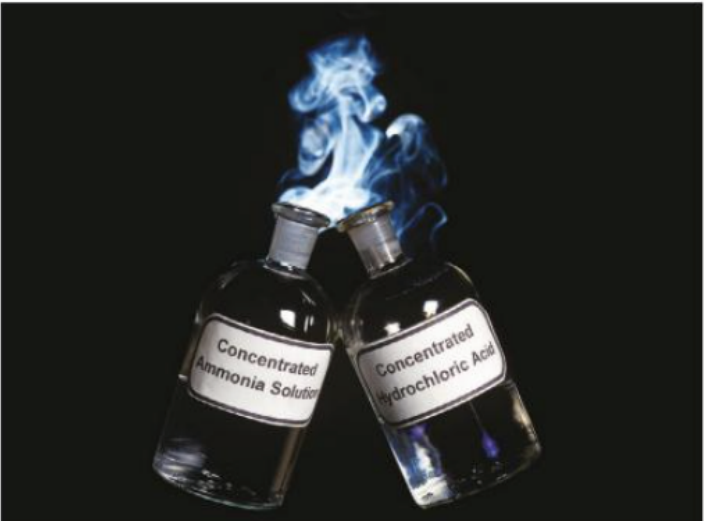
This produces ammonium chloride, but since no water is involved, the Arrhenius theory cannot classify this as an acid-base reaction, even though it clearly behaves like one.
These limitations led scientists to develop more comprehensive theories of acids and bases that could explain a broader range of chemical behaviour.
Summary
Key Points to Remember:
- Acids produce H⁺ ions when dissolved in water (Arrhenius definition)
- Bases produce OH⁻ ions when dissolved in water (Arrhenius definition)
- Strong acids/bases dissociate almost completely, while weak acids/bases only dissociate slightly
- Monobasic acids produce 1 H⁺, dibasic produce 2 H⁺, tribasic produce 3 H⁺ ions
- The Arrhenius theory is limited to aqueous solutions only and cannot explain all acid-base reactions