The Brønsted-Lowry Theory (Leaving Cert Chemistry): Revision Notes
📚Revision Notes
The Brønsted-Lowry Theory
Historical background
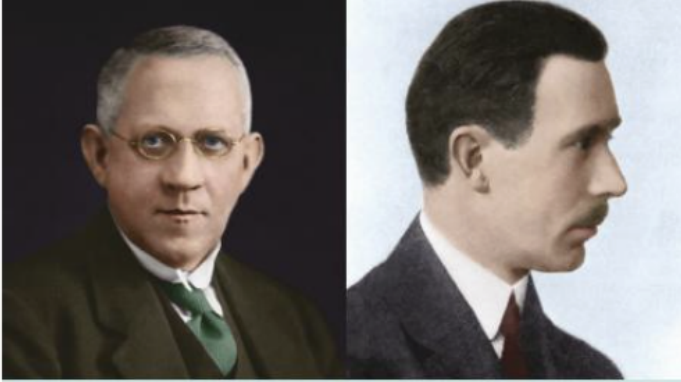
In 1923, two chemists working independently developed a new way of understanding acids and bases. Johannes Brønsted, a Danish chemist, and Thomas Lowry, an English chemist, both proposed similar definitions that revolutionised how we think about acid-base reactions.
Note
Their approach was groundbreaking because it focused on what actually happens during acid-base reactions - the transfer of protons (H⁺ ions) between substances. This represented a major shift from earlier definitions that were limited to aqueous solutions.
Core definitions
The Brønsted-Lowry theory is based on two simple but powerful definitions:
Important
Brønsted-Lowry acid: A substance that donates a proton (H⁺ ion)
Brønsted-Lowry base: A substance that accepts a proton (H⁺ ion)
This means that for any Brønsted-Lowry acid-base reaction to occur, there must be both a proton donor and a proton acceptor present. The reaction involves the transfer of a proton from the acid to the base.
Understanding proton transfer reactions
Let's examine how this works in practice with common examples:
Example
Worked Example: Hydrogen chloride reacting with water
When HCl is added to water, the following reaction occurs:
- HCl acts as the acid because it donates a proton
- H₂O acts as the base because it accepts a proton
- The result is H₃O⁺ (hydronium ion) and Cl⁻ (chloride ion)
Example
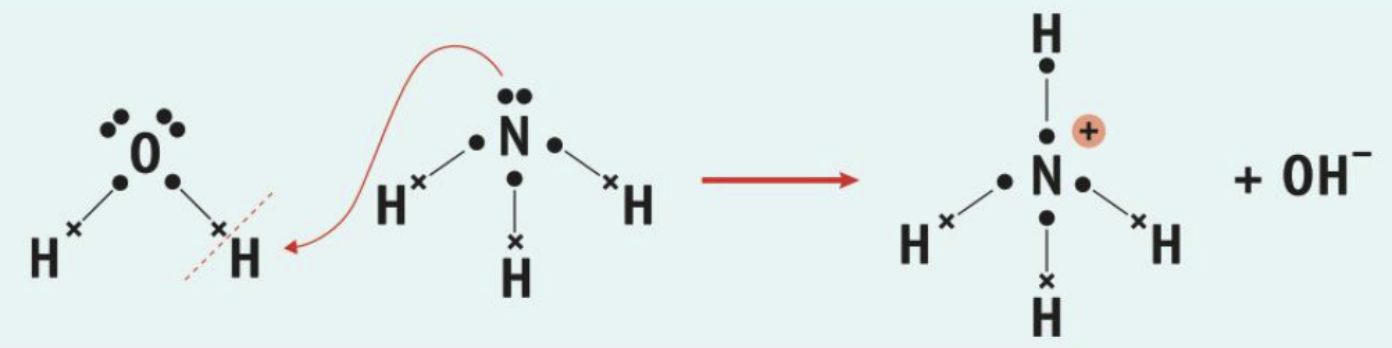
Worked Example: Ammonia dissolving in water
- NH₃ acts as the base because it accepts a proton from water
- H₂O acts as the acid because it donates a proton to ammonia
- This produces NH₄⁺ (ammonium ion) and OH⁻ (hydroxide ion)
Classifying acid and base strength
The Brønsted-Lowry theory allows us to understand acid and base strength in terms of proton transfer ability:
Strong vs weak acids
- Strong acid: Excellent proton donor - readily gives up protons
- Weak acid: Poor proton donor - reluctant to give up protons
Strong vs weak bases
- Strong base: Excellent proton acceptor - readily accepts protons
- Weak base: Poor proton acceptor - less likely to accept protons
Note
This classification helps predict how completely acid-base reactions will proceed and explains why some acids and bases are more reactive than others.
Amphoteric substances
One of the most important insights from the Brønsted-Lowry theory is that some substances can act as either acids or bases, depending on what they're reacting with. These are called amphoteric or amphiprotic substances.
Important
Key example: Water (H₂O)
- When reacting with HCl: water acts as a base (accepts a proton)
- When reacting with NH₃: water acts as a acid (donates a proton)
The term "amphi" comes from Greek meaning "both sides", which helps you remember that these substances can function on both sides of acid-base reactions.
Advantages of the Brønsted-Lowry theory
This theory provides several important advantages over earlier definitions:
- Broader scope: Can explain acid-base behaviour in non-aqueous solutions
- Focus on mechanism: Explains what actually happens during reactions (proton transfer)
- Flexibility: Accounts for substances that can act as both acids and bases
- Predictive power: Helps predict the products of acid-base reactions
Note
The theory is particularly useful for understanding reactions that don't involve water as the solvent, making it more comprehensive than earlier approaches.
Key terminology to master
- Proton: An H⁺ ion (hydrogen atom without its electron)
- Proton donor: Another term for Brønsted-Lowry acid
- Proton acceptor: Another term for Brønsted-Lowry base
- Amphoteric/Amphiprotic: Can act as either acid or base
- Hydronium ion (H₃O⁺): Formed when water accepts a proton
Summary
Key Points to Remember:
- Acids donate protons, bases accept protons - this is the core of Brønsted-Lowry theory
- Water is amphoteric - it can act as either an acid or base depending on the reaction partner
- Strong acids are good proton donors, weak acids are poor proton donors
- Strong bases are good proton acceptors, weak bases are poor proton acceptors
- Every B-L acid-base reaction involves proton transfer from the acid to the base