How Scientists Work (LC 2027) (Leaving Cert Chemistry): Revision Notes
📚Revision Notes
How Scientists Work
What is science?
Science comes from the Latin word scientia, which means knowledge. It represents our systematic study of the natural world around us. Scientists work to provide accurate explanations for how our world functions and why things happen the way they do.
Science can be divided into different branches:
- Natural sciences: These study the physical world around us, including subjects like physics, chemistry, biology, and geology
- Social sciences: These focus on human behaviour and society, such as psychology and sociology
The natural sciences are further split into:
- Physical sciences: Deal with non-living things and include physics, chemistry, astronomy, and geology
- Biological sciences: Focus on living organisms and include botany (study of plants), zoology (study of animals), and microbiology (study of microorganisms)
Note
Chemistry specifically describes the composition of substances, what these substances are made of, how they react with each other, and how new substances are formed. Without chemistry, we wouldn't have medicines, colourful clothing, soaps, deodorants, or perfumes!
The scientific method
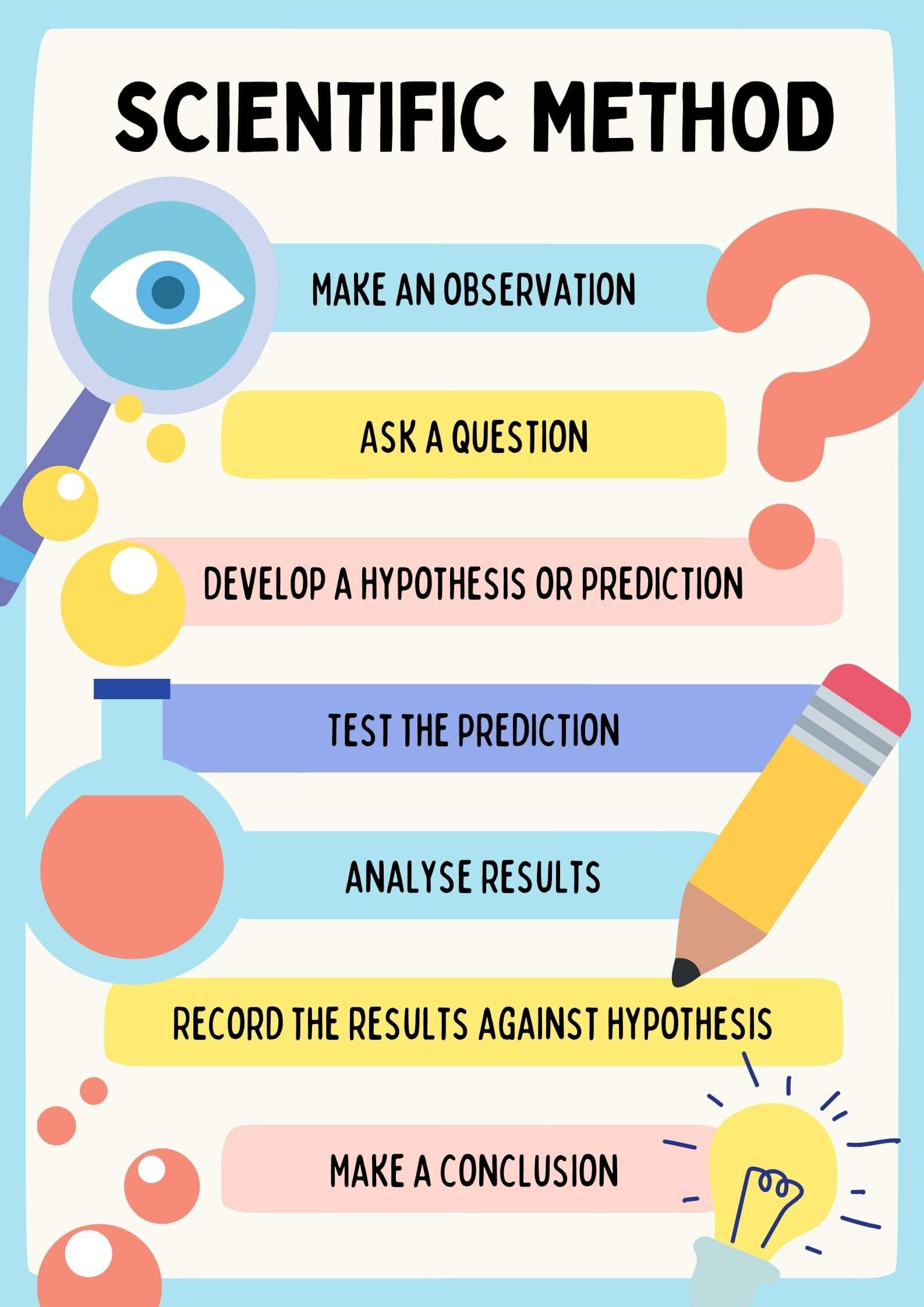
All scientists, including chemists, share a common trait - they're curious about how the world works. To satisfy this curiosity, they follow a logical and organised process called the scientific method. This step-by-step approach helps scientists test ideas, answer questions, and discover new knowledge.
Important
The scientific method consists of seven key steps that work in a cycle. This cyclical nature means that if your conclusions don't support your hypothesis, you can return to earlier steps and try again with new ideas.
Step 1: Observation
Scientists begin by noticing something interesting in the world around them. This involves carefully watching and recording what happens in their environment.
Example
Example: Chemical Reaction Observation
A chemist might observe that marble chips react more slowly in dilute acid compared to concentrated acid. This careful observation becomes the starting point for further investigation.
Step 2: Question
From their observations, scientists develop questions they want to answer. Using our marble chip example, they might ask: "What is the relationship between the concentration of acid and the rate of reaction?"
Step 3: Hypothesis
A hypothesis is an educated guess or proposed explanation for why certain events happen. It's like a suggested answer to the question that hasn't been proven yet.
Note
A hypothesis must be testable - you need to be able to design an experiment to check whether it's correct or not.
For example, a hypothesis might be: "If I increase the concentration of the acid, then the rate of reaction will increase." This prediction gives scientists something specific to test.
Step 4: Experiment
Scientists design and carry out controlled experiments to test their hypothesis. They might decide to react equal amounts of marble chips with different concentrations of acid and measure how much carbon dioxide is produced over time.
During experiments, scientists collect data - the information gathered from their tests.
Step 5: Results
The results are collected and summarised, often in tables and graphs. Experiments are repeated several times to ensure the results are reliable. If you get the same or similar results repeatedly, you can trust your findings more.
Step 6: Analysis
This is one of the most important parts of the scientific method. Scientists examine their data carefully and look for patterns. They try to understand what their results mean and whether the data supports their hypothesis.
Step 7: Conclusions
Based on their analysis, scientists draw conclusions about whether their hypothesis was supported or not. If the data supports the hypothesis, it might be accepted. If not, scientists develop a new or modified hypothesis and repeat the process.
Important
The scientific method is cyclical - if conclusions don't support the original hypothesis, scientists can return to earlier steps and try again with new ideas. This is not a failure - it's how science progresses!
Types of data
Scientists collect two main types of data during their experiments, and understanding the difference between them is essential for scientific work:
Quantitative data consists of numerical measurements made using scientific instruments. Examples include:
- Mass (measured in grammes)
- Volume (measured in litres)
- Temperature (measured in degrees Celsius)
- Time (measured in seconds)
Qualitative data involves descriptive observations made by the person conducting the experiment. Examples include:
- Colour changes
- Gas production (bubbling)
- Formation of precipitates
- Odours
- Temperature changes (hot/cold without exact measurement)
Note
Both types of data are important for understanding what happens during chemical reactions and other scientific processes. Quantitative data provides precise measurements, while qualitative data helps describe what you actually observe happening.
Research investigations
As part of chemistry studies, students carry out their own research investigations. These practical activities help develop the laboratory skills necessary for scientific work. The investigations follow the same scientific method principles, allowing students to experience firsthand how scientists work to understand our world.
Summary
Key Points to Remember:
-
Science means knowledge - it comes from the Latin word scientia and involves studying the natural world systematically
-
The scientific method has seven steps: Observation → Question → Hypothesis → Experiment → Results → Analysis → Conclusions
-
The process is cyclical - if your hypothesis isn't supported, you can return to earlier steps and try again with new ideas
-
Data comes in two forms: quantitative (numerical measurements) and qualitative (descriptive observations)
-
Scientists are naturally curious - they want to understand how and why things work the way they do, and they use the scientific method to find reliable answers