Models in Chemistry and Chemistry in Society (LC 2027) (Leaving Cert Chemistry): Revision Notes
📚Revision Notes
Models in Chemistry and Chemistry in Society
What are scientific models?
In chemistry, we often need to understand and explain things that are too small to see with our eyes. Scientific models are simplified representations that help us visualise, explain and understand chemical concepts. They also allow us to make predictions about what might happen during physical and chemical changes.
Think of models as bridges that connect what we can observe (the macroscopic world) to what we cannot see (the microscopic world of atoms and molecules). When we see a liquid boiling, for example, we use models to understand what's happening to the individual particles that we cannot observe directly.
Important
Key Definition: A scientific model is a simplified representation to help us to visualise, explain and understand chemistry concepts as well as making predictions about results of physical and chemical changes.
How models help us understand chemistry
Models serve several important purposes in chemistry:
Making the invisible visible
Chemistry deals with particles like atoms, molecules, ions and electrons that exist at the microscopic scale. Models help us visualise these tiny particles and understand their behaviour. Without models, it would be impossible to comprehend many chemical processes.
Connecting observations to explanations
When we observe chemical changes happening, models help us translate these observations into explanations of what's occurring at the particle level. This helps us understand the underlying mechanisms behind chemical reactions.
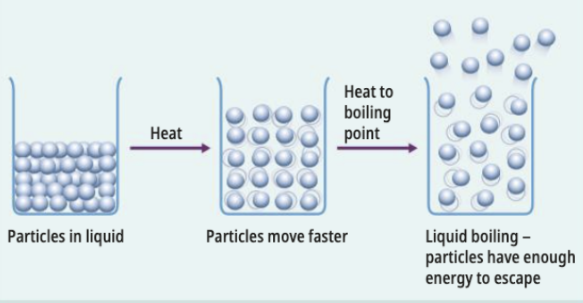
Example
Worked Example: Understanding Boiling with Particle Models
The diagram above shows how we can use particle models to understand boiling:
Step 1: Observe the macroscopic change - liquid water becomes steam when heated Step 2: Apply the particle model - particles gain energy and move faster Step 3: Explain the mechanism - particles break away from the liquid to form a gas Step 4: Make predictions - increasing heat will speed up this process
Making predictions
Models are extremely useful for predicting what might happen in different chemical situations. For example, the particle model can predict that decreasing the volume of a gas will increase its pressure, as more particles are pushed into a smaller space.
Examples and applications of models
Models come in many different forms:
- Diagrams and animations that show particle movement and interactions
- Three-dimensional molecular models that help us understand the shapes of molecules and chemical bonding
- Mathematical models that use equations to predict chemical behaviour
- Computer simulations that model complex chemical processes
Note
Scientists today use sophisticated mathematical models and computer simulations to understand complex systems like climate change and to predict future environmental conditions.
Limitations and evolution of models
It's crucial to understand that models have limitations. They are simplified representations of reality, not perfect copies. While models help us understand complex chemical processes, they cannot capture every detail of what actually happens.
Important
Critical Understanding: Model Limitations
- Models are simplified representations, not perfect copies of reality
- They cannot capture every detail of what actually happens
- Models evolve as our scientific knowledge improves
- New discoveries lead to more accurate and detailed models
Models also evolve over time as our scientific knowledge improves. For example, our understanding of atomic structure has changed dramatically since Dalton's early atomic model, with new discoveries leading to more accurate and detailed models.
As more scientific knowledge becomes available, chemists modify and improve existing models or develop entirely new ones. This process helps us develop better tools for understanding chemistry and making more accurate predictions.
Chemistry in health
Chemistry plays a vital role in protecting and improving human health:
Medical treatments
- Medicines: Chemists develop drugs for treating various diseases and conditions
- Vaccines: Chemical knowledge is essential for vaccine development and production
- Antibiotics: These life-saving drugs, originally discovered by Alexander Fleming with penicillin, are manufactured in laboratories worldwide
- Chemotherapy: Specialised drugs for cancer treatment are developed through chemical research
Pain relief and surgery
Important drugs for pain management and anaesthetics for surgical procedures are all products of chemical research. Without these chemical innovations, modern medicine would be impossible.

Chemistry in technology
Chemistry is fundamental to many technological advances:
Electronics and energy storage
- Batteries: Lithium-ion batteries that power smartphones, laptops and electric vehicles rely on chemical reactions
- Solar panels: Chemical knowledge is essential for developing efficient solar energy systems
- Touchscreens: The materials used in modern touchscreen devices are developed by materials chemists
Modern materials
- Silicon chips: Essential components in all electronic devices
- Polymers: Used in 3D printing and countless other applications
- Advanced materials: New materials with specific properties are constantly being developed
Chemistry in sustainability
Chemistry research is crucial for addressing environmental challenges:
Environmental solutions
- Biodegradable plastics: Chemists are developing materials that break down naturally in the environment
- Carbon capture: Chemical processes are being developed to remove carbon dioxide from industrial emissions
- Cleaner energy: Research into hydrogen fuel cells and other clean energy technologies
- Industrial efficiency: New catalysts help improve the efficiency of chemical processes and reduce waste
Green chemistry
The development of more environmentally friendly chemical processes and materials is a growing area of research, helping to create a more sustainable future.
Note
The field of green chemistry focuses on designing chemical products and processes that reduce or eliminate the use and generation of hazardous substances, contributing to environmental protection and sustainability.
Society's influence on chemistry research
Society plays an important role in directing chemistry research priorities. Public concerns and global challenges drive scientists to focus on specific areas:
- The COVID-19 pandemic led to intensive research into mRNA vaccine development
- Climate change awareness has increased research into green energy solutions and environmental technologies
- Public health concerns influence pharmaceutical research priorities
Personal responsibility
Each of us has a responsibility to make informed choices about how science and technology affect society. This includes understanding the impact of our daily decisions and staying informed about scientific developments.
Important
Your Personal Responsibility in Chemistry Applications
- Choose products with less packaging when possible
- Use biodegradable materials where available
- Reduce personal energy consumption by using energy-efficient devices
- Stay informed about scientific issues by following reliable sources of information
- Understand scientific developments to make better personal and societal decisions
The bigger picture
Chemistry truly plays a key role in every aspect of our daily lives. It helps protect our health through medicine development, drives technological advancement, and offers solutions for building a more sustainable future. The development of biodegradable plastics, cleaner energy sources, and more efficient industrial processes all depend on chemical research.
Chemistry is often called "the creative science" because it combines scientific knowledge with innovation to solve real-world problems. As you begin your journey studying chemistry, you'll discover how this fascinating subject connects to virtually every aspect of modern life.
Summary
Key Points to Remember:
- Scientific models are simplified representations that help us visualise and understand chemistry concepts, especially at the microscopic level
- Models have limitations but are essential tools for making predictions and connecting observations to explanations
- Chemistry impacts health through medicines, vaccines, antibiotics, and medical treatments
- Chemistry drives technology including batteries, electronics, and advanced materials
- Chemistry offers sustainability solutions like biodegradable materials and cleaner energy sources
- Society influences research priorities, and we all have personal responsibility for making informed choices about science and technology