Single Covalent Bonds (Leaving Cert Chemistry): Revision Notes
📚Revision Notes
Single Covalent Bonds
What is covalent bonding?
Covalent bonding occurs when atoms achieve stability by sharing electrons rather than transferring them completely. This type of bonding typically happens between non-metal atoms that need to gain electrons to complete their outer energy levels.
Unlike ionic bonding (which involves complete electron transfer), covalent bonding involves the sharing of electron pairs between atoms. When atoms share electrons in this way, they form what we call a covalent bond.
Important
A covalent bond is formed when two atoms share one or more pairs of electrons. This sharing allows both atoms to achieve a stable electron configuration, similar to the nearest noble gas.
Understanding molecules
When atoms join together through covalent bonding, they form molecules. A molecule is the smallest particle of an element or compound that can exist independently whilst retaining the chemical properties of that substance.
It's important not to confuse molecules with compounds:
Note
- A molecule can be made of atoms of the same element (like H₂) or different elements (like H₂O)
- A compound must contain atoms of different elements
Examples of single covalent bonds
The hydrogen molecule (H₂)
Hydrogen atoms have just one electron in their outer energy level, but they need two electrons to achieve stability (like helium). When two hydrogen atoms come together:
- Each hydrogen atom contributes one electron
- The two electrons are shared between both atoms
- This creates a single covalent bond
- Both atoms now have access to two electrons, achieving stability
The hydrogen molecule can be represented as H-H or simply H₂.
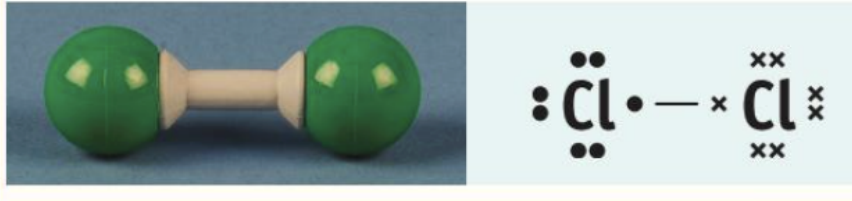
The chlorine molecule (Cl₂)
Chlorine atoms have seven electrons in their outer energy level and need eight for stability. When two chlorine atoms bond:
- Each chlorine atom shares one electron with the other
- This creates a single covalent bond between them
- Both atoms now have access to eight outer electrons
- The molecule formed is Cl₂
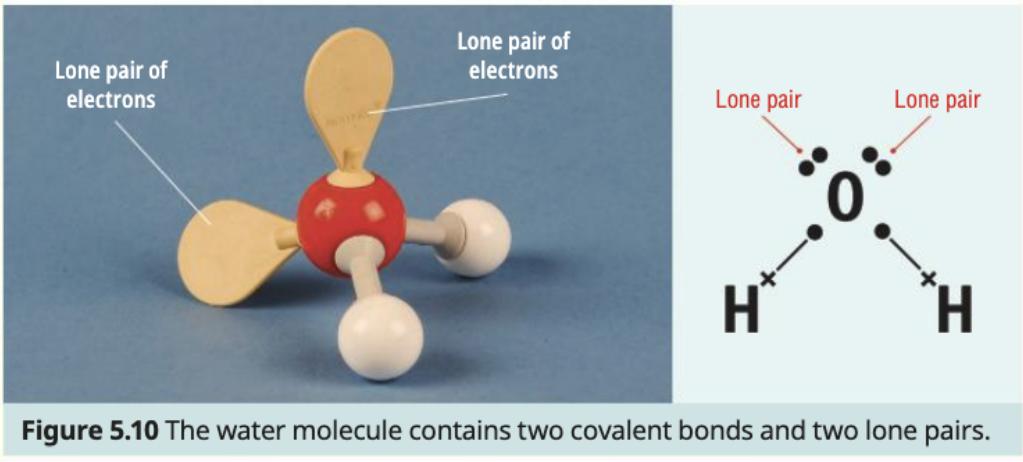
The water molecule (H₂O)
Example
Worked Example: Water Molecule Bonding
Water demonstrates how different atoms can form covalent bonds:
Step 1: Identify electron requirements
- An oxygen atom has 6 outer electrons and needs 2 more for stability
- Each hydrogen atom needs 1 more electron
Step 2: Electron sharing
- The oxygen atom shares one electron with each hydrogen atom
- This creates two single covalent bonds: O-H and O-H
Step 3: Result
- The oxygen atom also has two lone pairs of electrons that are not involved in bonding
Lone pairs are pairs of electrons that belong to one atom and are not shared in bonding. These affect the molecule's shape and properties.
The ammonia molecule (NH₃)
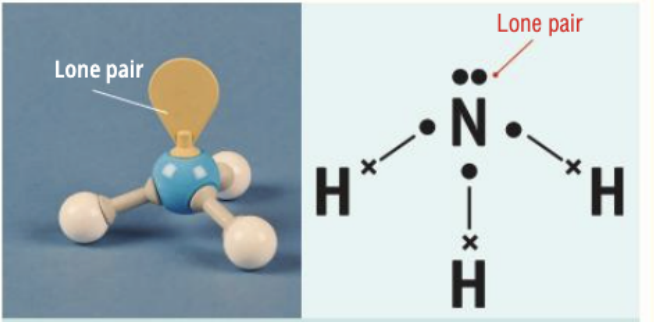
In ammonia, nitrogen demonstrates another bonding pattern:
- A nitrogen atom has five outer electrons and needs three more for stability
- Each hydrogen atom needs one electron
- The nitrogen shares one electron with each of three hydrogen atoms
- This creates three single covalent bonds
- The nitrogen atom has one lone pair of electrons
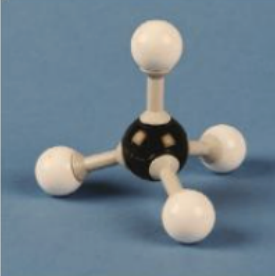
The methane molecule (CH₄)
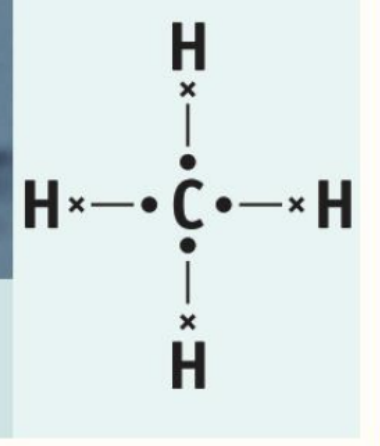
Methane shows how carbon forms covalent bonds:
- A carbon atom has four outer electrons and needs four more for stability
- Each hydrogen atom needs one electron
- The carbon atom shares one electron with each of four hydrogen atoms
- This creates four single covalent bonds arranged in a tetrahedral shape
Valency and bonding patterns
Valency refers to the number of bonds an atom can form. From the examples above, we can see common bonding patterns:
- Hydrogen: Forms 1 covalent bond (valency = 1)
- Oxygen: Forms 2 covalent bonds (valency = 2)
- Nitrogen: Forms 3 covalent bonds (valency = 3)
- Carbon: Forms 4 covalent bonds (valency = 4)
- Chlorine: Forms 1 covalent bond (valency = 1)
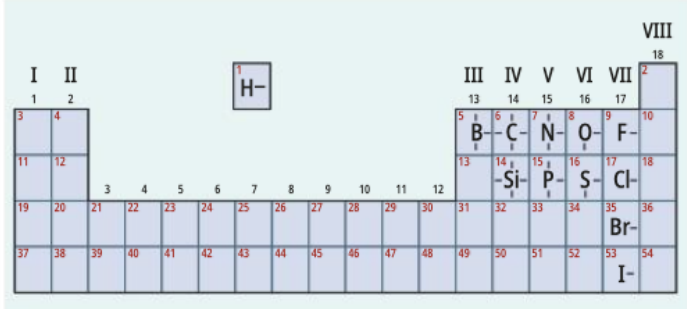
These patterns help us predict how atoms will bond together and what molecular formulas will result.
Drawing covalent bonds
Note
Covalent bonds can be represented in several ways:
- Molecular formulas: Show which atoms are present (e.g., H₂O, NH₃, CH₄)
- Structural formulas: Show how atoms are connected (e.g., H-O-H)
- Lewis structures: Show all electrons, including lone pairs
- Ball-and-stick models: Show 3D arrangement of atoms
When drawing Lewis structures, remember:
- Bonding pairs of electrons are shown as lines between atoms
- Lone pairs are shown as dots on individual atoms
- Each line represents a shared pair of electrons
Summary
Key Points to Remember:
- Covalent bonds form when atoms share electrons to achieve stability
- Single covalent bonds involve sharing one pair of electrons between two atoms
- Molecules are formed when atoms join through covalent bonding and represent the smallest independent unit
- Common valencies are: H(1), O(2), N(3), C(4) - remember "HONC" for the most important elements
- Lone pairs are unshared electron pairs that affect molecular shape and properties