Electronegativity (Leaving Cert Chemistry): Revision Notes
📚Revision Notes
Electronegativity
What is electronegativity?
Electronegativity is one of the most important concepts in understanding chemical bonding. Simply put, electronegativity is the relative attraction that an atom in a molecule has for the shared pair of electrons in a covalent bond.
Note
Think of it as a measure of how strongly an atom can "pull" electrons towards itself when it's bonded to another atom. Some atoms are much better at this electron-pulling than others!
Linus Pauling and the electronegativity scale
The electronegativity scale we use today was developed by American chemist Linus Pauling in the 1930s. His groundbreaking work earned him the Nobel Prize in Chemistry in 1954, and later the Nobel Peace Prize in 1962.

Pauling studied the energy needed to break different chemical bonds and created a scale of relative electronegativity values.
Example
Worked Example: Pauling's Scale Development
Pauling found that fluorine had four times the 'electron pulling power' of calcium, so he assigned:
- Fluorine: electronegativity value of 4.0
- Calcium: electronegativity value of 1.0
This established the relative scale we use today.
Key electronegativity values to remember:
- Fluorine: 3.98 (highest)
- Oxygen: 3.44
- Chlorine: 3.16
- Carbon: 2.55
- Hydrogen: 2.20
The 'tug-of-war' for electrons
When two atoms form a covalent bond, there's essentially a 'tug-of-war' happening for the shared electrons. The outcome of this tug-of-war depends on the electronegativity values of the atoms involved.
Example
Worked Example: Hydrogen Chloride (HCl)
In hydrogen chloride:
- Chlorine has higher electronegativity (3.16) than hydrogen (2.20)
- The shared electrons spend more time near the chlorine atom
- This creates a slightly negative charge on chlorine (δ-) and a slightly positive charge on hydrogen (δ+)
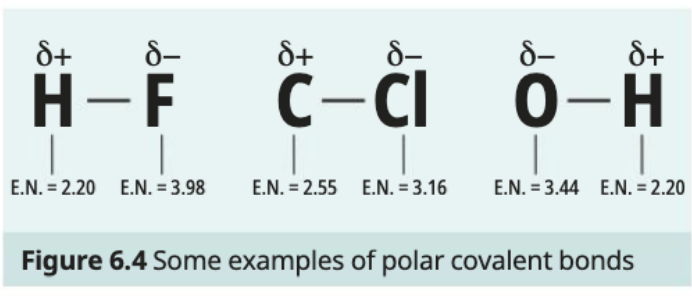
The symbol δ (delta) represents a partial charge - it's less than a full ionic charge but still significant enough to affect the molecule's properties.
Pure covalent bonds
Pure covalent bonds occur when there is equal sharing of electrons between two atoms. This happens when:
Note
Conditions for Pure Covalent Bonding:
- The atoms are identical (like in H-H, Cl-Cl)
- The electronegativity difference is zero or very small
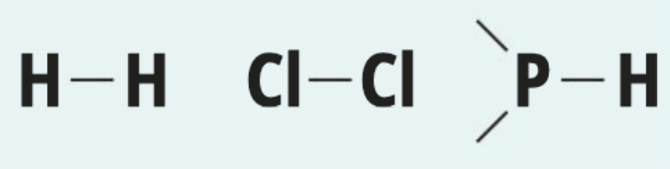
In these molecules, neither atom has a stronger pull on the electrons, so the electron density is evenly distributed.
Polar covalent bonds
Polar covalent bonds form when there is unequal sharing of electrons. This occurs when the atoms have different electronegativity values, causing:
Note
Results of Polar Covalent Bonding:
- One end of the bond to be slightly positive (δ+)
- The other end to be slightly negative (δ-)
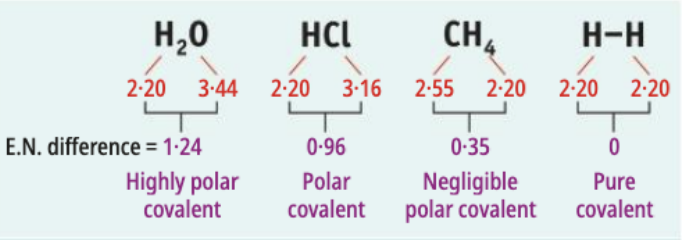
The greater the electronegativity difference, the more polar the bond becomes.
Using electronegativity values to predict bonding
Electronegativity differences help us predict what type of bonding will occur:
Important
Electronegativity Difference Guidelines:
- 0 to 0.5: Pure covalent (negligible polarity)
- 0.5 to 1.7: Polar covalent
- Above 1.7: Ionic bonding (complete electron transfer)
Example
Worked Examples: Predicting Bond Types
- H₂O: Electronegativity difference = 1.24 → highly polar covalent
- HCl: Electronegativity difference = 0.96 → polar covalent
- CH₄: Electronegativity difference = 0.35 → negligible polarity
- H-H: Electronegativity difference = 0 → pure covalent
Molecular polarity
Just because a molecule contains polar bonds doesn't automatically make the entire molecule polar. The shape of the molecule is crucial!
Important
For a molecule to be polar, two conditions must be met:
- It must contain polar covalent bonds
- The molecule must be asymmetrical (so the polar bonds don't cancel out)
Example
Examples of Molecular Polarity:
- Water (H₂O): Has polar bonds AND is V-shaped → polar molecule
- Methane (CH₄): Has slightly polar bonds BUT is symmetrical → non-polar overall
Testing for molecular polarity
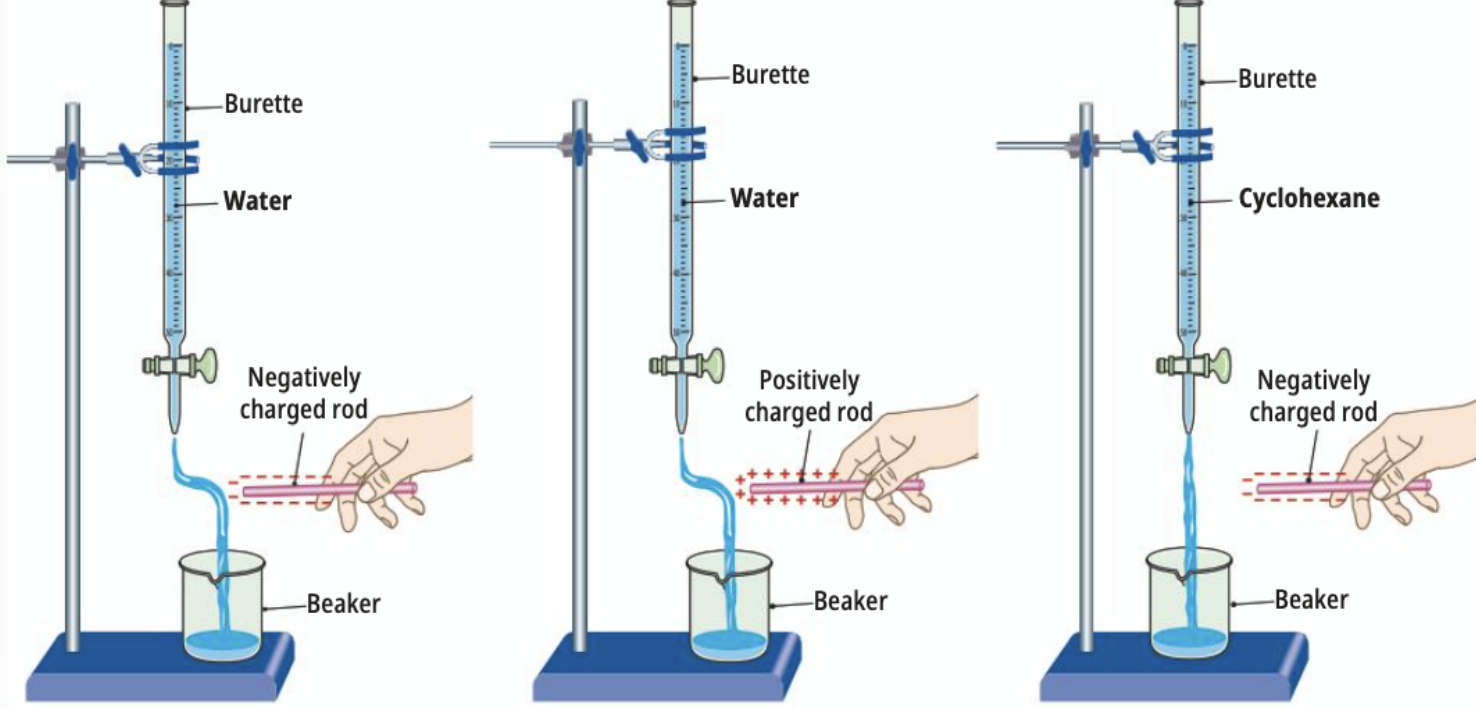
A brilliant way to demonstrate whether a liquid contains polar or non-polar molecules is the charged rod experiment.
Example
The Charged Rod Experiment:
Setup: A thin stream of liquid flows from a burette, and a charged rod (positive or negative) is brought near the stream.
Results:
- Polar liquids (like water): The stream bends towards the charged rod because the polar molecules are attracted to the charge
- Non-polar liquids (like cyclohexane): The stream is unaffected because there are no polar molecules to be attracted
Real-world applications
Understanding molecular polarity has practical importance. For example, microwave ovens work because water molecules are polar!

Note
How Microwaves Cook Food:
The electromagnetic waves in microwaves change direction millions of times per second. Polar water molecules continuously try to line up with these changing waves, creating friction that generates heat to cook food.
Summary
Summary
Key Points to Remember:
-
Electronegativity measures how strongly an atom attracts shared electrons in a covalent bond
-
Fluorine has the highest electronegativity (3.98), making it the best electron-puller
-
Polar covalent bonds form when atoms have different electronegativities, creating partial charges (δ+ and δ-)
-
Molecular shape matters - even molecules with polar bonds can be non-polar overall if they're symmetrical
-
Practical applications include explaining how microwaves cook food and why some liquids are attracted to charged objects