Ion-Dipole Forces (Leaving Cert Chemistry): Revision Notes
📚Revision Notes
Ion-Dipole Forces
What are ion-dipole forces?
An ion-dipole force is the attractive force that exists between an ion (a charged particle) and a polar molecule. These forces play a crucial role in many chemical processes, particularly when ionic compounds dissolve in polar solvents like water.
To understand this concept, you need to remember that polar molecules have partial positive and partial negative regions due to unequal sharing of electrons. When an ion comes near a polar molecule, the oppositely charged regions attract each other, creating an ion-dipole interaction.
How ion-dipole forces work in water
Water is an excellent solvent for many ionic compounds because it's a polar molecule. The oxygen atom in water carries a partial negative charge (δ-), whilst the hydrogen atoms carry partial positive charges (δ+). This polarity makes water particularly effective at surrounding and separating ions from their crystal structures.
Important
Water's polarity makes it particularly effective at surrounding and separating ions from their crystal structures, which is why it's such an excellent solvent for ionic compounds.
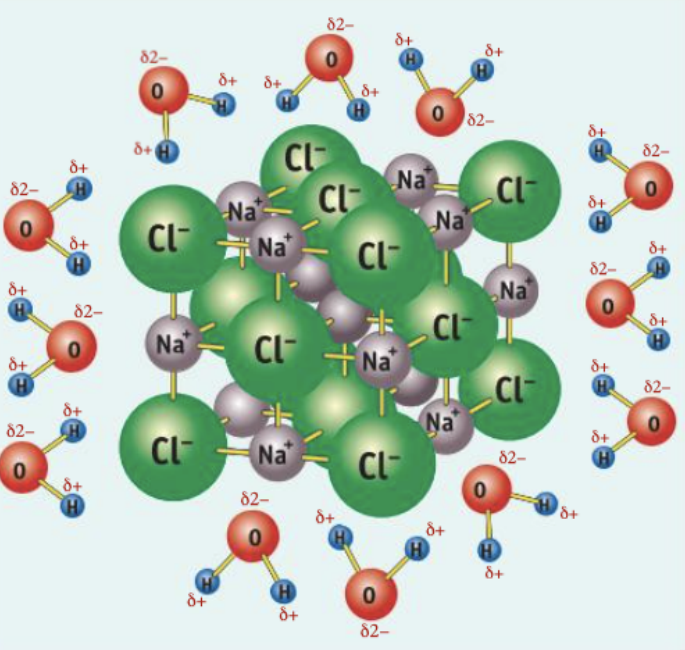
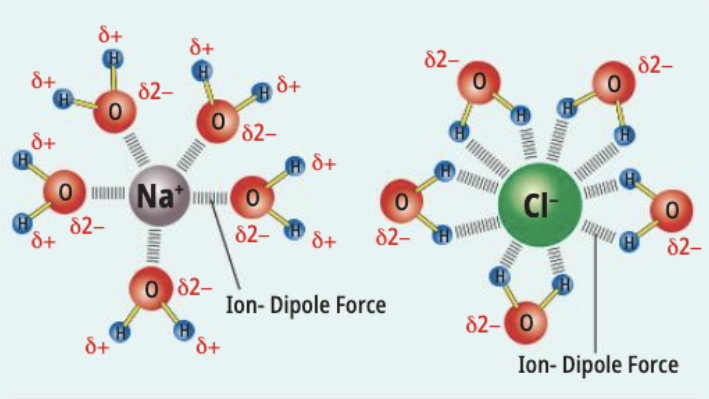
When an ionic compound like sodium chloride (NaCl) is placed in water, the ion-dipole forces become very important.
Note
The dissolution process involves:
- Positive ions (cations) are attracted to the negative end of water molecules (the oxygen atoms)
- Negative ions (anions) are attracted to the positive end of water molecules (the hydrogen atoms)
- These attractions help pull the ions away from their crystal lattice
- Each ion becomes surrounded by water molecules, a process called solvation
The sodium chloride example
Example
Worked Example: Sodium Chloride Dissolution
Sodium chloride provides an excellent demonstration of how ion-dipole forces work in practice. In the crystal structure, sodium ions (Na⁺) and chloride ions (Cl⁻) are held together by strong ionic bonds. However, when placed in water:
Step 1: The polar water molecules surround the crystal
Step 2: Water molecules orient themselves so their negative ends point towards Na⁺ ions
Step 3: Water molecules orient themselves so their positive ends point towards Cl⁻ ions
Step 4: The ion-dipole attractions become strong enough to overcome the ionic bonding in the crystal
Step 5: The ions are pulled away from the crystal and become dissolved in solution
Result: This process explains why sodium chloride dissolves so readily in water - the ion-dipole forces provide the energy needed to break apart the ionic crystal structure.
Key characteristics of ion-dipole forces
Strength: Ion-dipole forces are generally stronger than dipole-dipole forces but weaker than ionic bonds.
Note
Factors affecting strength:
- The charge on the ion (higher charges create stronger attractions)
- The polarity of the molecule (more polar molecules create stronger interactions)
- The distance between the ion and the polar molecule
Directionality: These forces are directional - the polar molecules orient themselves to maximise attraction between opposite charges.
Role in solubility: Ion-dipole forces are the primary reason why many ionic compounds dissolve in polar solvents like water, but not in non-polar solvents.
Evidence for intermolecular forces
Note
The existence of ion-dipole forces and other intermolecular forces is supported by several types of evidence:
- Physical properties: Many trends in melting points, boiling points, and solubility can only be explained if intermolecular forces exist
- Experimental observations: Non-polar gases can be liquefied at low temperatures, showing that even weak intermolecular forces exist
- Solid state behaviour: Some non-polar substances form solids at room temperature, indicating intermolecular forces hold molecules together in crystal lattices
Remember!
Summary
Key Points to Remember:
- Ion-dipole forces are attractions between charged ions and polar molecules
- Water is an excellent solvent because its polarity allows it to form strong ion-dipole interactions with dissolved ions
- Dissolution process involves ion-dipole forces overcoming ionic bonding in crystal structures
- These forces are directional - polar molecules orient to maximise attraction with ions
- Strength depends on ion charge, molecular polarity, and distance between particles