London Dispersion Forces (Leaving Cert Chemistry): Revision Notes
📚Revision Notes
London Dispersion Forces
What are London dispersion forces?
London dispersion forces are weak attractive forces that exist between molecules due to the formation of temporary dipoles. These forces are named after the German-American scientist Fritz London, who studied this particular type of intermolecular force in great detail.
Note
Fritz London was a pioneering physicist who made significant contributions to our understanding of intermolecular forces. His work in the 1930s helped explain why even non-polar molecules can experience attractive forces.
The key characteristics of London dispersion forces include:
- They are the only forces of attraction between non-polar molecules
- They exist between all atoms and molecules, regardless of whether the molecule is polar or non-polar
- They are much weaker than other types of intermolecular forces
- They are temporary and constantly changing
How do London dispersion forces work?
Understanding how London dispersion forces operate requires us to think about electron movement within molecules. The process involves three key stages that work together to create these intermolecular attractions.
Example
How London Dispersion Forces Form: A Step-by-Step Process
Step 1: Electron movement creates temporary dipoles In any molecule, electrons are constantly moving around. At any given moment, electrons might be closer to one end of the molecule than the other. This creates what we call a temporary dipole - one part of the molecule becomes slightly negative (δ-) while the other part becomes slightly positive (δ+).
Step 2: Induction occurs When a temporary dipole forms in one molecule, it can influence nearby molecules. The temporary dipole causes electrons in neighbouring molecules to move, creating induced dipoles. This process is called induction.
Step 3: Attraction between dipoles The temporary dipoles in different molecules attract each other - the slightly positive end of one molecule is attracted to the slightly negative end of another molecule. This creates the London dispersion force.
Important
These dipoles are instantaneous - they only exist for a very short time before the electrons move again and new temporary dipoles form elsewhere. This constant change is what makes London dispersion forces dynamic and ever-present.
The effect of London dispersion forces on physical properties
London dispersion forces have a significant impact on the physical properties of substances, particularly their boiling points and melting points. Understanding this relationship is crucial for predicting how substances will behave under different conditions.
Relationship between molecular size and force strength:
- Larger molecules have more electrons and bigger electron clouds
- Bigger electron clouds allow for more extensive temporary dipoles to form
- This means stronger London dispersion forces
- Stronger forces require more energy to overcome
- Therefore, larger molecules have higher boiling points
Example
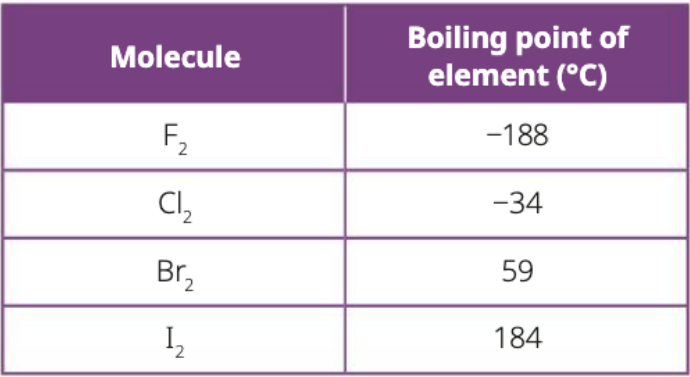
Trend Analysis: Halogen Group Boiling Points
Looking at the halogen group, we can see a clear trend:
- (fluorine): -188°C
- (chlorine): -34°C
- (bromine): 59°C
- (iodine): 184°C
As we move down the group, the atoms get bigger, the electron clouds get larger, and the boiling points increase dramatically by over 370°C from fluorine to iodine.
Factors affecting the strength of London dispersion forces
Several factors determine how strong London dispersion forces will be. Understanding these factors helps predict the relative strength of intermolecular attractions in different substances.
Note
The strength of London dispersion forces isn't random - it follows predictable patterns based on molecular characteristics that we can observe and measure.
1. Molecular size and number of electrons The more electrons a molecule has, the stronger its London dispersion forces. This is because:
- More electrons mean bigger electron clouds
- Bigger electron clouds can form more significant temporary dipoles
- More extensive temporary dipoles create stronger attractions
2. Shape of the molecule
- Molecules with larger surface areas have stronger London dispersion forces
- Linear molecules often have stronger forces than branched molecules of the same molecular formula
3. Polarisability
- Polarisability refers to how easily the electron cloud can be distorted
- Larger atoms and molecules are more polarisable
- Higher polarisability leads to stronger London dispersion forces
Examples and applications
London dispersion forces help explain many observable phenomena in chemistry. These real-world examples demonstrate how molecular size directly impacts physical properties.
Example
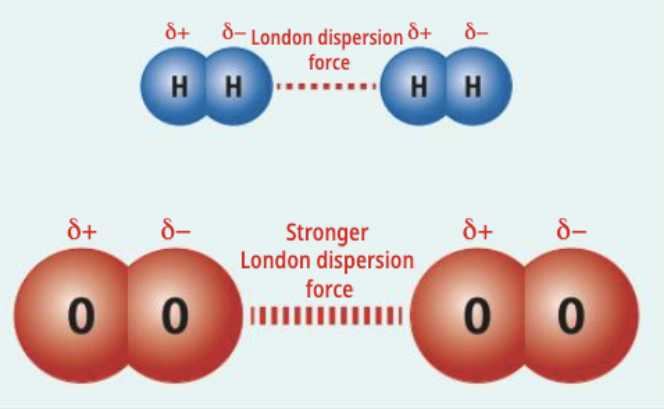
Worked Example: Hydrogen vs Oxygen
The boiling points of hydrogen and oxygen provide an excellent example of how molecular size affects London dispersion forces:
- boiling point: -253°C
- boiling point: -183°C
Even though both molecules are non-polar, oxygen has a significantly higher boiling point. This is because:
- Oxygen atoms are bigger than hydrogen atoms
- Oxygen molecules contain more electrons
- The larger electron cloud in allows for stronger temporary dipoles
- Therefore, more energy is needed to overcome the stronger London dispersion forces in oxygen
Hydrocarbon examples: London dispersion forces help explain boiling point differences in hydrocarbons:
- Propane (): smaller molecule, weaker forces, lower boiling point
- Butane (): larger molecule, stronger forces, higher boiling point
- Hexane (): even larger molecule, even stronger forces, even higher boiling point
Noble gases: Even single atoms like the noble gases experience London dispersion forces. The boiling points increase as we go down the group because the atoms get progressively larger with more electrons.
Summary
Key Points to Remember:
-
London dispersion forces are the only intermolecular forces between non-polar molecules - they're essential for explaining why non-polar substances can still exist as liquids and solids
-
Bigger molecules = stronger London dispersion forces = higher boiling points - this is the key relationship to remember for predicting physical properties
-
Temporary dipoles are constantly forming and disappearing - the forces are always changing but are always present
-
All molecules experience London dispersion forces - even polar molecules have London dispersion forces alongside their other intermolecular forces
-
These forces explain many everyday phenomena - from why petrol is liquid at room temperature to why noble gases can be liquefied under the right conditions