Charles' Law (Leaving Cert Chemistry): Revision Notes
📚Revision Notes
Charles' Law
Historical background
Charles' Law is named after Jacques Charles, a French scientist who studied gases in the late 18th century. In 1783, Charles constructed the first hydrogen balloon and made an important observation during his balloon flights. He noticed that as the balloon rose higher into the atmosphere, where temperatures are colder, both the temperature decreased and the volume of the gas in the balloon also decreased.

Note
Charles' observation was groundbreaking because it was one of the first systematic studies of how gas properties change with environmental conditions during actual atmospheric flights.
This observation led Charles to investigate the relationship between gas volume and temperature more systematically in his laboratory. His work built upon earlier studies by Robert Boyle, who had examined the relationship between gas volume and pressure.
What is Charles' Law?
Charles' Law describes the relationship between the volume and temperature of a gas when pressure remains constant. The law can be stated as:
Important
At constant pressure, the volume of a fixed mass of gas is directly proportional to its temperature measured on the Kelvin scale.
This means that when you heat a gas, its volume increases. When you cool a gas, its volume decreases. However, this relationship only works when we measure temperature using the Kelvin scale (absolute temperature), not Celsius.
Experimental demonstration
Charles investigated this relationship using apparatus similar to that shown below:
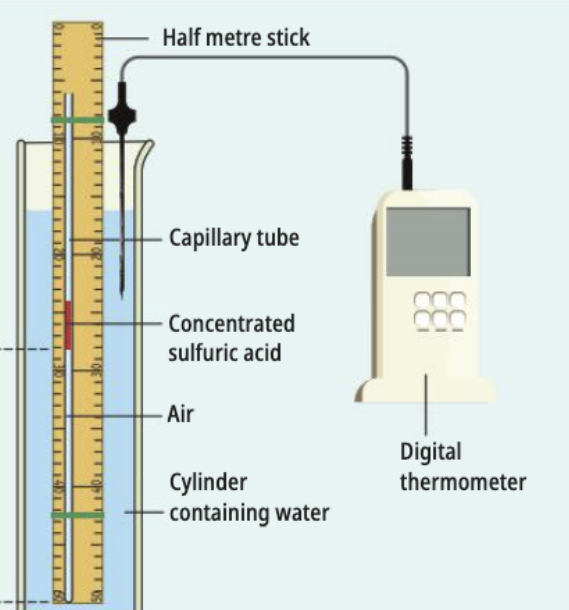
The experimental setup consists of:
- A glass cylinder containing water at the bottom
- A thin capillary tube inserted vertically
- Concentrated sulfuric acid trapping a fixed volume of air
- A measuring stick to record volume changes
- A thermometer to monitor temperature
Note
The sulfuric acid acts as a moveable piston that responds to gas expansion and contraction while maintaining constant pressure on the trapped air sample.
As the water is heated, the trapped air expands and pushes the sulfuric acid higher up the tube. The volume increase can be measured using the graduated scale alongside the apparatus.
Understanding Charles' Law through kinetic theory
The Kinetic Theory of Matter helps explain why Charles' Law works:
- Gases consist of tiny particles (atoms or molecules) in constant, random motion
- When temperature increases, these particles gain more kinetic energy
- Higher kinetic energy means the particles move faster and collide more forcefully with container walls
- To maintain constant pressure, the container must expand to give particles more space
- Therefore, volume increases with temperature
Note
The Kinetic Energy Connection
Temperature is directly related to the average kinetic energy of gas particles. Higher temperature = higher kinetic energy = more vigorous particle motion = greater volume needed to maintain constant pressure.
The opposite happens when temperature decreases:
- Particles lose kinetic energy and move more slowly
- They collide less forcefully with container walls
- The volume can decrease while maintaining the same pressure
Mathematical expression of Charles' Law
Charles' Law can be expressed mathematically in several ways:
Important
Mathematical Forms of Charles' Law:
Direct proportionality: (where T is in Kelvin)
As an equation: (where k is a constant)
Most commonly: (constant)
This means that for any gas sample at constant pressure:
Note
This equation is the working form of Charles' Law used in calculations. It shows that the ratio of volume to temperature remains constant for any gas sample at constant pressure.
Graphical representation
When we plot volume against temperature, we get important insights:
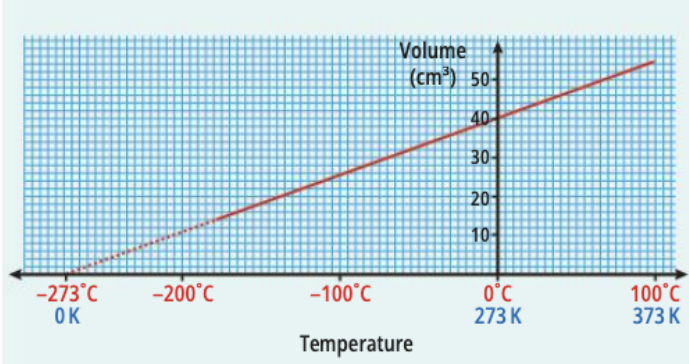
Key features of the graph:
- A straight line passing through the origin when temperature is in Kelvin
- The line shows direct proportionality between volume and absolute temperature
- If extended backwards, the line would reach zero volume at -273°C (absolute zero)
We can also plot against to verify the law:
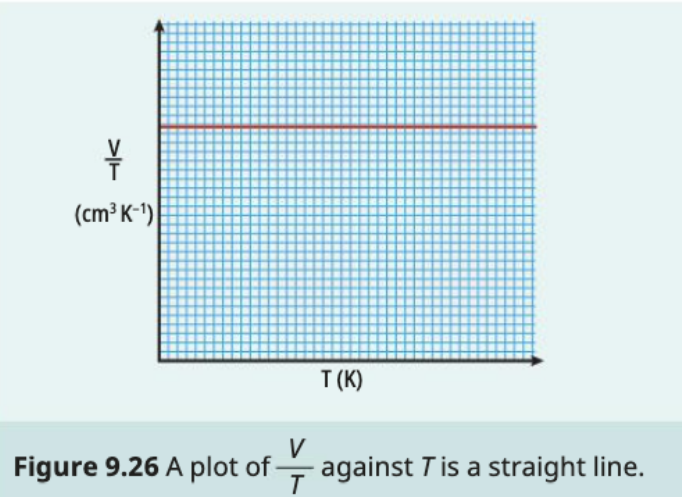
This graph shows a horizontal straight line, confirming that the ratio remains constant regardless of temperature.
Experimental data
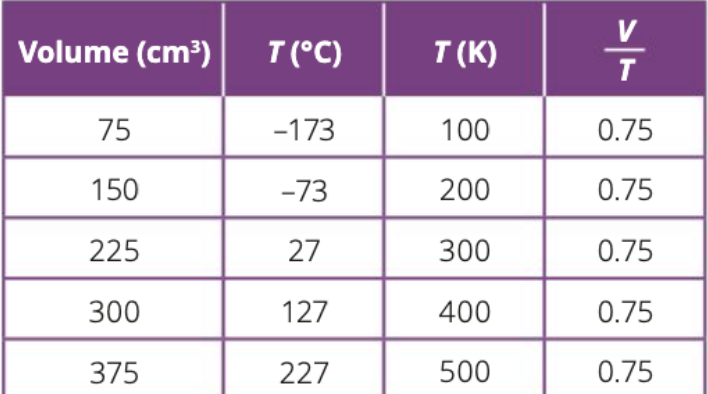
The table below shows typical data from a Charles' Law experiment:
Example
Data Analysis: Verifying Charles' Law
Notice how the ratio remains constant at 0.75 cm³ K⁻¹ for all measurements, regardless of the actual temperature or volume values.
Step 1: Calculate the ratio for each data point
- At 300 K: cm³ K⁻¹
- At 350 K: cm³ K⁻¹
- At 400 K: cm³ K⁻¹
Step 2: Verify consistency All ratios equal 0.75 cm³ K⁻¹, proving Charles' Law holds.
This constant ratio proves that volume and temperature are directly proportional.
Key points about temperature scales
Important
Critical Temperature Requirements:
- Charles' Law only works when temperature is measured in Kelvin (K)
- The Kelvin scale starts at absolute zero (-273°C = 0 K)
- To convert Celsius to Kelvin:
- Using Celsius temperatures would give incorrect results because the scale doesn't start at absolute zero
Practical applications
Charles' Law explains many everyday phenomena:
- Hot air balloons rise because heated air expands and becomes less dense
- Car tyres may appear flatter in cold weather due to volume decrease
- Aerosol cans work less effectively in cold conditions
- Weather balloons expand as they rise to colder altitudes
Note
These applications demonstrate how Charles' Law operates in real-world situations where pressure remains relatively constant but temperature changes significantly.
Remember!
Summary
Key Points to Remember:
-
Charles' Law: At constant pressure, gas volume is directly proportional to absolute temperature ()
-
Temperature must be in Kelvin - never use Celsius for Charles' Law calculations
-
The relationship is constant - this ratio stays the same for any gas sample at constant pressure
-
Higher temperature means larger volume - gas particles move faster and need more space
-
The kinetic theory explains the law - temperature affects particle motion, which affects the space needed to maintain constant pressure