Relationships Between Volume, Pressure, and Temperature of Gases (Leaving Cert Chemistry): Revision Notes
📚Revision Notes
Relationships Between Volume, Pressure, and Temperature of Gases
Understanding how gases behave requires knowledge of three fundamental properties: volume, pressure, and temperature. Unlike solids and liquids, gases don't have a fixed volume or shape - they expand to fill whatever container they're placed in. This makes measuring and comparing gas properties more complex, which is why scientists have established standard ways to measure and compare these properties.
Note
Gas behaviour is fundamentally different from solids and liquids because gas particles are much more spread out and move freely, making their properties highly dependent on the conditions of their container.
Volume of gases
Volume refers to the amount of space that a gas occupies. For gases, this is always equal to the volume of the container holding them. This is because gas particles spread out to completely fill any available space.
Note
This complete filling behaviour is unique to gases - it's why we can compress gases but not liquids or solids under normal conditions.
Units of volume
In chemistry, we use several different units to measure volume:
- Cubic metre (m³) - the SI base unit of volume
- Cubic centimetre (cm³) - commonly used in laboratory work
- Litre (L) - practical unit for everyday measurements
- Cubic decimetre (dm³) - exactly equivalent to one litre
Important volume conversions
You need to remember these key conversion factors:
- 1 cubic metre = 1 m × 1 m × 1 m = 1,000,000 cm³ ( cm³)
- 1 litre = 1000 cm³ = 1 cubic decimetre (dm³)
- 1 m³ = 1000 litres
Important
Exam tip: Remember that 1 m³ equals cm³, as you'll need this information for calculations in exams.
Temperature scales
Temperature measures how hot or cold something is, but for scientific work with gases, we need to understand two different temperature scales.
Celsius scale
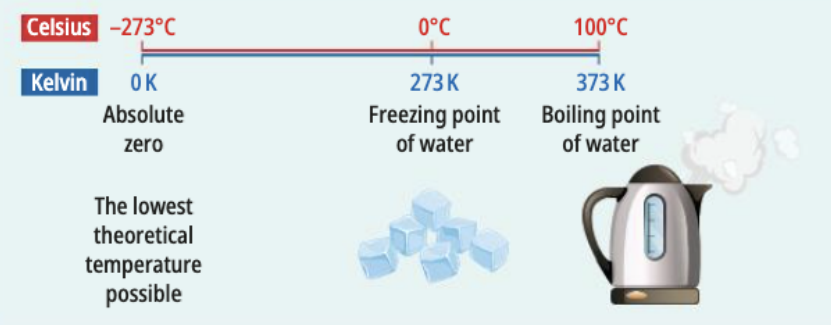
The Celsius scale is the everyday temperature scale you're familiar with:
- Water freezes at 0°C
- Water boils at 100°C
- Also called the centigrade scale because it's divided into 100 degrees between these two fixed points
Kelvin scale
The Kelvin scale is the absolute temperature scale used in scientific calculations:
- Zero kelvin (0 K) represents absolute zero - the lowest possible temperature
- At absolute zero, gas particles would theoretically stop moving completely
- The Kelvin scale uses the same degree intervals as Celsius, but starts from absolute zero
Note
The Kelvin scale is essential for gas law calculations because it provides an absolute reference point where molecular motion theoretically ceases.
Converting between temperature scales
Converting from Celsius to Kelvin is straightforward - just add 273:
Example
Worked Example: Temperature Conversions
Converting common temperatures from Celsius to Kelvin:
- (absolute zero)
Important
Key point: Temperature differences are the same on both scales. A 10°C increase equals a 10 K increase.
Pressure of gases
Pressure is the force that gas particles exert when they collide with the walls of their container. The more collisions per unit area, the greater the pressure.
Note
Think of pressure as the result of countless tiny gas particles constantly hitting the container walls - more energetic particles or more particles in the same space means higher pressure.
Units of pressure
Scientists measure pressure using several different units:
- Pascal (Pa) - the SI unit of pressure
- Kilopascal (kPa) - more practical for everyday use (1 kPa = 1000 Pa)
- Newtons per square metre (N m⁻²) - alternative way to express pascals
Atmospheric pressure
Normal atmospheric pressure at sea level is:
- Approximately 1 × 10⁵ N m⁻²
- Also written as 1 × 10⁵ Pa or 100,000 Pa
- Equals 100 kPa
Weather forecasters often use hectopascals (1 hPa = 100 Pa), so normal atmospheric pressure is about 1000 hPa.
Standard temperature and pressure (s.t.p.)
Because gas volume changes with both temperature and pressure, scientists needed to establish standard conditions for comparing different gas measurements. These standard conditions are called standard temperature and pressure or s.t.p.
Standard conditions
Important
Standard Temperature and Pressure (s.t.p.)
The internationally agreed standard conditions are:
- Standard temperature = 273 K (which equals 0°C, the freezing point of water)
- Standard pressure = 1 × 10⁵ Pa = 100 kPa
Why s.t.p. matters
When comparing volumes of different gases, you must ensure they're measured at the same temperature and pressure. Standard temperature and pressure provides a common reference point that allows meaningful comparisons between gas measurements taken at different times and places.
Note
Exam tip: If you see "standard pressure" mentioned in the SEC Formulae and Tables booklet, use the value 1.01325 × 10⁵ Pa for more precise calculations.
Summary
Key Points to Remember:
- Gas volume always equals the volume of its container
- Convert Celsius to Kelvin by adding 273
- Standard temperature and pressure (s.t.p.) = 273 K and 100 kPa
- 1 litre = 1000 cm³ = 1 dm³
- Pressure is the force gas particles exert on container walls
These fundamental relationships form the basis for understanding more complex gas laws that describe how volume, pressure, and temperature influence each other.