The Kinetic Theory of Matter (Leaving Cert Chemistry): Revision Notes
📚Revision Notes
The Kinetic Theory of Matter
Introduction
Matter is anything that occupies space and has mass. Everything around us - from the air we breathe to the chair you're sitting on - is made of matter. A key principle that helps us understand how matter behaves is that all matter consists of extremely tiny particles that are invisible to the naked eye.
The word 'kinetic' means 'movement', and the Kinetic Theory of Matter explains how these invisible particles are constantly moving. This theory helps us understand why substances behave differently and why materials can change from one state to another.
Note
The particle model of matter is fundamental to understanding chemistry and physics. Even though we cannot see individual particles with the naked eye, their constant motion explains many observable properties of materials around us.
The three states of matter
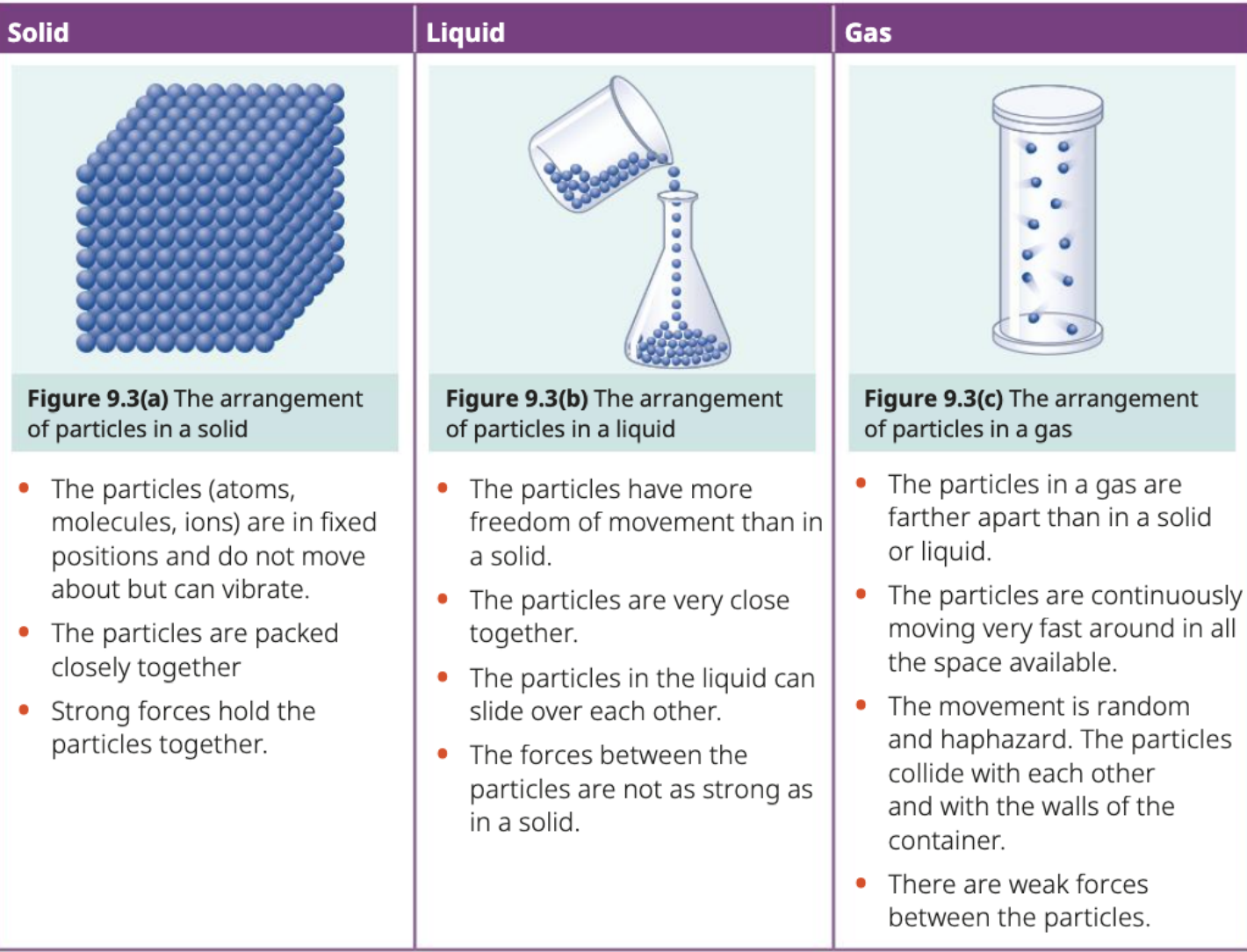
Matter exists in three main states, each with distinct characteristics based on how particles are arranged and how they move:
Solids
In solids, particles are packed very closely together in fixed positions. They can only vibrate about these fixed positions but cannot move around freely. This is why solids have a definite shape and volume. The strong forces between particles hold them tightly together, giving solids their rigid structure.
Liquids
In liquids, particles are still close together but are not in fixed positions. They can slide over each other, which allows liquids to flow and take the shape of their container. Liquids have a definite volume but no fixed shape. The forces between particles are weaker than in solids but still strong enough to keep the particles relatively close.
Gases
In gases, particles are much further apart and move around at high speed in random directions. The particles have lots of energy and move very fast in a random and haphazard way. Gases have no definite shape or volume - they expand to fill any container. The forces between gas particles are very weak.
Important
Key Difference Between States: The main difference between solids, liquids, and gases lies in the balance between particle kinetic energy (movement) and intermolecular forces (attractions between particles). When kinetic energy dominates, particles move freely (gas). When intermolecular forces dominate, particles are held in fixed positions (solid).
Assumptions of the Kinetic Theory of Matter
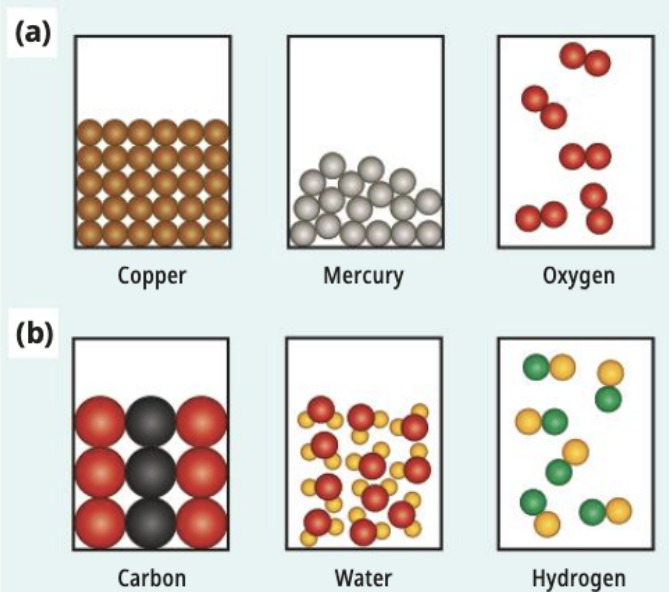
The Kinetic Theory is based on several key assumptions that help explain particle behaviour:
- Tiny particles are always in motion - The degree of motion depends on whether the substance is solid, liquid or gas. These three forms are often called the three states of matter.
- Particle size is negligible - The actual size of individual particles is so small compared to the spaces between them (especially in gases) that we can ignore their size in most calculations.
- Motion depends on temperature - Higher temperatures give particles more energy, making them move faster. Lower temperatures reduce particle energy and slow their movement.
Note
These assumptions are simplifications that work well for most practical purposes. While real particles do have size and complex interactions, the kinetic theory's assumptions allow us to make useful predictions about matter's behaviour.
Temperature and particle movement
Temperature plays a crucial role in determining how fast particles move and how they behave:
Increasing temperature:
- Causes particles to gain kinetic energy
- Makes particles move faster
- Can provide enough energy for particles to overcome forces holding them together
- May cause changes of state (e.g. solid to liquid, liquid to gas)
Decreasing temperature:
- Reduces particle kinetic energy
- Makes particles move more slowly
- Allows intermolecular forces to become more significant
- May cause changes of state (e.g. gas to liquid, liquid to solid)
This relationship between temperature and particle movement explains why heating a substance can cause it to change state, and why cooling can reverse these changes.
Example
Practical Example: Ice to Steam
When you heat ice:
- At 0°C: Ice particles gain enough energy to break free from fixed positions → melting occurs
- 0°C to 100°C: Liquid water particles move faster as temperature increases
- At 100°C: Water particles gain enough energy to completely overcome intermolecular forces → boiling occurs, forming steam
Phase transitions
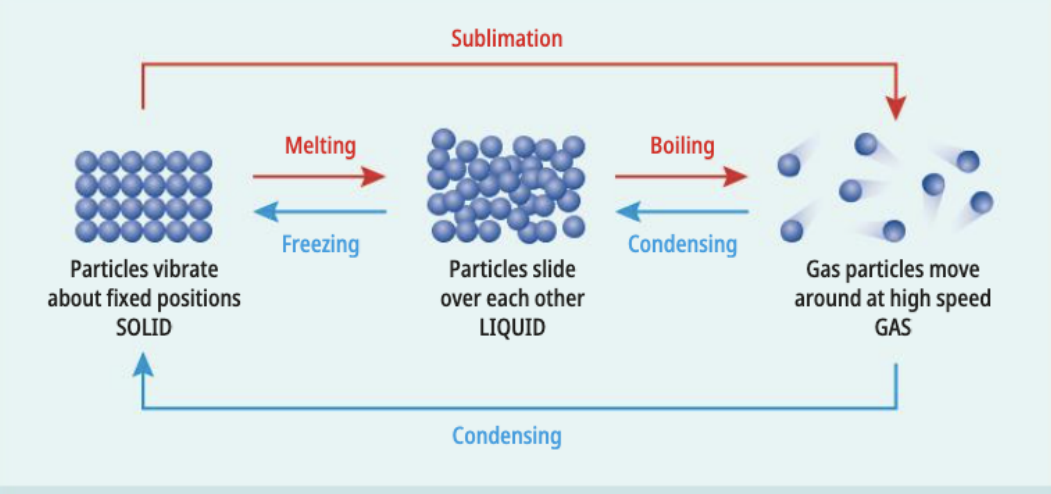
The Kinetic Theory helps explain how substances change from one state to another. These changes of state occur when particles gain or lose enough energy to overcome or be overcome by the forces between them.
Key phase transitions:
Melting: Solid changes to liquid when particles gain enough energy to break free from fixed positions. This occurs at the melting point - the temperature at which a solid changes to a liquid.
Boiling: Liquid changes to gas when particles gain enough energy to completely overcome intermolecular forces. This happens at the boiling point - the temperature at which a liquid changes to a gas throughout the liquid.
Evaporation: Similar to boiling, but occurs at the surface of a liquid at temperatures below the boiling point. Only the most energetic particles at the surface have enough energy to escape.
Condensation: Gas changes to liquid when particles lose energy. This is often seen when steam meets a cold surface, like a kitchen window on a cold day.
Freezing: Liquid changes to solid when particles lose enough energy that intermolecular forces can hold them in fixed positions. This occurs at the freezing point.
Sublimation: Solid changes directly to gas without becoming liquid first. Dry ice (solid carbon dioxide) is a common example of a substance that sublimates.
Note
Energy and Phase Changes: Phase transitions always involve energy changes. When changing from solid → liquid → gas, energy must be added. When changing from gas → liquid → solid, energy is released. The temperature remains constant during these transitions as the energy goes into breaking or forming intermolecular bonds.
Forces between particles
The strength of forces between particles varies significantly across the three states:
In solids: Very strong intermolecular forces hold particles tightly together in fixed positions. These forces give solids their definite shape and prevent particles from moving around freely.
In liquids: Weaker forces than in solids, but still strong enough to keep particles close together. These forces allow particles to slide over each other while maintaining the liquid's volume.
In gases: Very weak forces between particles, allowing them to move independently at high speeds. The weakness of these forces means gases can expand to fill any available space.
Important
Force vs. Energy Balance: The state of matter depends on the balance between intermolecular forces (trying to hold particles together) and kinetic energy (causing particles to move apart). Understanding this balance is crucial for predicting how substances will behave under different conditions.
Pressure in gases
Gases exert pressure because their particles are constantly moving and colliding with the walls of their container. Each collision exerts a tiny force, and the combination of millions of these collisions creates the pressure we can measure.
Key points about gas pressure:
- Pressure results from particle collisions with container walls
- Higher temperature increases particle speed, leading to more forceful collisions and higher pressure
- More particles in the same space means more collisions and higher pressure
- Gases naturally diffuse to fill all available space due to constant particle movement
The ability of gases to diffuse (spread out) is used to define what makes a substance a gas. Unlike solids and liquids, gases have no well-defined boundaries and will expand to fill any container completely.
Note
Gas Pressure in Daily Life: You experience gas pressure constantly - from the air pressure in your bicycle tyres to the atmospheric pressure that keeps liquids from boiling at room temperature. Weather changes occur partly due to variations in atmospheric pressure caused by temperature differences affecting particle movement.
Summary
Key Points to Remember:
- All matter is made of tiny, invisible particles that are constantly moving
- The three states of matter differ in particle arrangement and movement: tightly packed and vibrating (solid), close but mobile (liquid), widely separated and fast-moving (gas)
- Temperature controls particle energy - higher temperature means faster movement and potential state changes
- Phase transitions occur when particles gain or lose enough energy to overcome intermolecular forces
- Gas pressure results from countless particle collisions with container walls