The Alkenes (Leaving Cert Chemistry): Revision Notes
📚Revision Notes
The Alkenes
Introduction and definition
Alkenes represent the second major homologous series of hydrocarbons that you'll encounter in organic chemistry. Unlike alkanes, alkenes are unsaturated hydrocarbons, meaning they contain fewer hydrogen atoms than the corresponding saturated compound. The key feature that defines alkenes is the presence of a carbon-carbon double bond (C=C) between two carbon atoms in the molecule.
This double bond makes alkenes much more reactive than alkanes and gives them unique properties. The double bond consists of one sigma bond and one pi bond, with the pi bond being weaker and more reactive than the sigma bond.
Note
The increased reactivity of alkenes compared to alkanes is due to the pi bond in the C=C double bond. This pi bond can be easily broken, making alkenes excellent starting materials for many chemical reactions in both laboratory and industrial processes.
General formula and structure
All alkenes follow the same general molecular formula: CnH2n, where n represents the number of carbon atoms in the molecule. This formula tells us that alkenes have exactly twice as many hydrogen atoms as carbon atoms.
Example
Pattern Recognition: Alkene Formula Application
For any alkene, apply the formula :
- Ethene: n = 2 → (2 carbons, 4 hydrogens)
- Propene: n = 3 → (3 carbons, 6 hydrogens)
- Butene: n = 4 → (4 carbons, 8 hydrogens)
Notice the pattern: each alkene has exactly double the number of hydrogens compared to carbons.
The alkenes form a homologous series, meaning each member differs from the next by a unit. This systematic pattern makes it easier to predict properties and understand their behaviour.
Naming alkenes
The naming of alkenes follows similar rules to alkanes, but with one crucial difference: the suffix changes from -ane to -ene. Here are the key steps:
- Find the longest carbon chain containing the C=C double bond
- Number the chain starting from the end nearest to the double bond
- Indicate the position of the double bond with a number
- Name any substituents and indicate their positions
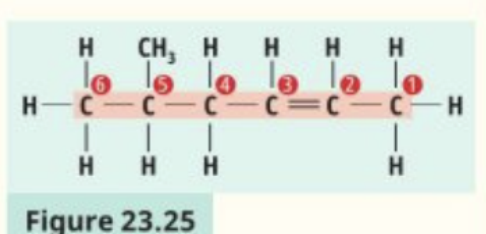
For example, if you have a six-carbon chain with a double bond between carbons 2 and 3, and a methyl group attached, this would be named systematically according to these rules.
Example
Worked Example: Naming 3,3-dimethylbut-1-ene
Step 1: Identify the longest carbon chain containing the double bond
- Main chain = 4 carbons → "but"
Step 2: Number from the end nearest the double bond
- Double bond between C1 and C2 → "but-1-ene"
Step 3: Identify and locate substituents
- Two methyl groups on carbon 3 → "3,3-dimethyl"
Step 4: Combine the name
- Final name: 3,3-dimethylbut-1-ene
Examples of common alkenes
- Ethene (): The simplest alkene, also known as ethylene
- Propene (): Has only one possible structure
- Butene (): Shows structural isomerism with multiple possible arrangements:
- But-1-ene (double bond between C1 and C2)
- But-2-ene (double bond between C2 and C3)
- Methylpropene (branched structure)
Note
Notice how the molecular complexity increases as we move down the homologous series, with more possibilities for isomerism in larger molecules. This is why organic chemistry becomes increasingly complex with larger hydrocarbons.
Molecular geometry around carbon atoms
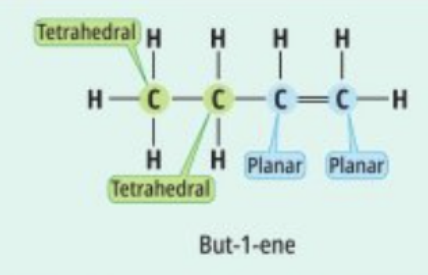
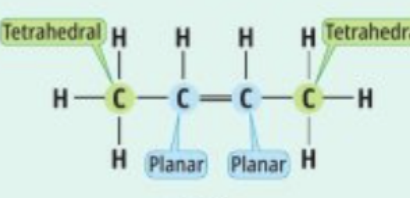
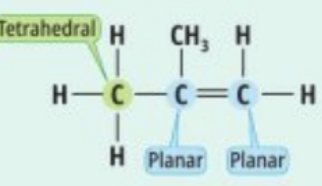
One of the most important concepts to understand about alkenes is that they contain carbon atoms with two different geometries within the same molecule:
Important
Mixed Molecular Geometry in Alkenes
Alkenes are unique because they contain two different types of carbon atoms with distinct geometries in the same molecule:
Tetrahedral geometry:
- Occurs at carbon atoms with four single bonds
- Bond angles of approximately 109.5°
- Results from sp³ hybridisation
- Three-dimensional arrangement
Planar geometry:
- Occurs at carbon atoms involved in the double bond
- Bond angles of approximately 120°
- Results from sp² hybridisation
- All atoms lie in the same plane
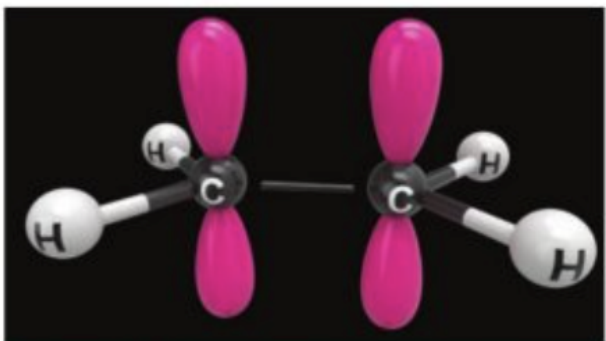
This image shows ethene with its pi orbital visualisation, demonstrating how the electron density is distributed above and below the molecular plane in the double bond region.
Cyclic alkenes
Alkenes can also form ring structures, creating cyclic alkenes. The most common example you'll encounter is cyclohexene:
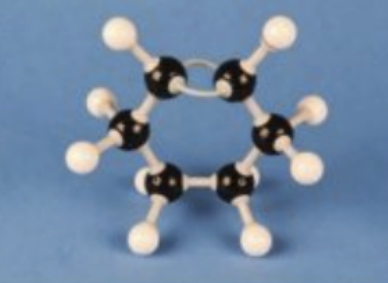
Key features of cyclohexene:
- Molecular formula: C₆H₁₀
- Contains a six-membered ring with one double bond
- Follows the same C=C bonding principles as straight-chain alkenes
- The ring structure adds conformational complexity
Note
Cyclic alkenes are important in many biological molecules and industrial applications. For example, cyclohexene is used in the production of nylon and other polymers, making them significant beyond just academic study.
Geometric isomerism (cis-trans isomerism)
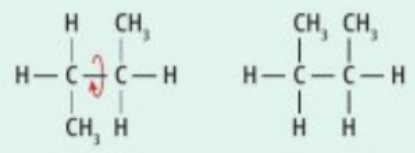
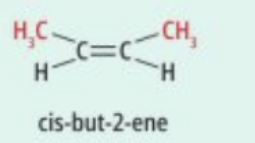
One of the most important concepts in alkene chemistry is geometric isomerism, also called cis-trans isomerism. This type of isomerism arises because rotation around the C=C double bond is not possible under normal conditions.
Important
Why Geometric Isomerism Occurs
- The pi bond in the C=C double bond prevents free rotation
- Breaking the pi bond would require significant energy (about 250-300 kJ/mol)
- Therefore, groups attached to the double bond are "locked" in position
- For geometric isomerism to exist, each carbon atom in the double bond must have two different groups attached to it
Cis and trans arrangements:
- Cis isomer: Identical groups are on the same side of the double bond
- Trans isomer: Identical groups are on opposite sides of the double bond
Properties of geometric isomers
Although cis and trans isomers have the same molecular formula and same connectivity of atoms, they have different physical and chemical properties:
Physical properties:
- Different boiling points and melting points
- Different densities
- Different solubilities
Chemical properties:
- Generally similar chemical properties since they have the same functional groups
- May react at different rates due to spatial arrangement effects
- Heat of combustion values are very similar but not identical
Important
Exam Tip: Isomer Types
Remember that geometric isomers are not the same as structural isomers:
- Structural isomers: Different connectivity of atoms
- Geometric isomers: Same connectivity but different spatial arrangements
This distinction is frequently tested and is crucial for understanding organic chemistry.
Summary
Key Points to Remember:
-
Alkenes are unsaturated hydrocarbons with the general formula and contain a C=C double bond
-
Mixed molecular geometry exists in alkenes - tetrahedral (109.5°) around sp³ carbons and planar (120°) around sp² carbons involved in the double bond
-
Naming follows IUPAC rules by changing -ane to -ene and numbering from the end nearest the double bond
-
Geometric isomerism occurs due to restricted rotation around the C=C double bond, creating cis (same side) and trans (opposite sides) arrangements
-
Physical properties differ between geometric isomers, but chemical properties remain largely similar due to identical functional groups