Planar Carbon Compounds (Leaving Cert Chemistry): Revision Notes
📚Revision Notes
Planar Carbon Compounds
Planar carbon compounds are an important family of organic molecules where carbon atoms adopt a flat, planar geometry around certain functional groups. This revision note covers four key families: aldehydes, ketones, carboxylic acids, and esters - all containing the carbonyl group (C=O) which creates this planar arrangement.
What makes these compounds planar?
The carbon atom in the carbonyl group (C=O) uses sp² hybridisation, creating a flat triangular arrangement with bond angles of approximately 120°. This planar geometry is crucial for understanding their properties and reactivity.
Important
The planar geometry around the carbonyl carbon is fundamental to understanding why these compounds have similar physical properties and chemical reactivity patterns. This sp² hybridisation creates a rigid, flat structure that affects how these molecules interact with each other and with other substances.
Aldehydes
Aldehydes are organic compounds containing the aldehyde functional group (-CHO). This group consists of a carbon atom double-bonded to oxygen and single-bonded to hydrogen, positioned at the end of a carbon chain.
General formula and structure
The general formula for aldehydes is RCHO, where R represents an alkyl group (or H in the case of methanal).
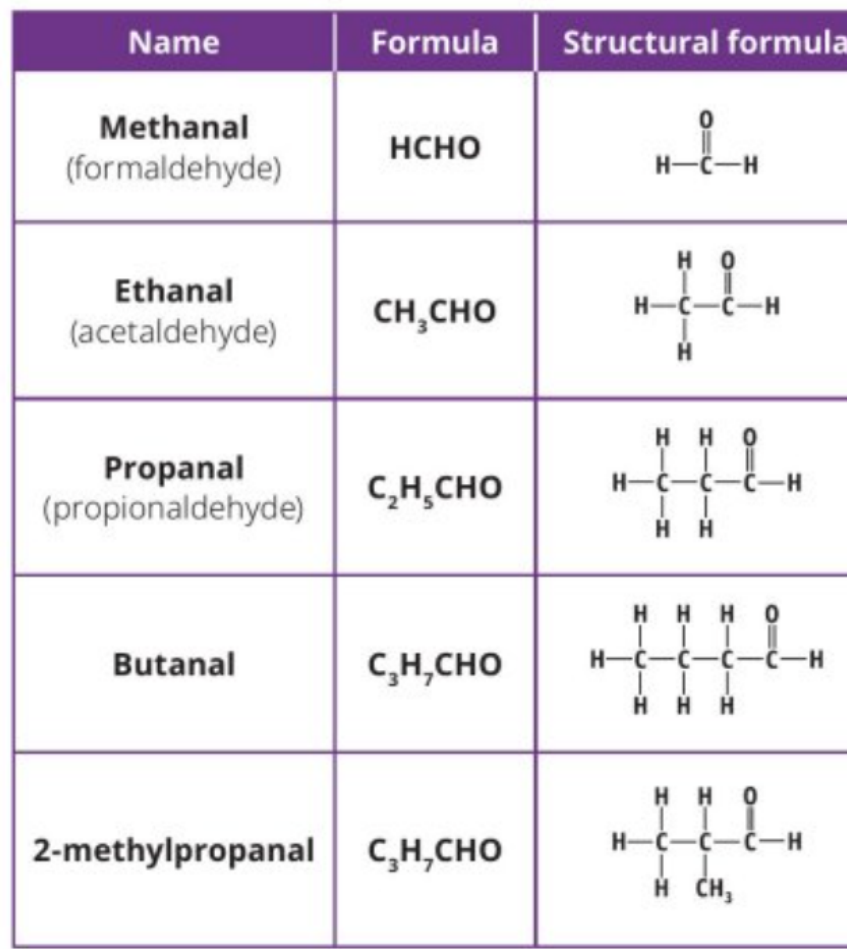
Key characteristics of aldehydes
Understanding the structural features of aldehydes is essential for predicting their behaviour:
- The carbonyl carbon is always at the end of the carbon chain
- The C=O bond creates a planar geometry around the carbon atom
- Bond angle around the carbonyl carbon is approximately 120°
- They can form hydrogen bonds with water molecules
Note
The terminal position of the aldehyde group means that aldehydes can be easily oxidised to form carboxylic acids. This is a key difference from ketones, where the carbonyl group is protected by being in the middle of the carbon chain.
Physical properties
Aldehydes have several important physical properties that can be explained by their molecular structure:
- Boiling points are higher than corresponding alkanes but lower than alcohols
- Solubility decreases as carbon chain length increases
- Lower members (like methanal and ethanal) are very soluble in water due to hydrogen bonding
- They exhibit dipole-dipole interactions between molecules
Natural occurrence and uses
Many aldehydes occur naturally and are important in everyday life:
- Benzaldehyde gives almonds their characteristic smell and flavour
- Methanal (formaldehyde) is used as a preservative
- Many aldehydes are used as flavouring agents in food
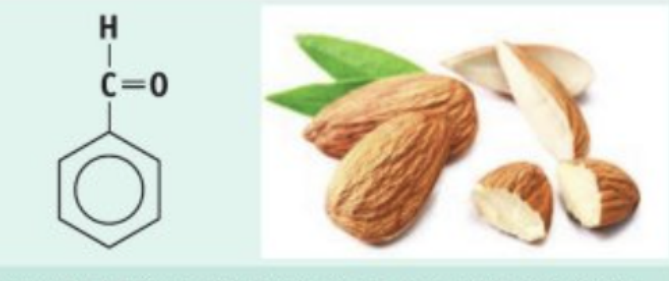
Ketones
Ketones are organic compounds containing the ketone functional group, where a carbon atom is double-bonded to oxygen and positioned between two alkyl groups.
General formula and structure
The general formula for ketones is RCOR', where R and R' are alkyl groups (which may be the same or different).
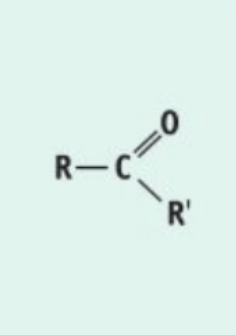
Key differences from aldehydes
While ketones and aldehydes both contain the carbonyl group, their structural differences lead to important distinctions in properties:
- The carbonyl group is never at the end of the chain - it's always internal
- Cannot be oxidised as easily as aldehydes
- Similar physical properties to aldehydes due to the same functional group
Important
The internal position of the ketone functional group makes ketones much more resistant to oxidation than aldehydes. This is why ketones require much stronger oxidising agents and harsher conditions to undergo oxidation reactions.
Physical properties
Ketones share many properties with aldehydes because they both contain the carbonyl group:
- Form dipole-dipole interactions between molecules
- Lower members are soluble in water due to hydrogen bonding with water molecules
- Boiling points increase with molecular size
- Used as organic solvents (like propanone/acetone)
Carboxylic acids
Carboxylic acids contain the carboxyl functional group (-COOH), which combines a carbonyl group with a hydroxyl group.
General formula and structure
The general formula for carboxylic acids is RCOOH, where the carboxyl group is typically at the end of the carbon chain.
The carboxyl group
The carboxyl group (-COOH) has unique properties that distinguish carboxylic acids from other carbonyl compounds:
- Contains both C=O and O-H bonds
- The carbon maintains planar geometry with 120° bond angles
- Can be drawn in different ways but represents the same structure
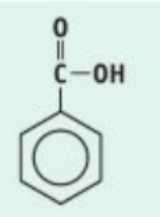
Hydrogen bonding in carboxylic acids
Carboxylic acids form particularly strong hydrogen bonds due to their -COOH group:
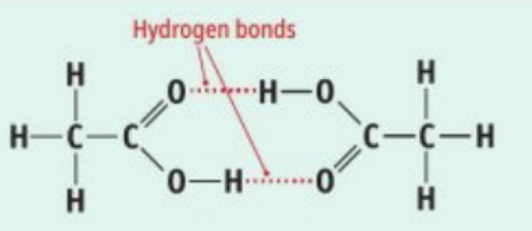
- They can form dimers (pairs of molecules) through hydrogen bonding
- This leads to higher melting and boiling points compared to aldehydes and ketones
- Very soluble in water for shorter chain acids
Note
The ability of carboxylic acids to form dimers through hydrogen bonding is particularly significant. Each carboxylic acid molecule can form two hydrogen bonds with another molecule, creating very stable dimers that require more energy to break apart during melting or boiling.
Physical properties
The physical properties of carboxylic acids are dominated by their strong hydrogen bonding capability:
- High boiling points due to strong hydrogen bonding
- Characteristic odours - many have sharp, acidic smells
- Lower members are completely miscible with water
- Ethanoic acid (acetic acid) is the main component of vinegar
Important examples
- Methanoic acid (formic acid) - found in ant stings
- Ethanoic acid (acetic acid) - main component of vinegar
- Benzoic acid - used as a food preservative
Esters
Esters are compounds formed when a carboxylic acid reacts with an alcohol, creating the ester functional group (-COO-).
Formation of esters
Esters form through an esterification reaction:
Carboxylic acid + Alcohol → Ester + Water
This is a condensation reaction because water is eliminated during the process.
Example
Worked Example: Formation of Ethyl Methanoate
Step 1: Identify the reactants
- Carboxylic acid: Methanoic acid (HCOOH)
- Alcohol: Ethanol (C₂H₅OH)
Step 2: Write the esterification reaction HCOOH + C₂H₅OH → HCOOC₂H₅ + H₂O
Step 3: Name the product The ester formed is ethyl methanoate
Structure and naming
Esters have the general formula RCOOR', where:
- R comes from the carboxylic acid
- R' comes from the alcohol
Naming esters
Understanding ester nomenclature is essential for identifying these compounds:
Ester names have two parts:
- The alkyl group from the alcohol (comes first)
- The acid part with "-oic acid" changed to "-oate"
For example: Ethyl methanoate = ethyl group (from ethanol) + methanoate (from methanoic acid)
Note
Remember that ester names are "backwards" compared to the way we write the formula. The name starts with the alcohol part, but in the structural formula, we write the acid part first (RCOOR').
Physical properties and uses
Esters have distinctive properties that make them valuable in many applications:
- Pleasant, fruity smells - responsible for many natural flavours
- Lower boiling points than corresponding carboxylic acids (no hydrogen bonding between ester molecules)
- Limited solubility in water but soluble in organic solvents
- Widely used as flavourings and solvents
Applications
- Food flavourings - many fruit flavours are esters
- Perfumes and fragrances
- Solvents in industry
- Nail varnish remover (ethyl ethanoate)
Intermolecular forces summary
Understanding intermolecular forces helps explain the physical properties of these planar carbon compounds:
- Aldehydes and ketones: Dipole-dipole forces due to polar C=O group
- Carboxylic acids: Strong hydrogen bonding due to -COOH group
- Esters: Weaker dipole-dipole forces (no hydrogen bonding between ester molecules)
- All compounds: Can form hydrogen bonds with water, affecting solubility
Important
The strength of intermolecular forces directly correlates with boiling points: carboxylic acids (strongest hydrogen bonding) > aldehydes/ketones (dipole-dipole) > esters (weaker dipole-dipole). This pattern explains why carboxylic acids have the highest boiling points among these compound types.
Summary
Key Points to Remember:
- Aldehydes have -CHO at the end of carbon chains with formula RCHO
- Ketones have C=O between two alkyl groups with formula RCOR'
- Carboxylic acids contain -COOH groups with formula RCOOH and form strong hydrogen bonds
- Esters form from acids + alcohols with formula RCOOR' and have pleasant fruity smells
- All these compounds have planar geometry around the carbonyl carbon due to sp² hybridisation
- The type and strength of intermolecular forces determines physical properties like boiling point and solubility
- Structural differences (terminal vs internal carbonyl, presence of -OH group) lead to different chemical reactivities