Elimination and Redox Reactions (Leaving Cert Chemistry): Revision Notes
📚Revision Notes
Elimination and Redox Reactions
What are elimination reactions?
An elimination reaction occurs when a small molecule is removed from a larger organic molecule, creating a double bond in the remaining structure. These reactions are fundamental in organic chemistry and allow us to convert one type of compound into another.
Note
Elimination reactions are particularly important because they provide a systematic way to introduce unsaturation (double bonds) into organic molecules, which can then be used for further chemical transformations.
The most common type of elimination reaction you'll encounter is dehydration, where a water molecule (H₂O) is removed from an organic compound. This process is particularly important when converting alcohols into alkenes.
Dehydration of alcohols
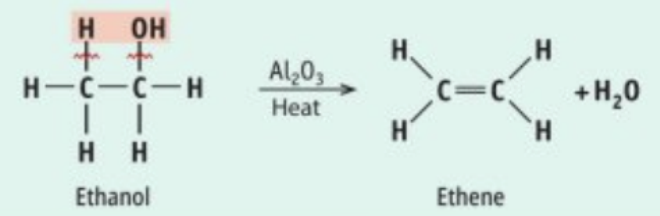
When alcohols are heated with a catalyst like aluminium oxide (Al₂O₃), they undergo dehydration to form alkenes. This reaction involves breaking a C-H bond and a C-O bond, while forming a new C=C double bond.
Example
Worked Example: Ethanol Dehydration
In this transformation, ethanol loses a water molecule to form ethene:
- The -OH group and a hydrogen atom from an adjacent carbon are removed together as H₂O
- This leaves behind the characteristic C=C double bond of an alkene
- The product is ethene, the simplest alkene
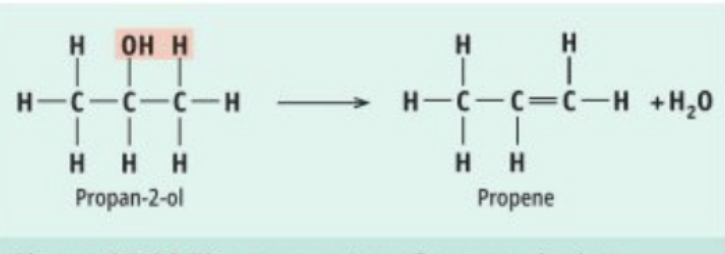
Similarly, propan-2-ol (a secondary alcohol) can be dehydrated to form propene. The reaction follows the same pattern - removal of water creates the alkene product.
Important
Key Concept: Elimination reactions can be thought of as the reverse of addition reactions. While addition reactions add molecules across double bonds, elimination reactions remove molecules to create double bonds.
Redox reactions of organic compounds
Redox reactions involve the transfer of electrons between substances. In organic chemistry, we often think about redox in terms of:
Note
Understanding Redox in Organic Chemistry:
- Oxidation: Adding oxygen or removing hydrogen
- Reduction: Adding hydrogen or removing oxygen
This definition makes it easier to identify redox processes in organic molecules without worrying about electron counting.
Oxidation reactions
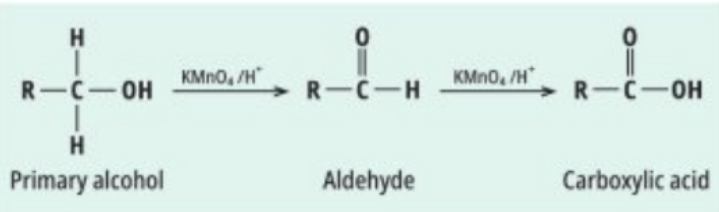
Primary alcohols are alcohols where the carbon bearing the -OH group is attached to only one other carbon atom. These compounds can undergo a two-step oxidation process.
Example
Worked Example: Primary Alcohol Oxidation
Using potassium permanganate (KMnO₄) in acidic conditions as an oxidising agent:
Step 1: Primary alcohol → Aldehyde (by removing two hydrogen atoms) Step 2: Aldehyde → Carboxylic acid (by adding oxygen)
This two-step process explains why primary alcohols can be completely oxidised to carboxylic acids under strong oxidising conditions.
Secondary alcohols have the carbon bearing the -OH group attached to two other carbon atoms. These can only be oxidised once.
Secondary alcohols are oxidised to ketones using the same KMnO₄/H⁺ conditions. However, unlike primary alcohols, the oxidation stops here because there are no hydrogen atoms attached to the carbon bearing the oxygen in a ketone.
Important
Critical Point: Tertiary alcohols cannot be easily oxidised because the carbon bearing the -OH group is attached to three other carbon atoms. There are no hydrogen atoms available for removal, making oxidation extremely difficult without breaking C-C bonds.
Reduction reactions
Reduction reactions are essentially the reverse of oxidation reactions. They involve adding hydrogen or removing oxygen from organic molecules.
Example
Worked Example: Reduction of Carbonyl Compounds
Both aldehydes and ketones can be reduced back to alcohols using hydrogen gas (H₂) with a nickel catalyst (Ni). This process adds hydrogen across the C=O double bond:
- Aldehydes are reduced to → Primary alcohols
- Ketones are reduced to → Secondary alcohols
Carboxylic acids can also be reduced, but this requires a two-step process.
Example
Worked Example: Carboxylic Acid Reduction
The reduction of ethanoic acid to ethanol occurs in stages:
Step 1: Carboxylic acid → Aldehyde Step 2: Aldehyde → Primary alcohol
Both steps use H₂/Ni as the reducing system.
Understanding reaction conditions
Important
Reaction Conditions are Crucial
The choice of reaction conditions is essential in organic chemistry:
- Elimination reactions: Usually require heat and a dehydrating agent (like Al₂O₃)
- Oxidation reactions: Use oxidising agents like KMnO₄ in acidic solution
- Reduction reactions: Employ reducing agents like H₂ with metal catalysts (typically nickel)
Exam tip: Always include reaction conditions (catalysts, temperature, etc.) when writing chemical equations - marks are often awarded for these details!
Real-world applications
Note
Practical Applications of These Reactions:
These reactions have important real-world uses:
- Wine production: Ethanol in wine can be oxidised to ethanoic acid (vinegar) if exposed to air
- Industrial synthesis: Elimination reactions are used to produce alkenes for plastic manufacture
- Biochemistry: Similar redox reactions occur in living organisms during metabolism
Summary
Summary
Key Points to Remember:
- Elimination reactions remove small molecules (like H₂O) to create double bonds, commonly converting alcohols to alkenes
- Primary alcohols can be oxidised twice: first to aldehydes, then to carboxylic acids using KMnO₄/H⁺
- Secondary alcohols oxidise once to form ketones, while tertiary alcohols resist oxidation
- Reduction reactions reverse oxidation using H₂/Ni catalyst, converting aldehydes and ketones back to alcohols
- Reaction conditions are essential - always include catalysts and reagents in your chemical equations