Substitution Reactions (Leaving Cert Chemistry): Revision Notes
📚Revision Notes
Substitution Reactions
What are substitution reactions?
A substitution reaction is a type of chemical reaction where one atom or group of atoms in a molecule gets replaced by a different atom or group of atoms. Think of it like swapping one piece in a jigsaw puzzle for another piece.
Note
Definition: A substitution reaction is a chemical reaction in which an atom or group of atoms in a molecule is replaced by another atom or group of atoms.
In organic chemistry, substitution reactions are particularly important for alkanes (saturated hydrocarbons). Since alkanes have strong C-H and C-C bonds and no reactive functional groups, they typically undergo substitution rather than other types of reactions.
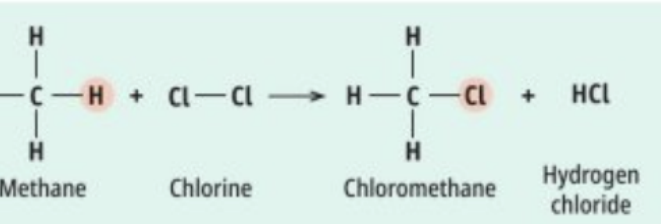
The most common example is the reaction between methane and chlorine gas, where a hydrogen atom in methane is replaced by a chlorine atom to form chloromethane.
Free radical substitution mechanism
Overview of the mechanism
Free radical substitution reactions follow a chain reaction mechanism, which means the reaction continues on its own once it gets started because products from one step become reactants for the next step. This type of reaction requires UV light or heat to initiate.
Important
Free Radicals: A free radical is an atom or group of atoms that have an unpaired electron, making them highly reactive. Free radicals are represented with a dot (•) next to the chemical symbol.
The mechanism involves species called free radicals - these are atoms or groups of atoms that have an unpaired electron, making them highly reactive. Free radicals are represented with a dot (•) next to the chemical symbol.
Note
The Four Steps of Free Radical Substitution:
- Initiation - the reaction gets started
- Propagation (Step 2) - hydrogen abstraction
- Propagation (Step 3) - halogen abstraction
- Termination - the chain reaction stops
Step 1: Initiation
The initiation step requires UV light to provide enough energy to break the covalent bond in a chlorine molecule. This process is called homolytic fission because the bond breaks in such a way that each chlorine atom gets one of the two electrons from the original bond.
The UV light converts chlorine molecules into two highly reactive chlorine free radicals:
This step is crucial because without these initial free radicals, the chain reaction cannot begin.
Step 2: Propagation (hydrogen abstraction)
In this step, a chlorine free radical attacks a methane molecule, removing (abstracting) a hydrogen atom. This forms hydrogen chloride and creates a methyl free radical.
Example
Step 2 Reaction: Hydrogen Abstraction
The chlorine free radical takes a hydrogen atom from methane, producing hydrogen chloride and a methyl free radical.
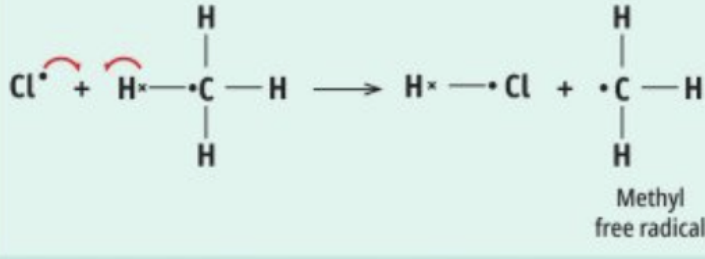
The methyl free radical () is now ready to participate in the next step of the chain reaction.
Step 3: Propagation (halogen abstraction)
The methyl free radical produced in Step 2 now attacks another chlorine molecule, forming the main product (chloromethane) and generating another chlorine free radical.
Example
Step 3 Reaction: Halogen Abstraction
The methyl free radical takes a chlorine atom, producing chloromethane and regenerating a chlorine free radical.
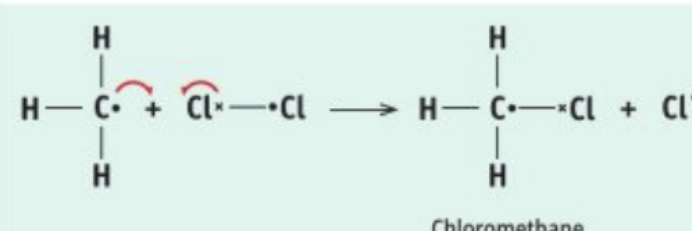
Notice how this step regenerates a chlorine free radical, which can then go back and repeat Step 2 with another methane molecule. This is why it's called a chain reaction - it keeps going!
Step 4: Termination
The chain reaction eventually stops when free radicals combine with each other to form stable molecules. Several termination reactions are possible:
Example
Termination Reactions
- Two chlorine free radicals combine:
- Two methyl free radicals combine: (ethane)
- A chlorine and methyl free radical combine:
Evidence for free radical mechanism
Note
Key Evidence for Free Radical Mechanism:
- UV light requirement: The reaction only occurs when exposed to UV light, supporting the need for photochemical initiation
- Formation of ethane: Small amounts of ethane () are found among the products, which can only be explained by methyl free radicals combining together
- Effect of accelerators: Adding compounds like tetraethyl lead increases the reaction rate because they provide additional free radicals
- Effect of inhibitors: Certain substances slow down or stop the reaction by removing free radicals from the system
Examples of substitution reactions
Chlorination of methane
The classic example we've been discussing:
Example
Worked Example: Chlorination of Methane
This reaction produces chloromethane (also called methyl chloride) and hydrogen chloride.
Chlorination of ethane
The same mechanism works with larger alkanes like ethane:
Example
Worked Example: Chlorination of Ethane
This produces chloroethane and hydrogen chloride.
During termination, ethyl free radicals can combine to form butane.
Bromination of cyclohexane
Free radical substitution also works with other halogens like bromine:
Example
Worked Example: Bromination of Cyclohexane
This reaction produces bromocyclohexane and hydrogen bromide.
Laboratory demonstration
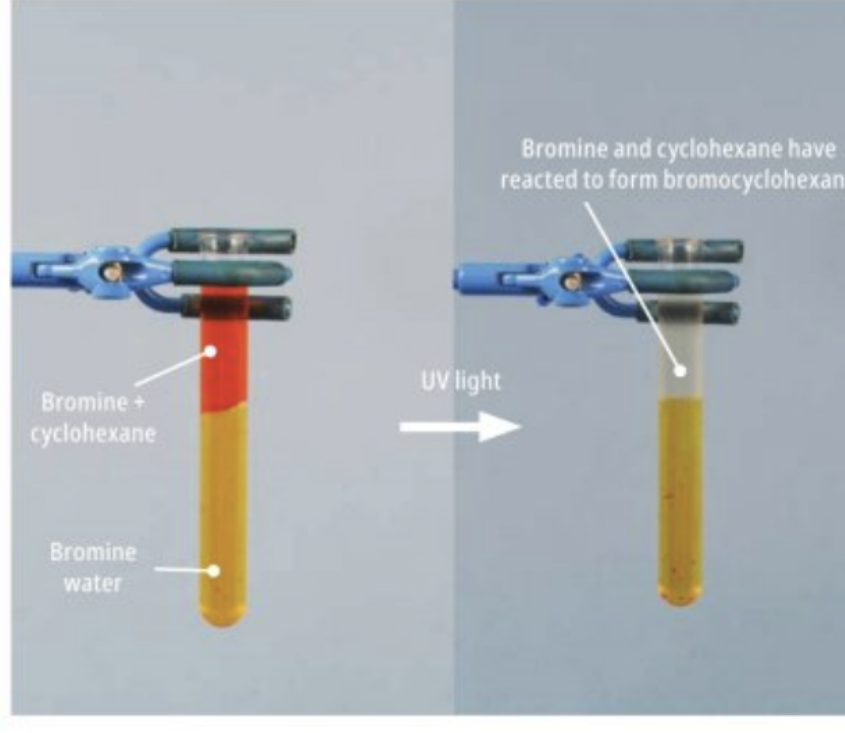
The bromination of cyclohexane can be demonstrated in the laboratory using a simple setup:
Note
Laboratory Demonstration Setup
Two test tubes are prepared - one containing cyclohexane and bromine water (showing distinct layers), and another exposed to UV light. After UV exposure, the bromine and cyclohexane react to form bromocyclohexane, showing a clear colour change that demonstrates the substitution reaction has occurred.
This practical demonstration provides visual evidence of the photochemical nature of free radical substitution reactions.
Summary
Key Points to Remember:
- Substitution reactions replace one atom or group with another in organic molecules
- Free radical mechanisms require UV light to initiate and follow a chain reaction pattern
- Four key steps: Initiation (UV breaks ), Propagation 1 ( takes H), Propagation 2 ( takes Cl), Termination (radicals combine)
- Evidence supports the mechanism through UV light requirements, unexpected products, and effects of accelerators/inhibitors
- Multiple alkanes undergo similar substitution reactions with halogens under UV light conditions