Collision Theory and Activation Energy (Leaving Cert Chemistry): Revision Notes
📚Revision Notes
Collision Theory and Activation Energy
What is collision theory?
Collision theory helps us understand why chemical reactions happen at different speeds. This theory was developed from the kinetic theory of gases to explain the factors that influence reaction rates.
Note
The collision theory bridges the gap between molecular behaviour and observable reaction rates, providing a molecular-level explanation for why some reactions are fast while others are slow.
The theory is based on the idea that for a chemical reaction to occur, the reacting particles must physically collide with each other. However, not all collisions between particles will result in a chemical reaction taking place.
Basic assumptions of collision theory
The collision theory makes several key assumptions about how reactions occur:
Important
Three Essential Requirements for Reaction:
-
Particles must collide - For any reaction to happen, the reacting particles must collide with each other.
-
Energy requirement - A collision will only result in product formation if a certain minimum energy is exceeded during the collision. This special collision is called an effective collision.
-
Correct orientation - For an effective collision to occur, particles must have sufficient energy and must collide in the correct orientation (head-on collision). If particles collide at the wrong angle, they may simply bounce off each other with no reaction taking place.
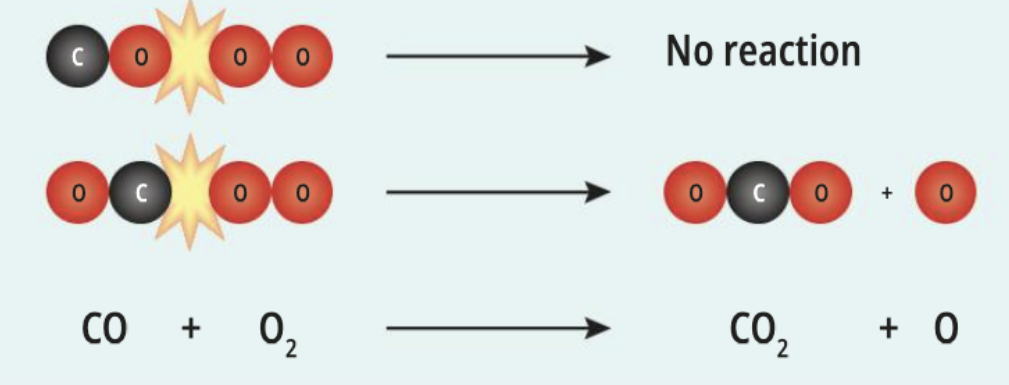
The diagram above shows how molecular orientation affects whether a reaction occurs. When carbon monoxide (CO) collides with oxygen molecules (O₂) in the correct orientation, products can form. However, if the collision occurs at the wrong angle, no reaction takes place even if the particles have enough energy.
Effective vs ineffective collisions
Effective collisions are collisions that result in the formation of products. When an effective collision occurs between particles, bonds are broken and new bonds are formed, leading to a chemical reaction.
Ineffective collisions occur when particles collide but do not have enough energy or are not oriented correctly. These collisions simply result in particles bouncing apart with no chemical change.
Note
The rate of reaction depends not only on the total number of collisions per second between reacting particles, but also on the fraction of these collisions that are effective. This is why increasing temperature speeds up reactions - more particles have sufficient energy for effective collisions.
Maxwell-Boltzmann energy distribution
Not all particles in a sample of gas have the same kinetic energy. The Maxwell-Boltzmann distribution shows how kinetic energies are spread among gas molecules at a particular temperature.
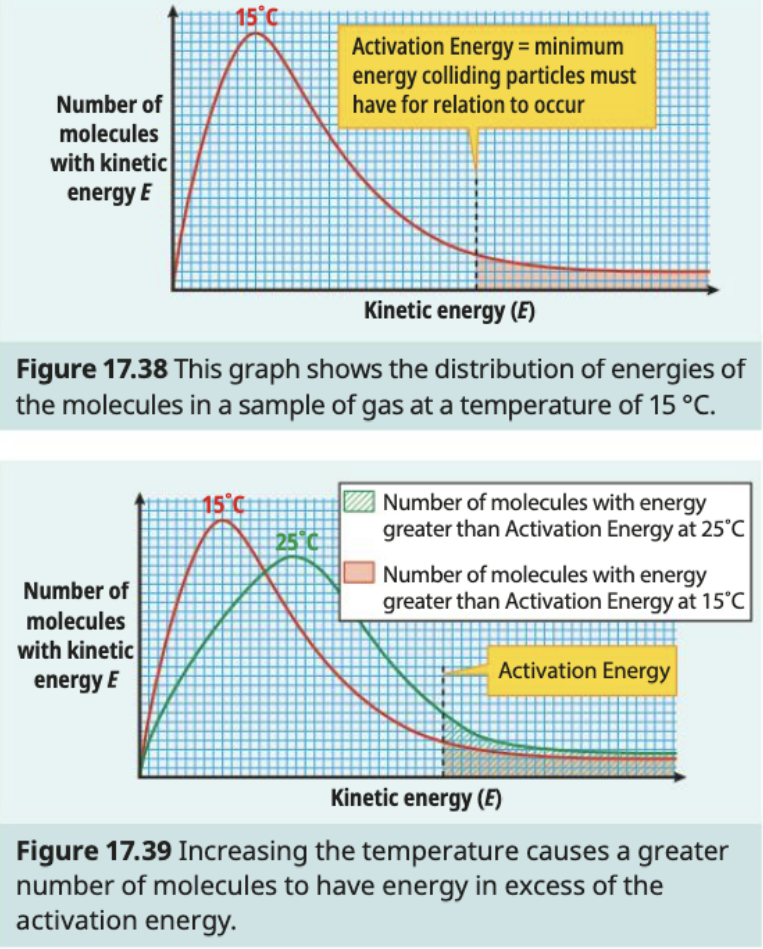
Key features of the Maxwell-Boltzmann distribution:
- Most molecules have moderate kinetic energies (around the peak of the curve)
- Some molecules have very low energies, and some have very high energies
- Only a small fraction of molecules have energies above the activation energy threshold
- At higher temperatures, the curve shifts to higher energies and becomes broader
- More molecules have sufficient energy to react at higher temperatures
Activation energy
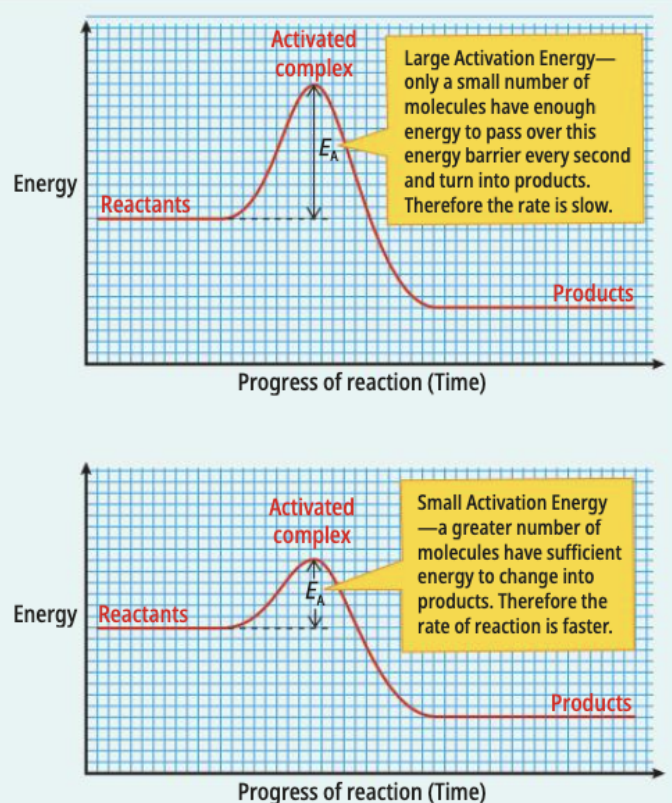
Activation energy () is the minimum energy that colliding particles must have for a reaction to occur. It represents an energy barrier that must be overcome for reactants to form products.
Important
Activation Energy and Reaction Rate:
- Large activation energy: Only a small number of molecules have sufficient energy to overcome the barrier, resulting in a slow reaction rate
- Small activation energy: A greater number of molecules have enough energy to react, leading to a faster reaction rate
The size of the activation energy depends on the nature of the reactants and the specific reaction taking place.
Reaction profile diagrams
A reaction profile diagram (also called an energy profile diagram) shows how energy changes during the progress of a chemical reaction.
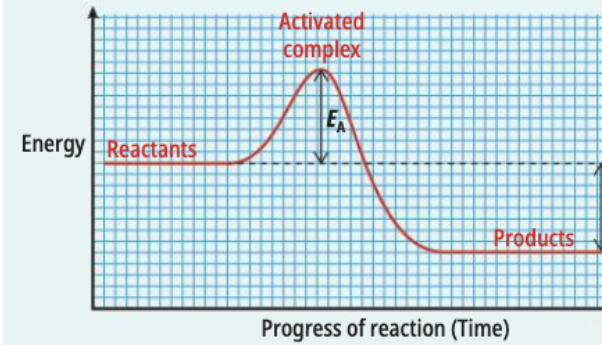
Key features of reaction profile diagrams:
- Reactants: Starting energy level on the left
- Activated complex: The highest energy point (transition state) where old bonds are breaking and new bonds are forming
- Products: Final energy level on the right
- Activation energy (): Energy difference between reactants and the activated complex
Exothermic reactions
In exothermic reactions, products have lower energy than reactants, and heat energy is released to the surroundings.
Endothermic reactions
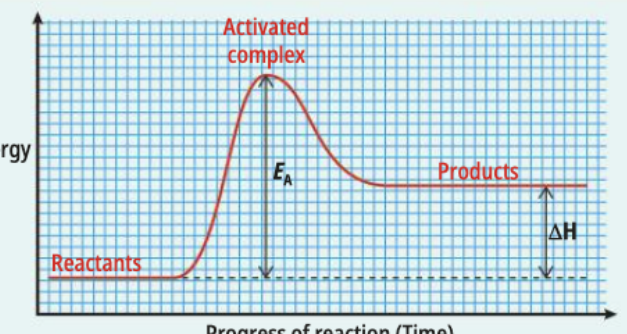
In endothermic reactions, products have higher energy than reactants, and heat energy is absorbed from the surroundings. The overall energy change (ΔH) is positive.
Factors affecting reaction rates
Several factors can increase reaction rates by increasing either the number of effective collisions or the energy of colliding particles:
Temperature
Increasing temperature has two important effects:
- Particles move faster, leading to more frequent collisions
- More particles have energies above the activation energy threshold
Note
The second effect is more significant. Even a small increase in temperature can dramatically increase the fraction of molecules with sufficient energy to react.
Concentration
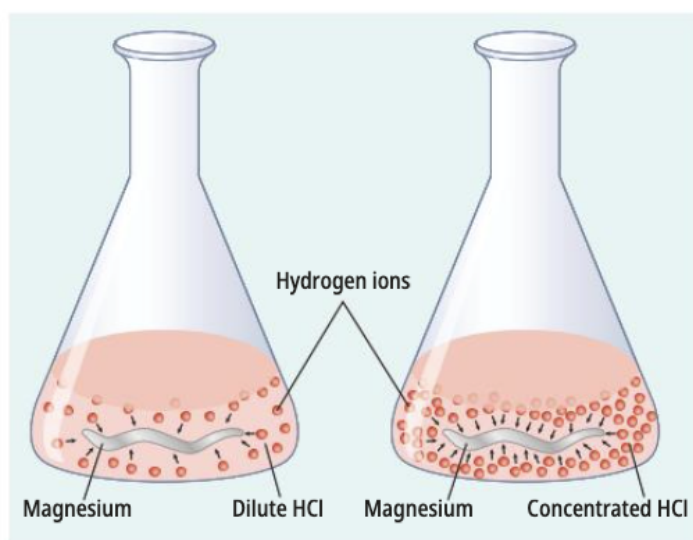
Increasing the concentration of reactants means:
- More particles are present in the same volume
- Particles are closer together
- Collisions occur more frequently
- More effective collisions per unit time
- Faster reaction rate
The diagram shows magnesium reacting with dilute versus concentrated hydrochloric acid, demonstrating how concentration affects reaction rate.
Particle size (surface area)
Smaller particle size means:
- Greater surface area exposed to reaction
- More particles available for collision at the surface
- Higher frequency of effective collisions
- Faster reaction rate
Note
This is particularly important for reactions involving solids, which is why powdered substances react faster than large chunks of the same material.
Catalysts
A catalyst provides an alternative reaction pathway with lower activation energy. Important features of catalysts:
- They lower the activation energy barrier
- More molecules can overcome the lower energy barrier
- Reaction rate increases significantly
- The catalyst is not consumed in the reaction
- The overall energy change (ΔH) remains the same
Important
Key Catalyst Properties: Catalysts create an alternative pathway (red curve) with lower activation energy compared to the uncatalysed reaction (black curve). This dramatically increases the number of successful collisions without changing the overall energy change of the reaction.
Pressure (for gaseous reactions)
Increasing pressure of gaseous reactants:
- Forces gas molecules closer together
- Increases collision frequency
- Results in faster reaction rates
- Has similar effect to increasing concentration
Summary
Key Points to Remember:
-
Collision theory explains reaction rates based on particle collisions - particles must collide with sufficient energy and correct orientation to react
-
Activation energy is the minimum energy barrier that must be overcome for reactions to occur - larger barriers mean slower reactions
-
Maxwell-Boltzmann distribution shows that only a fraction of particles have enough energy to react at any given temperature
-
Temperature increase dramatically increases reaction rates because more particles have energy above the activation energy threshold
-
Catalysts speed up reactions by providing alternative pathways with lower activation energy, without being consumed in the process