Stoichiometry: Limiting Reactants and Percentage Yield (LC 2027) (Leaving Cert Chemistry): Revision Notes
📚Revision Notes
The Limiting Reactant
What is a limiting reactant?
In chemical reactions, reactants are not always present in exactly the right proportions needed according to the balanced equation. When this happens, one reactant will be completely used up before the others, effectively stopping the reaction from continuing. This reactant is called the limiting reactant (or limiting reagent).
Note
Key Definitions
The limiting reactant is the substance that is used up first in a chemical reaction and therefore determines the maximum amount of product that can be formed. Once this reactant is consumed, the reaction cannot proceed further, even if other reactants remain.
The excess reactant is the substance that is not completely used up in the reaction. Some of this reactant will be left over after the reaction has finished because there wasn't enough of the limiting reactant to react with all of it.
Understanding limiting reactants with a visual example
Consider the reaction between iron and sulphur to form iron sulphide:
Fe + S → FeS
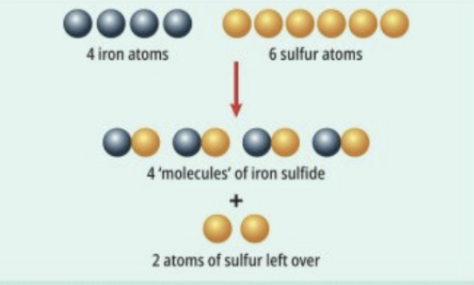
In this diagram, we can see what happens when 4 iron atoms react with 6 sulphur atoms. The balanced equation shows that iron and sulphur react in a 1:1 ratio. However, we have more sulphur atoms than iron atoms available.
What happens:
- 4 iron atoms react with 4 sulphur atoms to form 4 molecules of iron sulphide
- 2 sulphur atoms are left over (excess)
- Iron is the limiting reactant because it runs out first
- Sulphur is the excess reactant because some remains unreacted
How to identify the limiting reactant
To identify which reactant is limiting in a chemical reaction, follow these steps:
Step 1: Write the balanced chemical equation
Make sure you have the correct stoichiometric ratios for all reactants and products.
Step 2: Convert masses to moles
For each reactant, calculate the number of moles using:
Step 3: Compare the mole ratios
Use the balanced equation to determine how many moles of each reactant are needed. Compare this with how many moles you actually have.
Step 4: Identify the limiting reactant
The reactant that will be used up first (based on the stoichiometric ratios) is the limiting reactant.
Worked example: Iron and sulphur reaction
Example
Worked Example: Calculating Maximum Product Formation
Question: A student weighed out 10 grammes of iron and 10 grammes of sulphur. After mixing them, she placed them in a boiling tube and heated it to bring about the following reaction:
Fe + S → FeS
Calculate the maximum amount of iron sulphide that could be formed in this reaction.
Solution:
Step 1: Calculate the number of moles of each reactant
- Number of moles of Fe =
- Number of moles of S =
Step 2: Study the mole ratio in the balanced equation From the balanced equation Fe + S → FeS, we see that one mole of iron reacts with one mole of sulphur. Therefore, 0.18 moles of iron will require 0.18 moles of sulphur for the reaction to go to completion. However, since the student has weighed out 0.31 moles of sulphur, the sulphur is in excess. Therefore, the iron is present in limiting amount (limiting reactant).
Step 3: Calculate the maximum product formation Since sulphur is in excess, we can focus on the iron when carrying out calculations:
- Fe → FeS
- 1 mole → 1 mole
- 0.18 mole → 0.18 mole FeS
Step 4: Convert moles to grammes 1 mole FeS = 87.92 g (relative molecular mass FeS = 55.85 + 32.07 = 87.92) 0.18 mole FeS = 0.18 × 87.92 g = 15.83 g
Answer: The maximum amount of iron sulphide that could be formed is 15.83 grammes.
Key characteristics of limiting reactants
Important
Critical Concepts About Limiting Reactants
-
The limiting reactant controls the amount of product formed - no matter how much excess reactant you have, you cannot make more product than the limiting reactant allows
-
The limiting reactant is completely consumed - at the end of the reaction, none of the limiting reactant remains
-
Excess reactants are left over - these reactants are not completely used up because there wasn't enough limiting reactant to react with them
-
You must identify the limiting reactant before calculating product yields - this is essential for accurate stoichiometric calculations
Practical analogy
Note
The Sandwich Analogy
Think of making cheese sandwiches with one slice of cheese between two slices of bread. If you have 10 slices of bread and 3 slices of cheese, you can only make 3 sandwiches because you'll run out of cheese first. The cheese is your "limiting ingredient" - it doesn't matter that you have extra bread left over.
This perfectly illustrates how the limiting reactant works in chemical reactions!
Summary
Key Points to Remember:
- The limiting reactant is the one that gets used up first and stops the reaction from continuing
- The excess reactant is the one that has some left over after the reaction finishes
- To find the limiting reactant, convert masses to moles and compare with the stoichiometric ratios from the balanced equation
- The limiting reactant determines the maximum amount of product that can be formed
- Always identify the limiting reactant before calculating how much product will be made in a reaction