The Mole (Leaving Cert Chemistry): Revision Notes
📚Revision Notes
The Mole
What is the mole?
The mole is chemistry's special counting unit, just like how we use other counting units in everyday life. Think about how we count different things - we talk about a pair of gloves (2), a dozen eggs (12), or a ream of paper (500 sheets). In chemistry, we use the mole to count incredibly tiny particles like atoms and molecules.
Note
Just as we use familiar counting units in everyday life (dozen = 12, ream = 500), chemistry needed its own counting unit for the incredibly small world of atoms and molecules. The mole serves this exact purpose!
The mole allows chemists to work with manageable quantities of substances while still being able to count the actual number of particles involved in chemical reactions. Without this counting unit, it would be impossible to work with individual atoms and molecules because they are far too small to count directly.
Understanding Avogadro's constant
The mole is defined as containing exactly elementary entities (atoms, molecules, or ions) of a substance. This enormous number is called Avogadro's constant, and its symbol is .
Important
Avogadro's constant () is the bridge between the microscopic world of atoms and the macroscopic world we can measure in the laboratory. This number is so large that it's difficult to comprehend - it's larger than the entire population of Earth multiplied by billions of billions!
To put this number in perspective, is larger than the entire population of Earth multiplied by billions of billions. It's so large that it's difficult to comprehend, but it represents the bridge between the microscopic world of atoms and the macroscopic world we can measure in the laboratory.
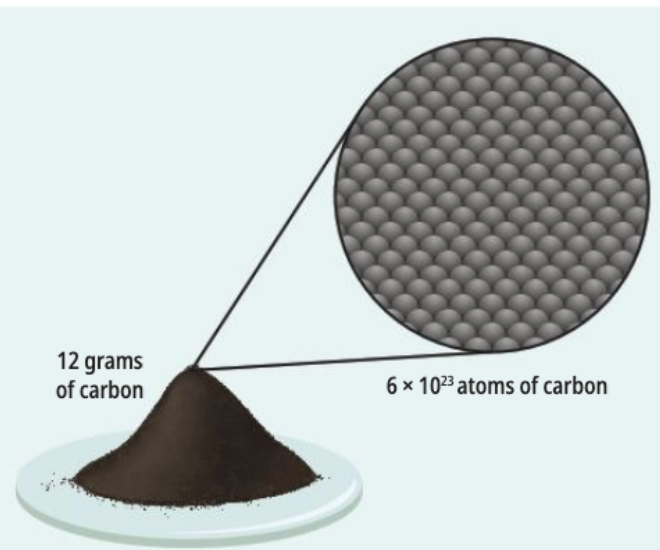
This diagram shows how 12 grammes of carbon contains exactly atoms of carbon - this is what we call one mole of carbon atoms.
The historical connection - Amedeo Avogadro
The constant is named after Amedeo Avogadro (1776-1856), an Italian chemist who developed important ideas about how to count atoms and molecules. Avogadro created a system that enabled chemists to count atoms and molecules by weighing substances, which was revolutionary for chemistry at the time.
Note
Interestingly, the actual numerical value of Avogadro's constant was determined by experiment using X-rays and other precise methods long after Avogadro's death. The International Union of Pure and Applied Chemistry (IUPAC) officially defined the mole in 2018 to emphasise the importance of Avogadro's constant.
Atomic masses and equal numbers of particles
One of the most important concepts about moles is that one mole of any element always contains the same number of atoms - exactly atoms. However, because different atoms have different masses, one mole of different elements will have different total masses.
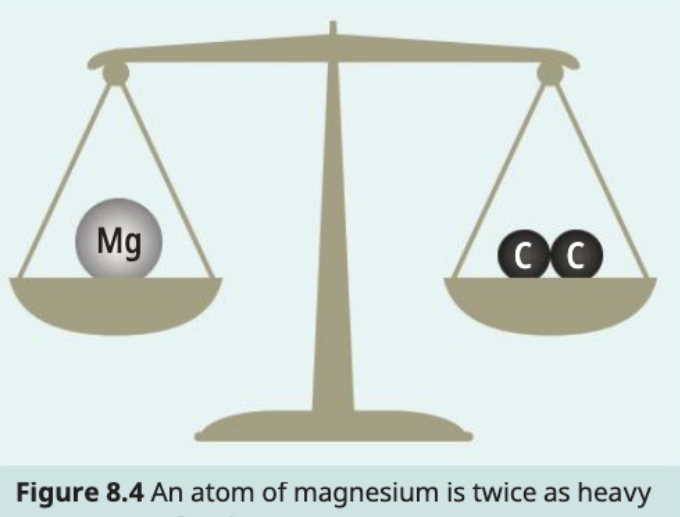
This balance scale shows that a magnesium atom is twice as heavy as a carbon atom. This means that if we have equal numbers of magnesium and carbon atoms, the magnesium sample will weigh twice as much.
Important
Key Concept: Even though different elements have different molar masses, one mole of ANY element contains exactly the same number of atoms ( atoms). The mass differs because individual atoms have different masses.
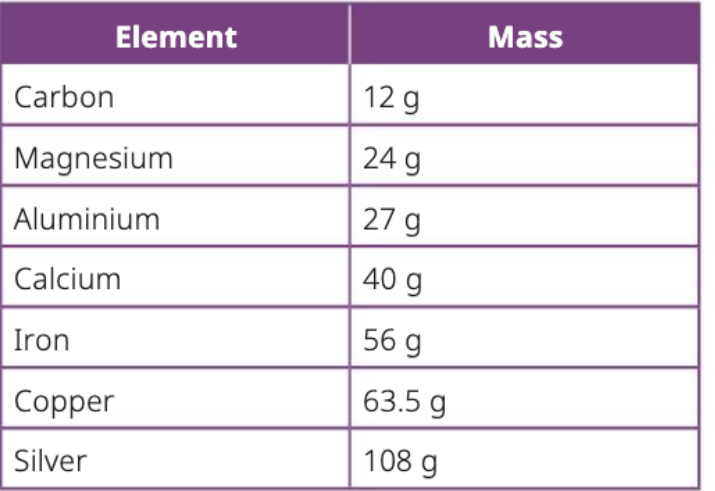
This table shows the mass of one mole of various elements. Notice how:
- One mole of carbon has a mass of 12g
- One mole of magnesium has a mass of 24g (twice that of carbon)
- One mole of silver has a mass of 108g
Even though these masses are very different, each sample contains exactly the same number of atoms - atoms.
Practical examples with different elements
Let's explore some practical examples to understand this concept better:
Example
Worked Example: Comparing Equal Moles of Different Elements
Carbon example: When you weigh out 12 grammes of carbon, you have exactly one mole, containing carbon atoms.
Magnesium example: Since a magnesium atom is twice as heavy as a carbon atom, you need 24 grammes of magnesium to get the same number of atoms (). This is also one mole of magnesium.
Silver and carbon comparison: A silver atom is nine times heavier than a carbon atom, so 108 grammes of silver contains the same number of atoms as 12 grammes of carbon.
This relationship allows chemists to count atoms by weighing - similar to how a bank cashier can count the number of coins in a bag by weighing it, since they know the mass of each individual coin.
National Mole Day celebration
Note
Chemistry students around the world celebrate National Mole Day from 6:02 a.m. to 6:02 p.m. on 23 October each year (representing ). This celebration includes chemistry jokes and activities to help students remember and appreciate the importance of the mole concept.
Some popular Mole Day jokes include:
- "What face cream did Avogadro invent?" Answer: "Oil of Molay"
- "What element do moles love to study in chemistry?" Answer: "Molybdenum"
The word "mole" - where does it come from?
Note
Etymology: The word "mole" comes from the Latin word moles, meaning "a heap or pile." This name draws attention to the particle nature of matter - thinking of substances as enormous heaps or piles of particles containing Avogadro's constant number of particles.
Working with moles in calculations
The mole concept enables chemists to perform essential calculations in chemistry:
Note
What the Mole Concept Enables:
- Convert between mass and number of particles
- Predict how much product will form in chemical reactions
- Calculate the composition of compounds
- Determine molecular formulas
Understanding moles is essential for all quantitative chemistry work, as it provides the connection between what we can measure (mass) and what actually reacts (individual atoms and molecules).
Summary
Key Points to Remember:
- The mole is chemistry's counting unit - like a dozen, but for atoms and molecules
- One mole always contains particles (Avogadro's constant)
- Different elements have different molar masses, but one mole of any element contains the same number of atoms
- The mole allows us to count atoms by weighing - making chemistry calculations possible
- Avogadro's constant bridges the gap between the microscopic atomic world and the macroscopic laboratory world