The Context of Greek Tragedy (Leaving Cert Classical Studies): Revision Notes
📚Revision Notes
The Context of Greek Tragedy
Theatre design & audience experience
Understanding how Greek tragedies were performed helps us appreciate their impact on ancient audiences. The physical design of Greek theatres created a unique shared experience that blended spectacle with meaning.
Theatre layout and architecture
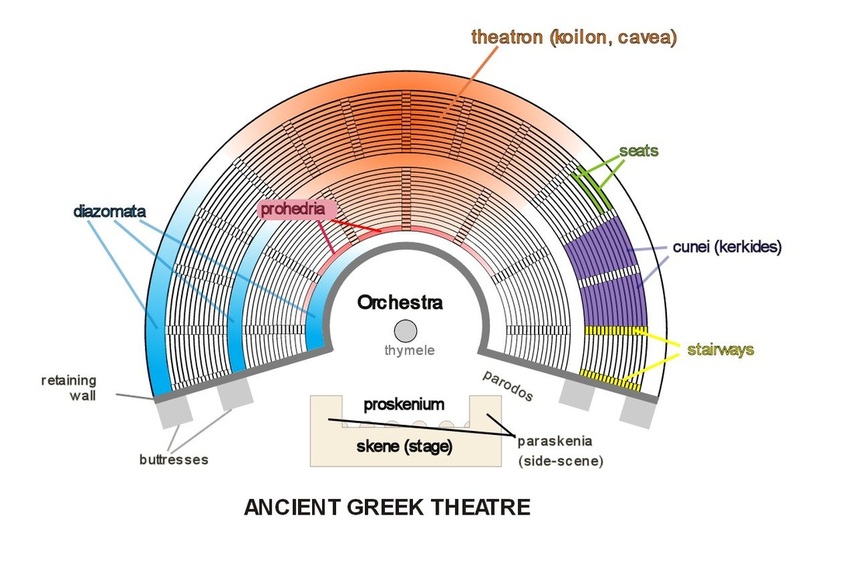
Greek theatres were architectural marvels built into natural hillsides. The theatron consisted of semicircular stone seating arranged in tiers, providing excellent acoustics that allowed even whispered dialogue to reach the furthest seats. This design could accommodate massive audiences - the Theatre of Dionysus in Athens held approximately 14,000-17,000 spectators.
Note
The acoustics of Greek theatres were so sophisticated that a coin dropped in the orchestra could be heard clearly in the back rows. This wasn't accidental - the curved stone seating and natural hillside amplification were carefully engineered to create this effect.
The orchestra served as a circular performance area where the chorus would sing, dance, and provide commentary on the dramatic action. This space connected the audience directly with the performers, creating an intimate yet communal atmosphere.
Behind the orchestra stood the skênê, a stage building that served multiple purposes. It provided a backdrop for scenes, contained entrances and exits for actors, and featured a roof called the theologeion where gods could make dramatic appearances.
The parodoi were side passageways that allowed both the chorus and actors to enter the performance space. These entrances also served as the main access points for audience members.
Production elements and stagecraft
Greek tragic productions employed sophisticated techniques to create powerful theatrical effects. All performers were male - typically three main speaking actors called hypokritai who would play multiple characters through costume and mask changes.
The chorus usually consisted of 12 members (in Aeschylus' works) or 15 (in Sophocles and Euripides), representing citizen-performers who sang choral songs and interacted with the main characters.
Important
Masks were crucial for Greek theatre performance. Made from linen or wood, they featured exaggerated facial expressions for visibility from great distances. These masks helped indicate character traits like gender, age, emotional state, and social status, while also enabling actors to portray multiple roles within a single production.
Costumes included long robes (chitôn) and cloaks (himation), with some characters wearing special raised boots (cothurni) to increase their stature. Colours and props provided visual clues about character identity and status.
Stage devices and special effects
Greek theatre employed ingenious mechanical devices to enhance dramatic impact:
Example
Worked Example: Stage Devices in Action
-
Mêchanê (meaning "machine"): A crane system that could lower actors portraying gods onto the stage, creating the famous deus ex machina effect where divine intervention resolved complex plot situations
-
Ekkyklêma: A wheeled platform that could be rolled out from the skênê to reveal scenes that had taken place offstage, such as the aftermath of violent acts
-
Periaktoi: Rotating triangular prisms with painted scenes on each side, allowing for quick scene changes
This combination of vast communal space, music, dance, and sophisticated visual elements created an intense, ritualised experience that merged entertainment with civic and religious significance.
The Dionysia festival context
Greek tragedy wasn't simply entertainment - it was a central part of Athens' most important religious and civic festival. Understanding this context reveals why these plays carried such cultural weight.
Festival organisation and programme
The City Dionysia (or Great Dionysia) took place each spring in Athens as a state festival honouring the god Dionysus. The archôn eponymos (chief magistrate) organised the event, while wealthy citizens called chorêgoi served as sponsors, funding the productions as a form of public service.
Note
The festival programme extended over several days and included:
- Religious processions and sacrificial ceremonies
- Dithyramb competitions featuring choral hymns
- Tragic competitions spanning three days, where each playwright presented a tetralogy (three tragedies plus one satiric play)
- Comedy performances held on separate occasions
Audience and accessibility
The festival audience was remarkably diverse for ancient times. Citizens, metics (resident foreigners), allies, and likely some women attended performances. The theôrikon was a special festival fund that subsidised ticket costs for poorer citizens, ensuring broad public participation.
Before performances began, the festival featured civic displays that connected drama to Athenian imperial pride and democratic identity. These might include tribute lists from allied cities, parades featuring war orphans, and official proclamations celebrating Athens' achievements.
Judging and civic participation
Ten judges drawn by lot (one from each tribe) evaluated the competing productions. This democratic selection process reinforced the festival's role in civic participation and collective decision-making.
Important
The Dionysia demonstrates that tragedy served multiple functions simultaneously. Rather than being private entertainment, these productions were public, political, and sacred events funded by the state to educate, challenge, and unite the citizen body.
Characters & chorus as social mirrors
Greek tragic characters weren't just individuals in stories - they represented different social groups and explored the tensions within Athenian society. This made tragedy a powerful tool for civic reflexion and debate.
Character types and social commentary
Kings and leaders like Agamemnon and Oedipus allowed audiences to examine questions of authority, accountability, and the dangers of unchecked power. These figures embodied issues central to democratic Athens, where citizens governed themselves and needed to understand the limits and responsibilities of leadership.
Female characters such as Antigone, Medea, and Electra often served as moral agents who revealed tensions between the oikos (household/family) and polis (state/city). These women challenged or confirmed societal expectations about obedience, agency, motherhood, and loyalty, forcing audiences to confront difficult questions about gender roles and social priorities.
Example
Worked Example: Character as Social Mirror
Foreigners and outsiders, including characters like Medea (from Colchis) or Trojan women, tested Athenian attitudes towards identity, empire, and empathy. Through these characters, playwrights could examine how Athens treated non-citizens and whether imperial expansion aligned with democratic values.
Slaves and messengers frequently served as truth-tellers who exposed the real costs of elite decisions. These lower-status characters often possessed crucial knowledge that revealed the gap between public rhetoric and private reality.
The chorus as community voice
The chorus typically represented groups of citizens (such as Theban or Argive elders) or communities of women or foreigners. Through their songs and movements, they voiced collective anxieties, provided ethical commentary, and offered ritual prayers that connected human action to divine will.
The chorus's physical movement and musical performance represented the community's emotional response - sometimes supporting the protagonists' choices, sometimes questioning them, and sometimes actively resisting their decisions. This created a dynamic relationship between individual action and collective judgement.

Important
The careful casting of both individual characters and chorus identities created a social map that invited audiences to evaluate actions against civic values, making tragedy a form of public moral education.
Why theatres spread across the eastern Mediterranean
The expansion of Greek-style theatres throughout the ancient world reveals their importance beyond mere entertainment - they became symbols of cultural identity and civic sophistication.
Historical spread and cultural significance
From the 5th century BCE, and particularly during the Hellenistic period following Alexander the Great's conquests, Greek-style theatres appeared across Asia Minor, the Levant, Egypt, and Sicily/Italy. Notable examples include theatres at Epidaurus, Syracuse, Ephesus, and Pergamon.
These theatres weren't simply copied architectural forms - they functioned as genuine civic centres that served multiple community needs. They hosted dramatic performances, religious festivals, public assemblies, official decrees, and ceremonial honours.
Multipurpose civic function
Beyond their theatrical use, these venues accommodated religious rituals, diplomatic ceremonies, and later Roman spectacles. The durable stone construction of the seating areas, orchestra, and stage buildings made them enduring symbols of Hellenic cultural identity and urban prestige.
Note
Cities throughout the Greek world competed to build impressive theatre complexes because they demonstrated participation in broader Greek civilisation. Having a well-constructed theatre proved a city's cultural sophistication, political organisation, and connection to the wider Mediterranean community.
These theatres became focal points of civic life, providing material evidence of a community's cultural achievements, political stability, and engagement with the broader Greek cultural network.
Exam tips
Important
Critical Exam Strategies:
-
When discussing audience experience: Always name the specific theatre spaces (theatron/orchestra/skênê) and staging devices (mêchanê, ekkyklêma) while explaining how they created meaning - for example, gods arriving by crane demonstrated divine authority
-
For Dionysia questions: Connect the religious, political, and artistic elements by mentioning sponsorship (chorêgoi), democratic judging (tribal representatives), subsidised access (theôrikon), and imperial displays to show how tragedy served public discourse
-
When analysing social roles: Choose one specific play and map different character types (ruler, woman, foreigner, chorus) to particular social tensions, such as conflicts between household loyalty versus state obligation
-
For questions about theatre expansion: Name specific locations and explain their significance in terms of Hellenistic cultural influence, civic prestige, and the multipurpose function of theatres as public spaces
-
General approach: Keep examples precise and focused - using one accurate technical term (like parodos or deus ex machina) correctly often demonstrates deeper understanding than vague generalisations
Remember!
Summary
Key Points to Remember:
- Greek theatres were designed as communal spaces that could hold thousands, creating shared civic experiences through excellent acoustics and sight lines
- The Dionysia festival combined religious worship, political display, and artistic competition, making tragedy a tool for public education and democratic engagement
- Tragic characters represented different social groups (rulers, women, foreigners, slaves) to explore tensions within Athenian society and democratic values
- The chorus served as the community's voice, responding to individual actions with collective wisdom, anxiety, or resistance
- Theatres spread throughout the Mediterranean as symbols of Greek cultural identity and civic sophistication, serving multiple community functions beyond drama