Characters (Leaving Cert Classical Studies): Revision Notes
📚Revision Notes
Characters
The characters in Homer's Odyssey are carefully crafted to represent different aspects of ancient Greek society and values. Understanding these characters is essential for grasping the epic's major themes of heroism, loyalty, justice, and divine intervention.
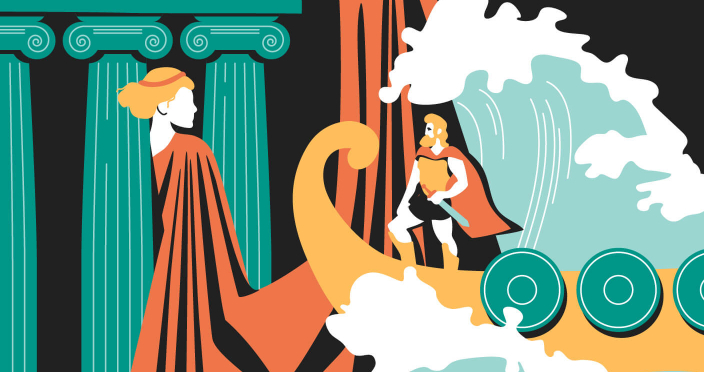
Odysseus - The complex hero
Odysseus stands as the central figure of the epic, serving as both its greatest strength and most fascinating contradiction. As the king of Ithaca, he has earned widespread fame for his sharp intelligence, tactical brilliance, and remarkable resilience in the face of adversity.
Homer introduces him with the memorable phrase "the man of twists and turns", immediately establishing his reputation for cleverness and adaptability. While Odysseus proved himself a formidable warrior during the Trojan War, his greatest challenge lies in his nostos (homecoming journey), which stretches across ten gruelling years.
Note
The Greek term nostos refers specifically to a hero's journey home from war, and became a central theme in ancient Greek literature. Odysseus's nostos is particularly significant because it takes longer than the Trojan War itself, emphasising the challenges of returning to peaceful domestic life.
His key strengths include exceptional bravery, natural leadership abilities, and cunning intelligence. These qualities shine through in episodes like his creation of the Trojan Horse and his clever defeat of Polyphemus. However, Odysseus also possesses significant character flaws, particularly his pride and occasional recklessness, which often create additional suffering for himself and his companions.
Example
Character Analysis: The Cyclops Episode
A perfect example of both his cleverness and his dangerous pride occurs in the Cyclops episode. He successfully outwits Polyphemus by calling himself "Nobody" and escaping hidden under sheep. Yet he then reveals his true identity, boasting: "Cyclops, if any man on the face of the earth should ask you who blinded you... say Odysseus of Ithaca" (Book 9). This moment of pride triggers Poseidon's wrath and prolongs his journey home.
Penelope - The epitome of loyalty
Penelope represents the ideal of the faithful Greek wife, embodying intelligence, loyalty, and resourcefulness. Her character serves as a powerful symbol of steadfast devotion and feminine wisdom within the patriarchal world of ancient Greece.
For twenty long years, she manages to keep over 100 persistent suitors at bay through her famous weaving trick - promising to choose a husband once she completes a shroud for Laertes, but secretly unravelling her work each night. This clever strategy demonstrates that she shares her husband's talent for cunning deception when circumstances require it.
Important
Penelope's weaving trick is more than just a clever delay tactic - it represents the power of feminine intelligence and resourcefulness within the constraints of ancient Greek society. Her ability to outsmart over 100 men for years demonstrates that wisdom and loyalty can be more powerful than physical strength.
Penelope represents the ideal Greek wife through her loyalty, cautiousness, and resourcefulness. When Odysseus finally returns, she tests his identity through various means, including the famous bed test - a secret only the real Odysseus would know.
Example
Textual Evidence: The Bed Test
Her wisdom and caution become evident in her response to the disguised Odysseus: "Do not rage at me, Odysseus! You always had the clearest head... This secret sign of our bed is known to us alone" (Book 23). This quote demonstrates both her intelligence and the intimate bond between husband and wife.
Telemachus - The maturing prince
Telemachus begins the epic as a young man struggling with powerlessness against the suitors who have invaded his home. Throughout the narrative, we witness his transformation from a timid youth into a confident leader worthy of his father's legacy.
Initially appearing fearful and ineffective against the suitors' behaviour, Telemachus gradually develops courage and leadership skills under Athena's guidance. He embarks on his own mini-journey (known as the Telemachy, Books 1-4), seeking news of his father and learning valuable lessons about rulership and bravery.
Note
The Telemachy (Books 1-4) serves as Telemachus's own heroic journey, mirroring his father's adventures but focusing on personal growth and the search for information rather than physical trials. This parallel structure emphasises the theme of generational succession and coming-of-age.
Example
Character Development: Telemachus's Assertion of Authority
A pivotal moment in his character development occurs in Book 1, where he boldly confronts the suitors and orders Penelope to return to her chambers: "Mother, go back to your quarters... As for giving orders, men will see to that" (Book 1). This scene demonstrates his growing confidence and reflects the patriarchal values of ancient Greek society.
Athena - The divine protector
As the goddess of wisdom, Athena serves as Odysseus's primary divine supporter throughout his trials. Her character represents the positive aspects of divine intervention - guidance, justice, and rational thought.
Athena frequently appears in disguise to assist both Odysseus and Telemachus, demonstrating her commitment to justice and order. She symbolises divine wisdom and reason, standing in direct contrast to Poseidon's vengeful anger.
Example
Divine Intervention: Athena's Power
Her protective nature becomes clear in numerous scenes, including when she disguises herself as Mentor to guide Telemachus. The narrator describes her divine power helping mortals: "With a quick glance at Odysseus, grey-eyed Athena held back the night, prolonged the golden light of day" (Book 23). This intervention shows how divine favour can literally change the natural world to aid worthy mortals.
Poseidon - The divine antagonist
Poseidon, god of the sea, represents the primary supernatural obstacle to Odysseus's homecoming. His relentless pursuit of vengeance against Odysseus (for blinding his son Polyphemus) symbolises both divine anger and the unpredictable dangers of the natural world.
As a character, Poseidon embodies the concept of obstacles beyond human control. His anger demonstrates how even heroes must face consequences for their actions, regardless of their noble intentions or ultimate righteousness.
Example
Divine Wrath in Action
The god's power becomes terrifyingly clear when he destroys Odysseus's raft: "Poseidon... roused the sea against him, loosed the stormwinds, let loose the squalls" (Book 5). This destruction shows how divine displeasure can instantly overwhelm human achievements and planning.
The suitors - Antagonists representing social decay
The suitors function as a collective antagonist, representing greed, disrespect, and social disorder within Odysseus's own kingdom. More than 100 noblemen from Ithaca abuse the sacred concept of xenia (hospitality) by consuming Odysseus's wealth while pressuring Penelope to remarry.
Note
Xenia was the ancient Greek concept of sacred hospitality between host and guest. It was considered a divine law protected by Zeus himself, making the suitors' violation of xenia not just rude behaviour, but a serious religious offence deserving divine punishment.
These characters embody negative values - greed, disrespect for proper social order, and violation of sacred hospitality laws. Among them, Antinous emerges as a particularly violent leader, while Eurymachus represents cunning manipulation and false charm.
Example
Justice Restored: The Suitors' Downfall
Their eventual deaths serve to restore justice and proper social order. The moment of their downfall arrives when Odysseus reveals himself and strikes Antinous: "Odysseus aimed and shot Antinous in the throat... the cup fell from his hand" (Book 22). This scene marks the beginning of justice's restoration.
Minor but significant characters
Several secondary characters play crucial thematic roles:
Eumaeus the swineherd represents loyal service and proper xenia. His faithful devotion to Odysseus demonstrates ideal servant-master relationships and good hospitality practices.
Eurycleia the nurse serves as a figure of recognition and memory, identifying Odysseus by his distinctive scar and maintaining connection to his past.
Calypso and Circe are goddesses who detain Odysseus during his journey, representing the themes of temptation and distraction from one's ultimate purpose.
Polyphemus the Cyclops provides a brutal contrast to civilised society, representing the opposite of proper xenia and social order.
Example
Model Hospitality: Eumaeus's Wisdom
Eumaeus demonstrates proper guest-friendship when he tells the disguised Odysseus: "Stranger, it is wrong to send a stranger packing... All strangers and beggars come from Zeus" (Book 14). This quote illustrates the Greek belief in sacred hospitality duties.
Character relationships and themes
The characters work together to explore major themes of the epic. Odysseus represents heroism but also human fallibility, while Penelope embodies unwavering loyalty and feminine strength. Telemachus shows the importance of maturity and proper succession, while Athena represents divine justice supporting worthy mortals.
Note
The contrast between good and bad xenia runs throughout the epic - Eumaeus and Penelope represent proper hospitality, while the suitors and Polyphemus violate these sacred social bonds. This theme reinforces the importance of social order and divine law in ancient Greek culture.
The contrast between good and bad xenia runs throughout - Eumaeus and Penelope represent proper hospitality, while the suitors and Polyphemus violate these sacred social bonds. Similarly, the divine realm shows both support (Athena) and opposition (Poseidon), reflecting the complex relationship between mortals and gods in Greek thought.
Summary
Key Points to Remember:
- Odysseus combines heroic qualities with human flaws - his cleverness saves him, but his pride creates problems
- Penelope represents ideal feminine loyalty and intelligence, using cunning to protect her household
- Telemachus undergoes a coming-of-age journey, developing from powerless youth to confident leader
- Divine characters (Athena vs Poseidon) represent different aspects of supernatural influence on human affairs
- The suitors embody social disorder and violation of sacred hospitality, making their deaths necessary for justice's restoration