Soil Investigation (Leaving Cert Construction Studies): Revision Notes
📚Revision Notes
Soil investigation
Understanding the importance of soil investigation
Before any construction begins, it's essential to investigate the site thoroughly. Understanding how the land has been used previously can save valuable time and resources during the building process. For instance, knowing whether the site was used for mining, quarrying, or waste disposal helps inform planning decisions.
Note
Soil investigation forms a crucial part of site preliminaries because a house must be built on solid foundations. The ground conditions directly determine what type of foundation system will work best and whether the site is suitable for building at all.
Key elements affected by soil type
The type of soil found on a building site influences three main aspects of construction:
- Foundation design - Different soil types require different foundation approaches
- Septic tank installation - If sewage treatment is needed on-site, the soil must be able to handle wastewater effectively
- Surface water drainage - How well water drains away from the building depends on soil characteristics
When septic tanks are planned, the soil undergoes additional testing to ensure it can treat wastewater properly, provide adequate drainage for treated water, and maintain minimum separation distances. A percolation test checks whether the soil can cope with these requirements.
Professional soil assessment
The significant impact of soil conditions on building viability means that professional assessment is essential. A qualified land surveyor carries out detailed tests to determine soil type and suitability, particularly important for new building sites.
Important
The surveyor produces a comprehensive report detailing the soil's load-bearing capacity - essentially how much weight the ground can safely support. This report also recommends suitable foundation types, which may limit the size and height of proposed buildings.
The recommendations consider various factors, including how compacted the soil is.
Identifying soil types through observation
Initial soil assessment can begin with careful site observation. On greenfield sites, the vegetation provides clues about soil quality. Good soil typically supports plants like thistle, bracken and ragwort, while poor soil conditions are indicated by plants such as alder, iris and rushes.
Note
Ireland's geography affects soil quality patterns. Generally, northern and western regions tend to have poorly drained soils, while southern and eastern areas typically have richer, well-drained soils.
Soil density and load-bearing capacity
Important
Soil can be loose or compacted, which significantly affects its ability to support buildings. Loose soil contains more air spaces between particles and provides poor load support. Compacted soil has particles pressed more tightly together, offering improved load-bearing capacity and better foundation support.
| Category of Soil | Types of Subsoil | Bearing Capacity | Description |
|---|---|---|---|
| 1. Sand and 2. Gravel | Compacted sand | >600 kN/m² | This soil is hard to work. It must be excavated with a pick. |
| Compacted gravel | >300 kN/m² | ||
| Loose gravel | >200 kN/m² | This soil is easy to work. It can be excavated with a spade. | |
| Loose sand | >100 kN/m² | ||
| 3. Clay and 4. Silt | Hard clay | 300–600 kN/m² | A pick is needed for excavation – it cannot be moulded by hand. |
| Stiff sand/clay | 150–300 kN/m² | ||
| Firm clay | 75–150 kN/m² | This soil can be excavated with a spade and moulded by hand under substantial pressure. | |
| Soft clay | 75 kN/m² | This soil can be easily excavated and easily moulded by hand. | |
| Soft silt/clay | 75 kN/m² | ||
| Soft sand/clay | 75 kN/m² | ||
| Very soft clay | 75 kN/m² | On squeezing, this soil breaks down and escapes through the fingers. | |
| Very soft silt | 75 kN/m² | ||
| 5. Peat | Soft/firm | <75 kN/m² | This soil is not suitable to build on. |
Trial hole investigation
To properly assess soil conditions, surveyors dig trial holes at various locations across the site. For typical dwelling construction, these holes measure 1m by 1m and extend between 2.5m and 4m deep. This depth allows clear identification of different soil layers and subsoil composition.
Multiple trial holes provide an overall assessment of soil conditions across the entire site. The holes reveal the natural layering of soil, typically showing humus at the surface, followed by topsoil, weathered rock, and bedrock at the deepest level.
Irish soil and rock classification
Ireland's geology includes limestone, sandstone, shale, clay and slate as typical rock and soil types. These local materials are worth considering when selecting building finishes to complement the surrounding landscape.
Note
Irish Soil and Rock Classification for Building
For building purposes, soil and rock types are classified into six main categories:
- Rock - Highest bearing capacity
- Sand - Good drainage, varying compaction levels
- Gravel - Excellent drainage, strong load-bearing when compacted
- Clay - Variable properties depending on hardness
- Silt - Poor drainage, limited load-bearing capacity
- Peat - Unsuitable for building

Understanding bearing capacity
Each soil category has different load-bearing capabilities, measured in kilonewtons per square metre (kN/m²). This measurement indicates how much weight the ground can sustain over a given area.
Important
Soils with bearing capacity under 150kN/m² can be moulded by hand, indicating poor load-bearing properties. The classification ranges from compacted sand and gravel (over 300kN/m²) down to peat (under 75kN/m²), which is not suitable for building.
Sand and gravel categories:
- Compacted sand: over 600kN/m² - Hard to work, requires mechanical excavation
- Compacted gravel: over 300kN/m² - Similar properties to compacted sand
- Loose gravel: over 200kN/m² - Easy to work, can be excavated with hand tools
- Loose sand: over 100kN/m² - Similar workability to loose gravel
Clay categories:
- Hard clay: 300-600kN/m² - Requires mechanical excavation
- Stiff sand/clay: 150-300kN/m² - Cannot be moulded by hand
- Firm clay: 75-150kN/m² - Can be excavated and moulded under pressure
- Soft clay varieties: 75kN/m² - Easily excavated and moulded by hand
Silt and peat:
- Very soft clay/silt: 75kN/m² - Will ooze between fingers when squeezed
- Peat: under 75kN/m² - Not suitable for building
Groundwater assessment
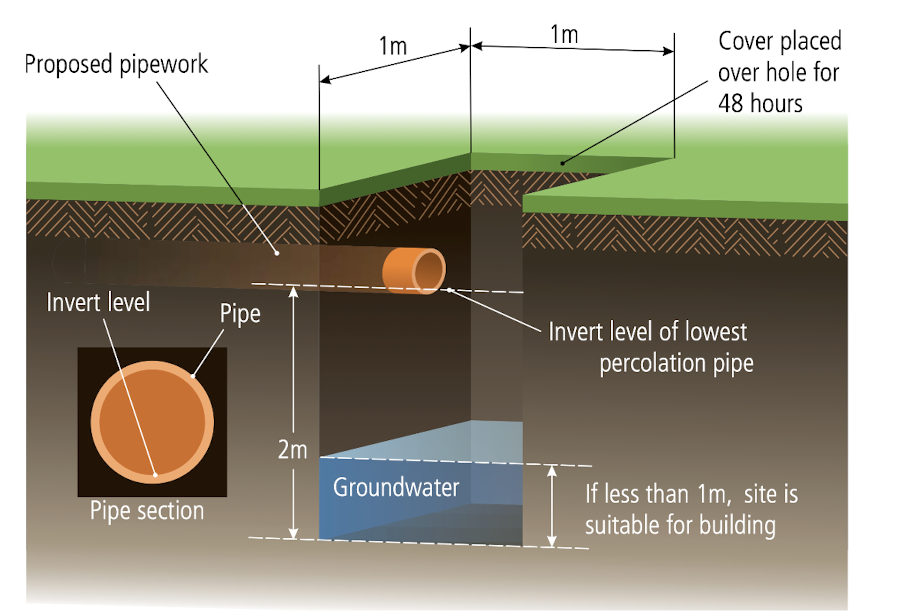
Discovering the site's groundwater level requires digging trial holes, providing essential information for construction planning. High water tables can cause flooding and excavation problems, making this assessment crucial.
Important
Water table levels fluctuate throughout the year, so timing of assessment matters. If water depth exceeds 1m, the site fails this test and is considered unsuitable for building.
The trial hole used for groundwater testing measures 1m square and extends 2m below the proposed invert level of percolation pipes. The invert level represents the horizontal measurement taken from the lowest part of a pipe in its installed position. After covering the trial hole for at least 48 hours, the water level is measured.
Percolation testing
Sites requiring septic tanks must undergo percolation testing to ensure proper wastewater treatment. This test measures how quickly soil allows liquid to philtre through, determining whether standard septic systems will function effectively.
Percolation test procedure
Example
Worked Example: Percolation Test Procedure
The test requires measuring tape, stopwatch, spade, and a large water supply. Follow these seven key steps:
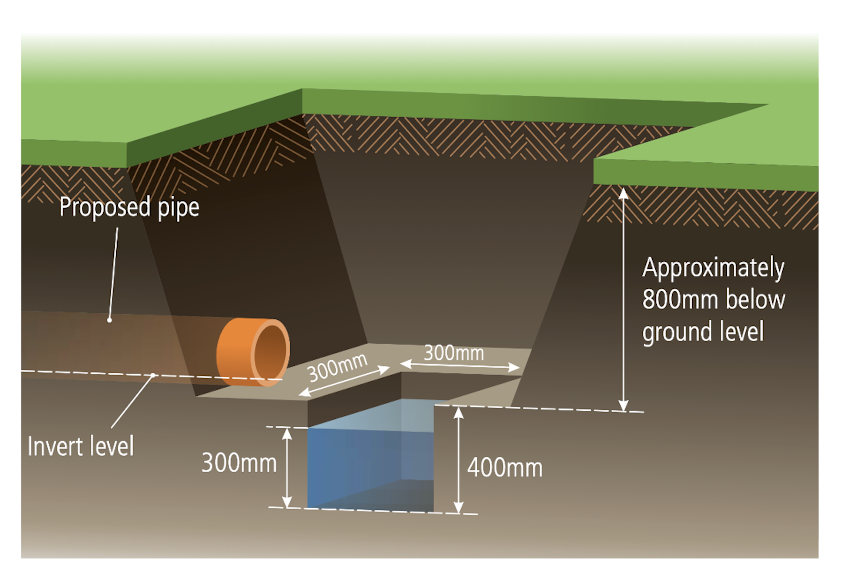
Step 1: At the bottom of the 2m deep trial hole, dig a 300mm square hole to 400mm depth, keeping the sides rough to expose natural soil surfaces.
Step 2: Fill the hole completely with water and allow seven hours for initial percolation. After this period, refill the hole and leave overnight.
Step 3: The following day, refill the hole with water at the same time as step 2.
Step 4: Wait for the water level to drop from 400mm to 300mm, then time how long it takes to drop from 300mm to 200mm using a stopwatch.
Step 5: Refill to 300mm depth and time the drop to 200mm again. Repeat this measurement three times total.
Step 6: Calculate the percolation value by averaging the three readings and dividing by four. This gives the time for water to drop 25mm.
Step 7: Repeat the entire procedure in a second percolation hole to verify results.
Test requirements and standards
Important
Critical Percolation Test Requirements:
- The test must take place over at least two days
- Minimum of two holes must be tested for accuracy
- To pass, the percolation value must fall between 5 and 60
- Values outside this range indicate site failure, requiring alternative waste disposal methods
Sites with percolation rates too fast or too slow cannot use standard septic tanks, and alternative wastewater treatment systems must be found to satisfy planning and environmental regulations.
Summary
Key Points to Remember:
- Professional soil investigation is essential before construction begins - it determines foundation types and building viability
- Trial holes (1m x 1m, 2.5-4m deep) reveal soil layers and composition across the entire site
- Bearing capacity measured in kN/m² indicates how much weight soil can support - under 150kN/m² means soil can be moulded by hand
- Percolation testing is required for septic tank installations - the value must fall between 5 and 60 to pass
- Groundwater levels above 1m depth make sites unsuitable for building - water tables fluctuate seasonally so timing matters