Sensors and Switches (Leaving Cert Engineering): Revision Notes
📚Revision Notes
Sensors and Switches
Sensors and switches are essential components in modern engineering systems, particularly in automation and control applications. Engineers must understand the different types available and their specific characteristics to select the most appropriate device for each application.
What are sensors and switches?
Sensors and switches are devices that detect changes in their environment and provide electrical signals or mechanical actions in response. They serve as the interface between the physical world and electronic control systems, allowing machines to respond to external conditions.
Note
The selection of the right sensor or switch depends on understanding the operating principles, strengths, and limitations of each type. Factors such as reliability, operating environment, and cost must all be considered when making engineering decisions.
Mechanical switches
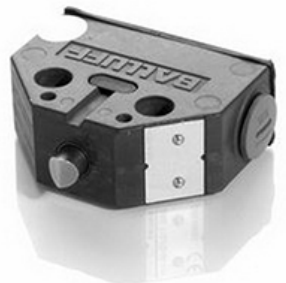
Mechanical switches are the most straightforward devices in this category. They function using a simple cam and plunger mechanism.
Operation principle
When the cam trips the plunger, a switch inside becomes activated. This activation can occur in two ways:
- Normally closed (NC): The switch moves from closed position to open
- Normally open (NO): The switch moves from open position to closed
Advantages of mechanical switches
Mechanical switches offer several important benefits:
- High temperature tolerance: They can operate in extreme temperature conditions
- High current ratings: Capable of handling heavy electrical loads
- Safety applications: In normally closed configuration, they provide "fail to safe" operation during power failures
- Simple design: No complex circuitry required
Important
In safety-critical applications, the "fail to safe" operation of normally closed mechanical switches is essential - if power fails, the system automatically moves to a safe state.
Disadvantages of mechanical switches
However, mechanical switches have notable limitations:
- Limited lifespan: Mechanical parts experience wear over time
- Larger size: Generally bigger than solid-state alternatives
- Dimensional constraints: May not fit applications with tight space requirements
Photoelectric sensors
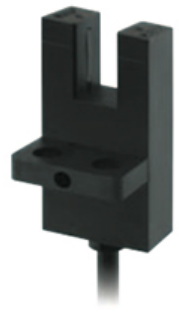
Photoelectric sensors, also called optical sensors, function by detecting changes in light intensity.
Through-beam mode operation
The most common operating mode for photoelectric sensors in linear actuator applications is through-beam mode. This system can be configured in two ways:
- Two-housing design: Separate housings for transmitter and receiver with a light beam between them
- Slotted housing design: Both transmitter and receiver contained in a single slotted housing
Note
The slotted type housing offers the advantage of requiring no alignment during installation, making it particularly useful for applications where precise positioning is difficult.
Advantages of photoelectric sensors
- Compact size: Smaller than many other sensor technologies
- Large sensing range: Good detection distance relative to their size
- Cost-effective: Benefit from mass production economies
- Wide applications: Used in both industrial and consumer devices (such as garage doors)
Disadvantages of photoelectric sensors
- Dust sensitivity: Performance can be affected by dust and debris interfering with light detection
- Environmental limitations: May require protective measures in harsh conditions
Proximity sensors
Proximity sensors operate by emitting an electromagnetic field and detecting the presence of a metal target within their sensing field.
Operation principle
These sensors work through non-contact operation, making them highly reliable and stable even in applications with shock loads and vibrations. The sensors are typically encapsulated in resin, providing protection against liquids, dirt, and other non-metallic particles.
Advantages of proximity sensors
- High reliability: Non-contact operation eliminates mechanical wear
- Stability: Consistent performance even with vibrations and shock loads
- Environmental resistance: Protected against liquids and contamination
- Versatile sizing: Available in various shapes, sizes, and detection distances
Important
Proximity sensors have a significant limitation: they typically have a sensing distance restricted to 50mm or less, and metallic debris can interfere with their operation.
Disadvantages of proximity sensors
- Metal target requirement: Only detect metallic objects
- Interference issues: Metallic debris can interfere with operation
- Limited sensing distance: Typically restricted to 50mm or less
Reed switches
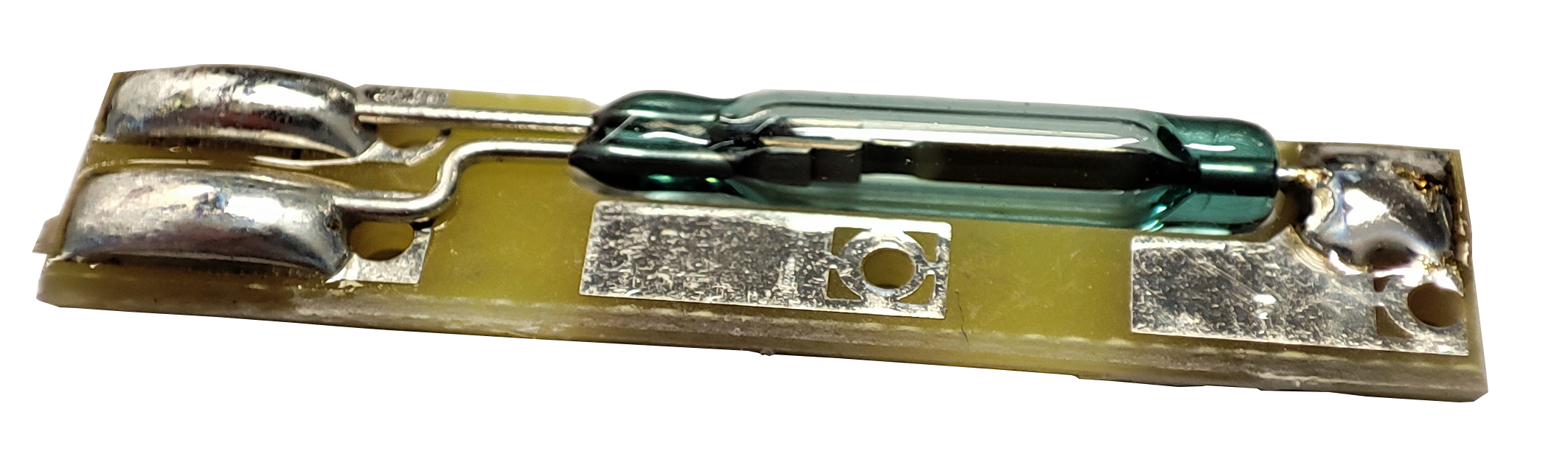
Reed switches operate similarly to mechanical switches but use magnetic activation instead of mechanical force.
Operation principle
Reed switches contain ferromagnetic contacts that open or close when a magnetic field is applied. Unlike mechanical switches that use cam and plunger activation, reed switches respond to magnetic fields.
Advantages of reed switches
- Lower current rating flexibility: Can operate with AC power
- Simple configuration: Two-wire setup possible
- Intrinsically safe: Suitable for hazardous environments due to hermetically sealed glass envelope
- No mechanical wear from activation: Magnetic operation reduces some wear issues
Disadvantages of reed switches
- Limited lifespan: Contact wear still occurs over time
- Magnetic field sensitivity: Can be disabled by strong external magnetic fields
Hall sensors
Hall sensors are solid-state devices that detect magnetic fields by varying their output voltage when a magnetic field perpendicular to the sensor is detected.
Operation principle
Hall sensors measure the Hall effect - the production of a voltage difference across an electrical conductor when a magnetic field is applied perpendicular to the current flow.
Advantages of Hall sensors
- Virtually infinite lifetime: No moving parts means minimal wear
- Solid-state reliability: Consistent electronic operation
- Precise detection: Accurate magnetic field measurement
Important
While Hall sensors offer virtually infinite lifetime, they are highly sensitive to temperature variations and electro-static discharge, which can limit their applications in certain environments.
Disadvantages of Hall sensors
- Temperature sensitivity: Limited operating temperature range
- ESD susceptibility: Sensitive to electro-static discharge
- Limited sensing distance: Must be positioned close to the actuator
- Mounting considerations: Distance limitations must be accounted for during installation
Selection considerations for engineering applications
When choosing sensors and switches for engineering applications, several factors must be evaluated to ensure optimal performance and reliability.
Primary considerations
The key function of any sensor selection process involves balancing three critical factors:
- Reliability requirements: Match sensor reliability to application criticality
- Operating environment: Consider temperature, contamination, and vibration levels
- Performance vs cost: Balance technical requirements against budget constraints
Note
Industry Expert Advice: "Look first at reliability for the application and the operating environment. Then weigh performance against cost." This approach ensures that the selected sensor or switch will perform reliably while meeting economic constraints.
Application-specific factors
- Detection requirements: What needs to be sensed (position, presence, etc.)
- Environmental conditions: Temperature, humidity, contamination levels
- Safety requirements: Whether fail-safe operation is needed
- Dimensional constraints: Available mounting space
- Electrical requirements: Current handling, voltage levels, power consumption
Remember!
Summary
Key Points to Remember:
-
Mechanical switches use cam and plunger mechanisms and are best for high-temperature, heavy-load applications despite their limited lifespan
-
Photoelectric sensors detect light changes using through-beam mode and are compact but sensitive to dust and debris
-
Proximity sensors use electromagnetic fields to detect metal targets reliably but have limited sensing distance (typically 50mm or less)
-
Reed switches are magnetically activated and suitable for intrinsically safe applications but can be affected by strong magnetic fields
-
Hall sensors are solid-state devices with virtually infinite lifetime but are sensitive to temperature and electro-static discharge
-
Selection priority: Always consider reliability first, then operating environment, and finally balance performance against cost