Power Control (Leaving Cert Engineering): Revision Notes
📚Revision Notes
DC Rectifier
What is power control in welding?
Welding processes require specific types of electrical power to work effectively. Mains electricity is supplied as 230V Alternating Current (AC), but this high voltage can be dangerous and unsuitable for many welding applications. The voltage needs to be reduced and the current type may need to be changed to provide the right power for different welding processes.
Note
The high voltage of mains electricity (230V) poses safety risks and is not suitable for direct use in welding applications. Power control systems are essential for converting this electricity into safe, usable power for welding.
What is a DC rectifier?
A DC rectifier is an electrical system that converts Alternating Current (AC) into Direct Current (DC). While AC constantly changes direction (creating a wave pattern that goes positive and negative), DC flows in one constant direction, providing steady power.
Some welding processes, particularly MIG welding, require DC power rather than AC. This is where a full wave rectifier becomes essential in the welding power supply system.
Note
Understanding the difference: AC power alternates direction 50-60 times per second, creating an unstable arc. DC power flows consistently in one direction, providing the stable arc needed for precision welding processes.
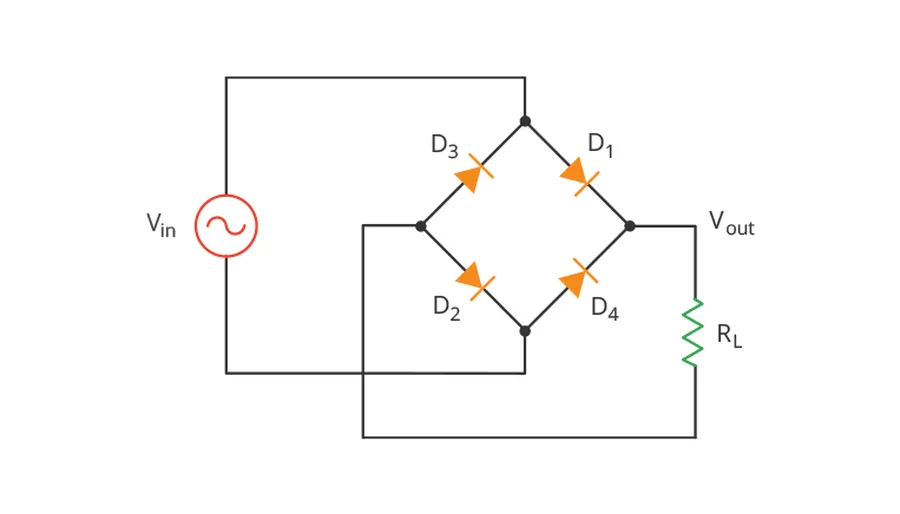
How does a DC rectifier work?
A DC rectifier system operates through three main stages, each with a specific function:
Stage A - voltage reduction
The first stage uses a step-down transformer to reduce the high AC voltage from the mains supply and increase the available current. This makes the power safer to work with and more suitable for welding applications.
Stage B - current direction control
The second stage uses diodes - electronic components that only allow electricity to flow in one direction. These diodes are arranged in a ring formation around the circuit. This arrangement removes the negative portions of the AC cycle, converting the alternating current into pulsing direct current.
Stage C - current smoothing
The final stage uses a capacitor to smooth out the pulsing DC. The capacitor stores electrical charge during the peak moments and releases this stored charge during the lower moments. This creates a steady, reliable supply of Direct Current suitable for welding.
Example
Worked Example: Three-Stage Process
Stage A: 230V AC → Step-down transformer → 110V AC (safer voltage, higher current)
Stage B: 110V AC → Diodes → Pulsing DC (negative portions removed)
Stage C: Pulsing DC → Capacitor → Smooth DC (steady current flow)
Why do we need DC rectifiers in welding?
DC power provides several advantages for certain welding processes:
- Consistent arc stability - DC maintains a steady arc without the fluctuations that can occur with AC
- Better control - The constant current flow allows for more precise welding control
- Suitable for MIG welding - MIG welding specifically requires DC power to function properly
- Improved weld quality - The steady power supply helps produce more consistent, higher-quality welds
Important
Critical for MIG welding: MIG welding cannot function properly with AC power. The process requires the consistent, directional flow that only DC can provide. Using AC would result in poor arc stability and weld quality.
Applications in welding
DC rectifiers are essential components in:
- MIG welding equipment - where DC power is mandatory for proper operation
- TIG welding on certain materials - where DC provides better arc characteristics
- Professional welding stations - where consistent, high-quality power is required
Note
Industry standard: Most modern professional welding equipment incorporates DC rectifier systems, even when AC welding is also available, because of the superior control and consistency DC provides.
Summary
Key Points to Remember:
- DC rectifiers convert AC mains power into steady DC power needed for specific welding processes
- The system works in three stages: A (transformer reduces voltage), B (diodes control current direction), C (capacitor smooths the output)
- MIG welding specifically requires DC power, making rectifiers essential for this process
- Diodes only allow current to flow in one direction, removing the negative portions of AC waves
- Capacitors store and release charge to create smooth, steady DC output from pulsing current