Tool Height (Leaving Cert Engineering): Revision Notes
📚Revision Notes
Tool Height
What is tool height?
Tool height refers to the vertical position of the cutting tool relative to the centre line of the workpiece in turning operations. The height at which you set your cutting tool has a massive impact on the cutting performance, tool life, and quality of the finished workpiece.
Important
Getting the tool height right is one of the most fundamental aspects of successful turning. Even small variations from the optimal height can cause significant problems with your machining operation.
Tool on centre
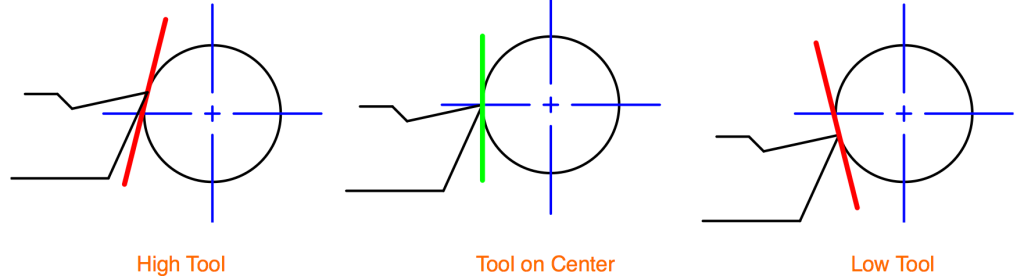
When the cutting tool is positioned on centre, the tip of the cutting tool aligns perfectly with the centre line of the workpiece. This is the optimal position for most turning operations.
Note
At this ideal height, the tool operates exactly as the manufacturer designed it, with all cutting angles working in perfect harmony to deliver optimal performance.
At this ideal height, several important things happen:
- The rake angle is set to its designed value, which determines how sharp the cutting action will be
- The clearance angle provides the right amount of space behind the cutting edge to prevent rubbing
- Only the cutting edge makes contact with the workpiece, reducing friction
- Tool wear is minimised because the cutting forces are distributed properly
- The cutting action operates at maximum efficiency
This centre position gives you the best balance between tool sharpness and tool strength, resulting in clean cuts and longer tool life.
Tool below centre
When the cutting tool sits below centre, several problems occur that negatively affect the machining process.
The most significant issue is that the rake angle becomes reduced. This makes the cutting action much less sharp and increases the cutting forces required. The tool essentially has to "push" through the material rather than slice through it cleanly.
At the same time, the clearance angle increases beyond what's needed. While this might seem like it would help, it actually weakens the tool tip and makes it more prone to breaking under cutting loads.
Key problems with tool below centre:
- Reduced cutting efficiency due to blunt cutting action
- Weaker tool tip that's more likely to chip or break
- Facing operations become impossible to perform properly
- A dimple will be left on the face of the workpiece during facing
- Poor surface finish on turned surfaces
Important
Critical Issue with Facing Operations
When the tool is below centre, facing operations cannot be performed properly. The geometry will always leave a dimple in the centre of the faced surface, making it impossible to achieve a flat finish.
Tool above centre
Setting the cutting tool above centre creates a different set of problems that can be even more damaging to your equipment.
When positioned too high, the rake angle increases, which would normally make the tool sharper. However, this advantage is completely lost because the tool tip is no longer in proper contact with the workpiece.
The clearance angle becomes reduced and may be eliminated entirely if the tool is raised high enough. This causes the tool to rub against the workpiece rather than cut cleanly.
Major issues with tool above centre:
- Massive increase in friction between tool and workpiece
- Excessive heat generation that can damage both tool and workpiece
- Rapid tool wear due to rubbing rather than cutting
- Poor surface finish and dimensional accuracy
- Potential damage to the laith itself due to excessive cutting forces
Important
AVOID THIS SETUP AT ALL COSTS
Tool above centre creates dangerous conditions with excessive friction and heat. This type of setup must be avoided in all machining operations as it can damage both your tooling and your machine.
Why correct tool height matters
Proper tool height is essential because it ensures that your cutting tool works as it was designed to. Tool manufacturers carefully engineer the rake and clearance angles to provide optimal cutting performance, but these angles only work correctly when the tool is positioned at the right height.
Note
Manufacturer Engineering
Tool manufacturers spend considerable time and resources engineering the perfect rake and clearance angles for their cutting tools. These carefully calculated angles only deliver their intended performance when the tool is positioned correctly at centre height.
Incorrect tool height doesn't just affect the current job - it can lead to:
- Premature tool failure and increased tooling costs
- Poor surface finish requiring additional operations
- Dimensional inaccuracy in finished parts
- Increased power consumption and machine wear
- Safety risks from tool breakage or excessive cutting forces
Summary
Key Points to Remember:
- Tool on centre is optimal - this gives the best balance of cutting performance and tool life
- Tool below centre makes cutting blunt - reduces rake angle and weakens the tool tip
- Tool above centre causes friction and wear - eliminates clearance and creates excessive heat
- Always check tool height before starting any turning operation
- Proper tool height ensures rake and clearance angles work as designed by the tool manufacturer