Electric Arc Welding (Leaving Cert Engineering): Revision Notes
📚Revision Notes
Metal Inert Gas Welding (M.I.G)
What is MIG welding?
Metal Inert Gas (MIG) welding is a semi-automatic welding process that uses an electric arc to join metals. The process operates on similar principles to Manual Metal Arc (MMA) welding, but offers several advantages that make it faster and easier to use.
The key characteristic of MIG welding is that it uses a consumable electrode in the form of a continuous wire that is automatically fed from a reel. This eliminates the need to stop and change electrodes frequently, making the process much more efficient than traditional stick welding methods.
Note
The main advantage of MIG welding over MMA welding is its continuous wire feed system. While MMA welding requires frequent stops to replace consumed electrodes, MIG welding allows for uninterrupted welding over longer periods, significantly increasing productivity.
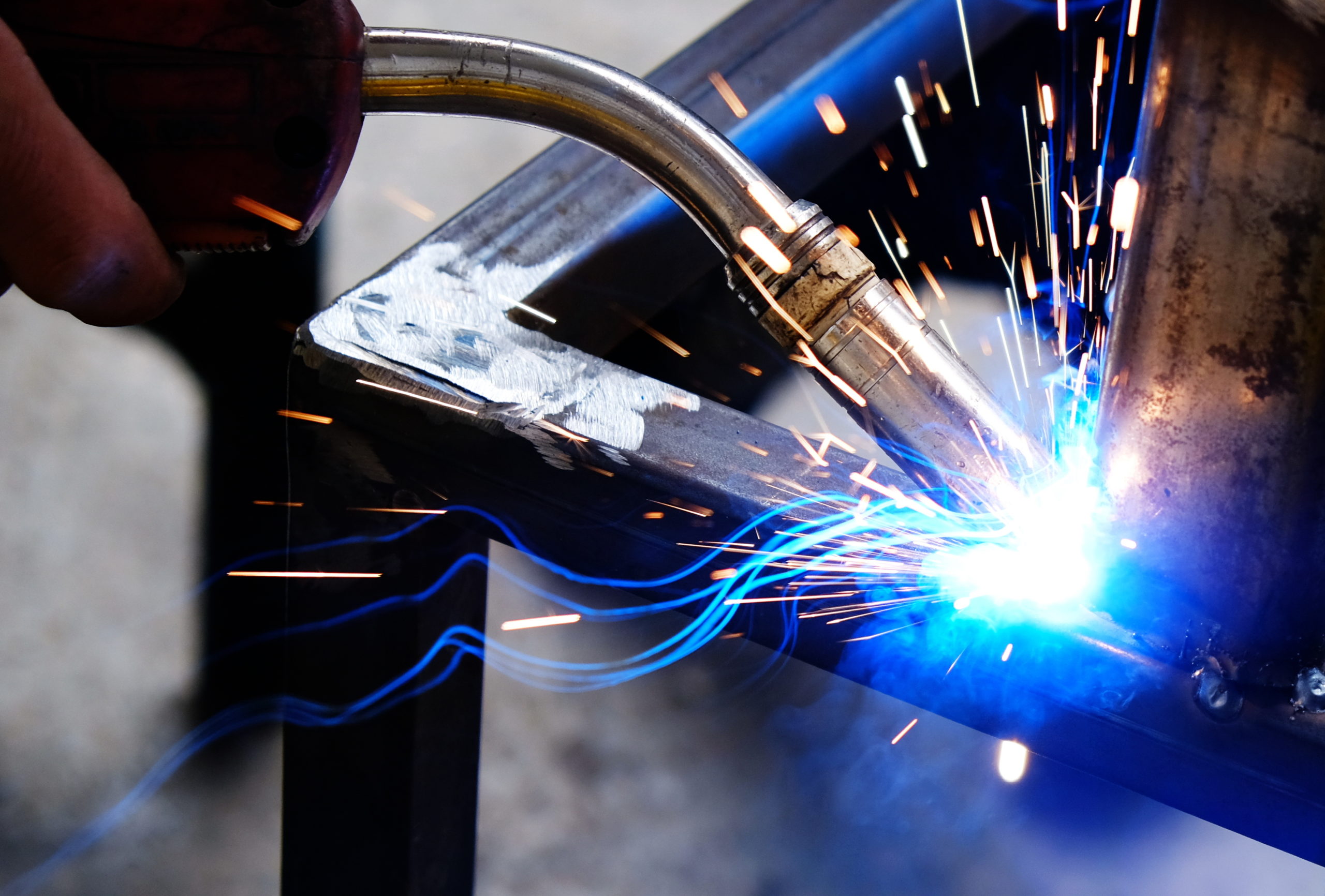
How MIG welding works
MIG welding starts with a direct current (DC) power supply, which makes the welding process easier to control and more stable. The welding current travels through a consumable electrode wire that is continuously fed from a spool by a motor and trigger system on the welding gun.
Unlike MMA welding electrodes, the welding electrode has no flux coating. Instead, protection from atmospheric contamination comes from a separate gas shielding system. This gas shield is supplied through the welding gun from a gas cylinder, typically containing CO₂ or Argon because these are non-reactive gases that won't interfere with the welding process.
Important
The absence of flux coating on MIG electrodes is crucial to understand. Without the separate gas shielding system, the weld would be contaminated by oxygen and nitrogen from the atmosphere, resulting in poor quality joints with porosity and weakness.
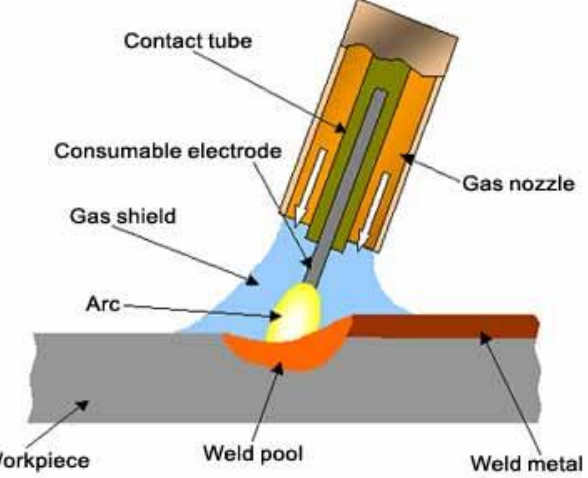
Key components of MIG welding equipment
The MIG welding system consists of several essential components working together:
- Power source unit: Provides the DC electrical supply for creating the arc
- Wire electrode supply: A spool system that continuously feeds consumable wire electrode
- Welding gun/torch: Contains the contact tube, gas nozzle, and trigger controls
- Contact tube: Conducts electrical current to the wire electrode
- Gas nozzle: Directs the protective gas around the weld area
- Shielding gas supply: Cylinder with regulator and flowmeter to control gas flow
- Cable assembly: Carries power, wire, and gas to the welding torch
- Work return/earth connection: Completes the electrical circuit through the workpiece
Note
All these components must work in perfect coordination for successful MIG welding. The wire feed rate, gas flow rate, and electrical current must be properly balanced to achieve optimal weld quality and penetration.
Process advantages and applications
The semi-automatic nature of MIG welding means that a motor and trigger on the gun control the wire feed to the weld pool. This makes the process much quicker and easier compared to manual methods, as the welder doesn't need to manually feed rod or constantly replace consumed electrodes.
MIG welding is particularly effective for working on mild steel and offers significant advantages for lighter applications such as car panel assembly. In these situations, MMA welding would tend to burn holes in the thinner gauge materials, making MIG the preferred choice for precision work on delicate components.
Note
The controlled heat input of MIG welding makes it ideal for automotive repair work and sheet metal fabrication. The process allows welders to work on materials as thin as 0.8mm without burn-through, which would be nearly impossible with traditional stick welding methods.
Summary
Key Points to Remember:
- MIG welding is semi-automatic - the wire feed is controlled by a motor, making it faster than manual processes
- Uses DC power supply - this makes welding easier and more controllable than AC systems
- No flux coating on electrode - protection comes from separate gas shielding instead of flux
- CO₂ and Argon are the main shielding gases - these non-reactive gases protect the weld from contamination
- Ideal for thin materials - particularly useful for car panels and light fabrication work where MMA would burn through