Manual Metal Arc M.M.A (Leaving Cert Engineering): Revision Notes
📚Revision Notes
Manual Metal Arc (M.M.A) Welding
What is electric arc welding?
Electric arc welding is a fundamental metalworking process that uses electricity to create the intense heat needed for joining metals. The process works when electricity jumps across a small gap, creating a spark called an electric arc. This arc generates temperatures high enough to melt steel, allowing pieces to be permanently joined together.
Note
The electric arc can reach temperatures of over 3,000°C (5,400°F), making it one of the most effective methods for melting and fusing metals. This extreme heat is what makes arc welding so versatile and widely used in industry.
There are several types of arc welding available today, ranging from manual processes requiring high skill levels to fully automatic systems used in mass production environments.
Manual Metal Arc (MMA) welding
Manual Metal Arc welding represents the most basic and widely used type of electric arc welding. It's a skilled manual process that works particularly well for welding mild steel plates and is commonly used in forge work and garage applications. The technique requires significant operator skill but offers excellent versatility and portability.
Equipment and setup
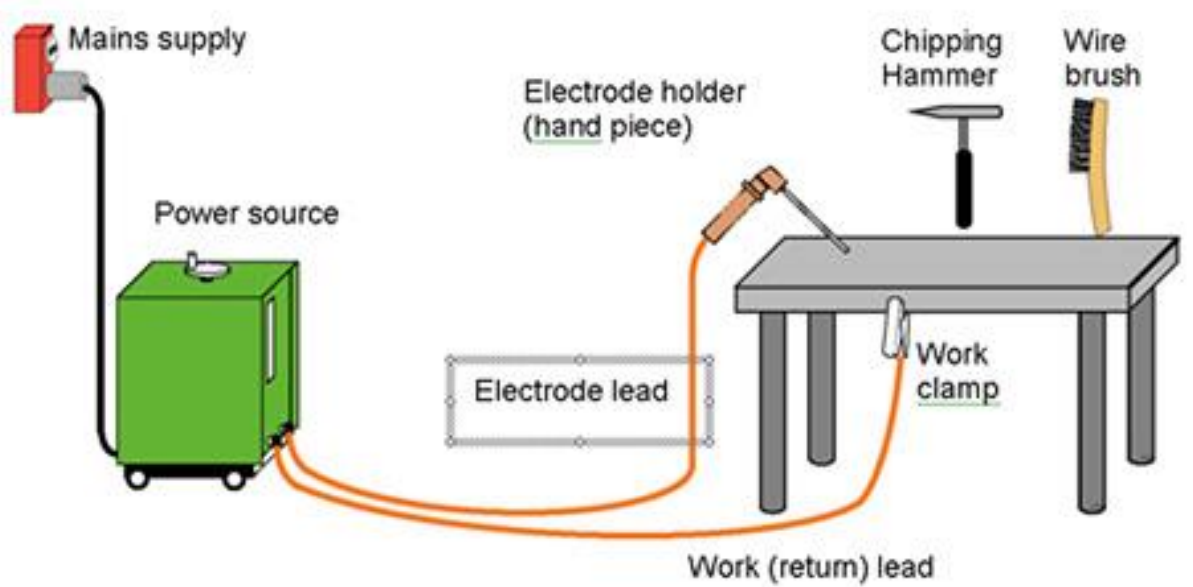
The MMA welding system requires several key components working together to create a complete electrical circuit. Understanding each component's role is essential for safe and effective welding.
Important
Complete Circuit Requirement
All components must be properly connected to create a complete electrical circuit. If any component is missing or poorly connected, no current will flow and welding cannot occur. This is a common troubleshooting point for beginners.
The main components include:
- Power source - A transformer that connects to the mains electrical supply and reduces the standard to a safer working voltage of approximately
- Electrode lead - Carries current from the power source to the welding electrode
- Electrode holder - Hand-held piece that grips the electrode and allows the welder to control its position
- Work clamp - Attaches to the workpiece to complete the electrical circuit
- Work return lead - Carries current back from the workpiece to the power source
- Chipping hammer - Used to remove slag after welding
- Wire brush - Used for cleaning the weld area
Note
The voltage reduction from to is crucial for both safety and weld quality. Lower voltages are safer for operators while still providing sufficient power to maintain a stable arc and achieve proper penetration in the base metal.
The welding process
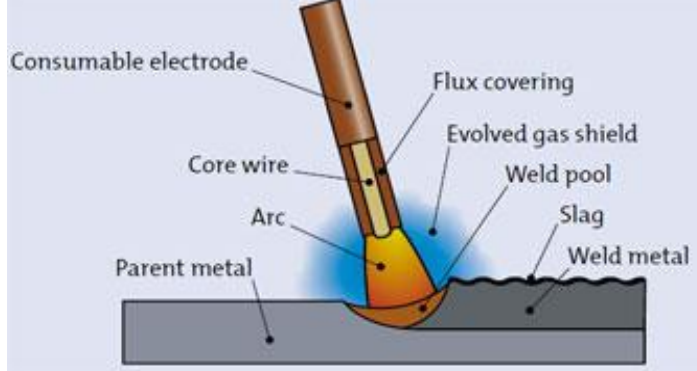
The MMA welding process involves several interconnected stages that work together to create a strong, clean weld. Understanding each stage helps welders control the process effectively.
Example
Step-by-Step MMA Welding Process
Step 1: Arc Initiation The electrode is brought close to the workpiece until an electric arc forms between them.
Step 2: Heat Generation The arc provides intense heat (over 3,000°C) to melt both the work material and the electrode.
Step 3: Protective Action As the electrode is consumed, the flux coating vaporises and creates a protective gas shield around the weld pool.
Step 4: Slag Formation The flux coating solidifies to form a protective slag layer over the cooling weld.
Step 5: Weld Completion The operator moves the electrode to create the desired weld shape, then allows cooling before slag removal.
The electrode is a specially designed metal rod covered with a chemical powder coating called flux. This flux coating is not just a simple covering - it performs multiple critical functions that ensure weld quality and integrity.
Flux coating functions: As the electrode is consumed during welding, the flux coating vaporises and creates a protective gas shield around the weld pool. This shield is essential because it prevents atmospheric contamination and stops air bubbles (porosity) from forming inside the weld, which would weaken the joint.
Slag formation: The flux coating also solidifies to form a protective coating over the weld called slag. This slag layer serves an important metallurgical function by helping the weld cool slowly and preventing it from becoming brittle. However, the slag must be completely chipped away afterwards using a chipping hammer to prepare for subsequent weld passes or finishing operations.
Operator control: The welder moves the electrode in the required direction to create the weld. Both the ground clamp and return lead are essential to complete the electrical circuit - without them, no current would flow and welding would be impossible.
Safety features for MMA welding
Electrical safety is paramount in MMA welding due to the combination of high currents and potentially hazardous working environments. Multiple safety systems work together to protect operators.
Important
Critical Safety Requirements
MMA welding involves potentially lethal electrical currents. Even the reduced working voltage of 80-100V can be dangerous, especially in damp conditions. All safety measures must be strictly followed - there are no acceptable shortcuts when it comes to electrical safety in welding.
Several important safety measures protect welders from electrical hazards:
- Surge protection - MMA welding machines include built-in protection from electrical surges that could damage equipment or harm operators
- Dry conditions - Welding stations must be kept completely free from dampness to prevent electrical accidents and shock hazards
- Insulation - All cables and electrode holders are covered with high-quality plastic insulators rated for welding applications
- Earthing - Welding machines must be properly earthed according to electrical safety standards
- Adjustable power - Power levels can be precisely adjusted to appropriate settings for different welding tasks and material thicknesses
Applications
MMA welding has proven particularly suitable for a wide range of applications where versatility and portability are key requirements:
- Welding mild steel plate in various thicknesses
- Forge work and blacksmithing applications
- Garage repairs and small-scale fabrication projects
- General metalwork where equipment portability is important
- Field repairs where other welding processes may not be practical
The process is highly valued for its simplicity, portability, and effectiveness on thicker materials, making it an essential skill for many engineering and fabrication applications.
Summary
Key Points to Remember:
- Electric arc welding uses electricity jumping across a gap to create heat for melting steel at temperatures exceeding 3,000°C
- MMA welding is the most basic type of arc welding, using a flux-coated consumable electrode that serves multiple functions
- The complete circuit must include power source, electrode lead, electrode, workpiece, work clamp, and return lead - all components are essential
- Flux coating serves two critical purposes: creates protective gas shield during welding and forms protective slag coating afterwards
- Safety is crucial - always ensure dry conditions, proper earthing, adequate insulation, and follow all electrical safety procedures