The Volunteers and Irish Citizen Army (Leaving Cert History): Revision Notes
📚Revision Notes
The Volunteers and Irish Citizen Army
The Irish Volunteers
- The Irish Volunteers were a nationalist paramilitary organisation formed in November 1913 in response to the growing Unionist opposition to Home Rule and the establishment of the Ulster Volunteer Force (UVF).
- The Volunteers were created to ensure that Home Rule would be implemented and to defend Irish nationalist interests against the threat of Unionist violence and British military intervention. The organisation quickly became a focal point for nationalist sentiment, drawing members from a broad spectrum of Irish society.
- The Irish Republican Brotherhood (IRB), a secret revolutionary organisation, played a crucial role in the foundation of the Irish Volunteers.
- However, the Volunteers initially attracted a wide range of supporters, including moderate nationalists who saw them as a necessary defence force and more radical elements who viewed the Volunteers as a potential army for Irish independence.
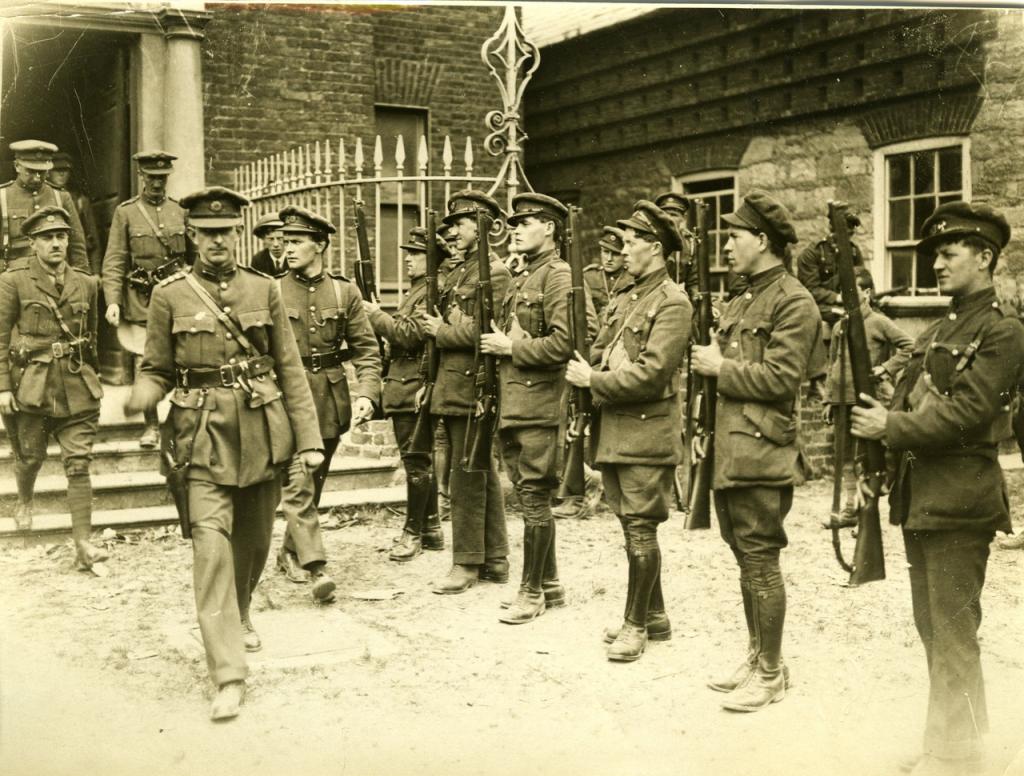
- Leadership of the Volunteers was initially in the hands of Eoin MacNeill, a respected academic and historian, who believed that the Volunteers should serve as a defensive force rather than an aggressive one.
- MacNeill's vision for the organisation was that it would only take up arms if Home Rule was blocked or if Unionists or the British government attempted to impose their will on nationalist Ireland by force.
- This approach helped the Volunteers gain broad support, including from members of the Irish Parliamentary Party (IPP), led by John Redmond.
- However, the Volunteers were deeply divided over the issue of supporting Britain during World War I. Redmond, who saw Irish participation in the war as a way to secure Home Rule, called on the Volunteers to enlist in the British Army.
- This led to a split in the organisation in September 1914. The majority of the Volunteers, about 150,000 to 170,000 men, followed Redmond and became known as the National Volunteers.
- They supported the war effort and aligned themselves with the British government, believing that this would lead to the implementation of Home Rule after the war.
- A smaller but significant faction of around 9,500 to 11,000 men rejected Redmond's call and retained the name Irish Volunteers.
- This group, led by MacNeill and heavily influenced by the IRB, refused to support the war and took a more radical stance.
- They believed that Ireland's future lay in achieving full independence from Britain, and they were determined to keep the Volunteers focused on that goal.
- This radical faction of the Irish Volunteers would go on to play a central role in the Easter Rising of 1916, an armed insurrection aimed at establishing an independent Irish Republic.
- Although the Rising was initially unsuccessful, the participation of the Volunteers in the rebellion cemented their place in Irish history as key players in the struggle for independence.
- The organisation continued to be a significant force in Irish nationalist politics, ultimately merging with other groups to form the nucleus of the Irish Republican Army (IRA) during the Irish War of Independence.
The Irish Citizen Army
-
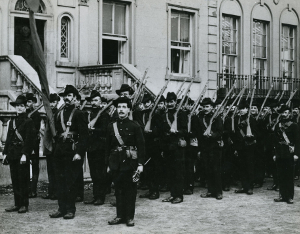
The Irish Citizen Army (ICA) was a small but highly influential socialist paramilitary organisation formed in 1913 by James Connolly and other leaders of the Irish labour movement.
-
The ICA was originally established to protect workers from police brutality during the Dublin Lockout, a major industrial dispute that saw thousands of workers striking for better conditions and rights.
-
The brutal treatment of strikers by the police highlighted the need for a protective force, leading to the formation of the ICA.
-
Under Connolly's leadership, the Irish Citizen Army developed into a disciplined and ideologically driven force dedicated to both national independence and the social and economic rights of the working class.
-
Connolly, a Marxist thinker and labour leader, envisioned the ICA not just as a paramilitary organisation but as a revolutionary army that would fight for a socialist Ireland free from both British rule and capitalist exploitation.
-
This dual focus on nationalism and socialism set the ICA apart from other nationalist groups of the time, which primarily focused on political independence.
-
The ICA was unique in its commitment to gender equality. Women played a prominent role in the organisation, with figures like Constance Markievicz serving as officers and participating actively in military drills and operations.
-
The ICA also emphasised the importance of class solidarity, seeking to unite workers across religious and political divides in the fight for a fairer and more just society.
-
Although the ICA was much smaller than the Irish Volunteers, with membership never exceeding a few hundred, its influence was significant.
-
The ICA trained its members in military tactics and was well-prepared for armed conflict. Its commitment to social justice and labour rights made it an attractive option for those disillusioned with other groups' purely nationalist focus.
-
The ICA's emphasis on worker solidarity and social equality attracted members deeply committed to creating a more just and equitable society in Ireland beyond simply achieving political independence.
-
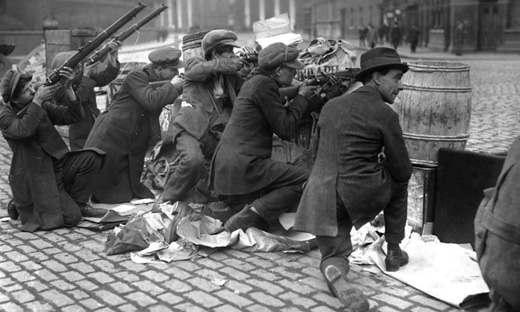
The Irish Citizen Army played a crucial role in the Easter Rising of 1916. James Connolly, who had become a key figure in the planning of the Rising, believed that Ireland's independence struggle could not be separated from the struggle for workers' rights.
-
He argued that an independent Ireland without social and economic justice for its citizens would be meaningless.
-
Connolly and the ICA took a leading role in the Rising, with ICA members among the first to seize key buildings in Dublin, including the General Post Office (GPO), which served as the headquarters for the rebellion.
-
Their determination and discipline marked the ICA's participation in the Easter Rising. Despite being outnumbered and outgunned, the Citizen Army fought bravely alongside the Irish Volunteers.
-
Connolly, who was severely wounded during the fighting, remained at his post, directing operations until the end. British forces ultimately suppressed the Rising, and many of its leaders, including Connolly, were executed.
-
Connolly's execution, particularly because he was so gravely injured that he had to be shot while sitting in a chair, had a profound impact on public opinion in Ireland and helped to galvanise support for the cause of independence.
-
The legacy of the Irish Citizen Army extends beyond their military role in the Easter Rising. The ICA left a lasting impression as a symbol of the struggle for both national independence and social justice.
-
Their vision of an Ireland where political freedom was accompanied by economic and social rights for all citizens continues to resonate in Irish history.
-
Although the ICA was eventually absorbed into other nationalist movements, their commitment to workers' rights and their pioneering stance on gender equality remain significant aspects of their legacy.