Containment: A Success? (Leaving Cert History): Revision Notes
📚Revision Notes
Containment: A Success?
End of the Cold War
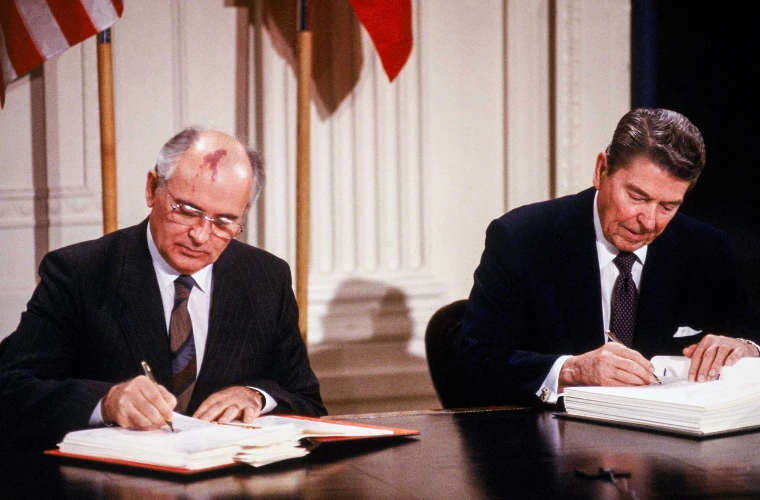
Reagan left office in 1989, leaving tensions significantly reduced between the US and the USSR. Gorbachev's reforms of the USSR continued. These reforms failed to restore the economy but they did allow people to voice their anger and frustration at the Soviet system. Gorbachev refused to use the Soviet army to keep communist governments in power in Eastern Europe when widespread protests began in 1989.
Across Eastern Europe, communist governments fell as their people rose in largely peaceful revolutions that ended all the communist governments in less than one year. On 9 November 1989 the Berlin Wall fell, symbolically ending the Cold War. On Christmas Day 1991, Gorbachev resigned as President of the USSR, and the Soviet Union ceased to exist.
Assessing Containment: Did the US Win the Cold War?
At the end of the Cold War, the US was the world's only superpower: the USSR had been consigned to history. If victory is survival, then it could be said that the US 'won' the Cold War. But does it follow that containment, as a policy, worked? The network of alliances, the financial and military aid to friendly nations, and military interventions were successful in limiting the spread of communism to some extent. In Western Europe, most of South America and parts of Asia and Africa, attempts by communist groups to take over states were prevented.
However, the US also had significant failures, most spectacularly in Vietnam. And the ways in which containment was implemented, particularly in support of dictatorial regimes, made communists and their allies more attractive to ordinary people in the developing world. According to historian Raymond L. Garthoff in The Great Transition, 'what containment did do was to successfully preclude any temptation by Moscow to advance Soviet hegemony by military means'.
In the competition between the superpowers, containment did contribute to the downfall of the Soviet Union. The huge expenditures on defence made by the USSR throughout the Cold War (in order to keep up with the US) were a factor in making worse the problems inherent in the Soviet system, government, and society. The Soviet Union was economically inefficient: it failed to provide an adequate standard of living for its people and it repressed them to such an extent that it lost its right to govern.
In spending vast amounts of money on the Cold War, the USSR was unable to spend the money needed to address its own problems. The failure of Gorbachev's radical reforms in the 1980s was the ultimate reason for the end of the Cold War, but the constant pressure from the US was a significant factor in forcing the Soviets to embark on such a radical course in the first place.