Large Fungi (Leaving Cert Home Economics): Revision Notes
📚Revision Notes
Large Fungi
What are basidiomycetes?
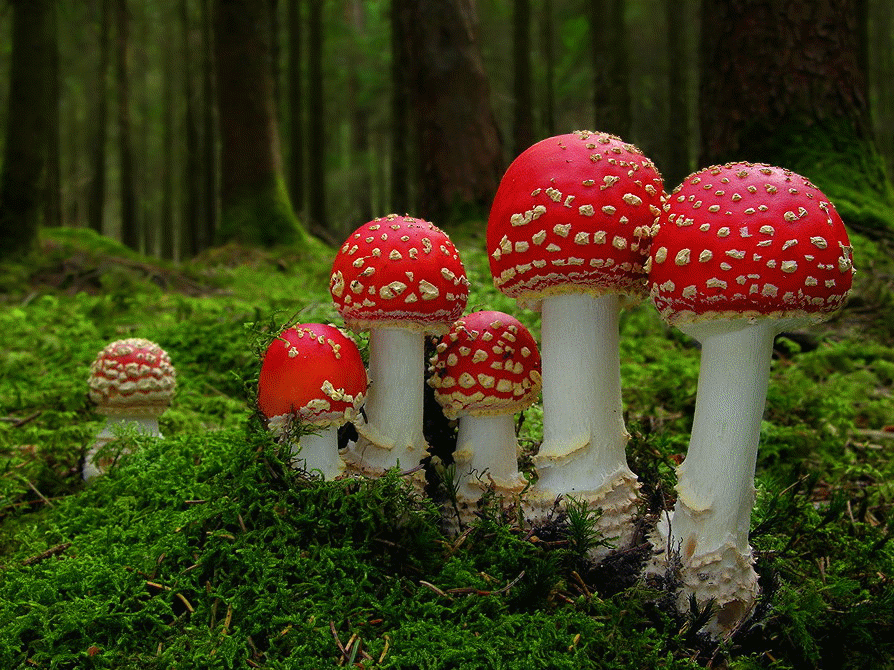
Basidiomycetes represent a major class of fungi that includes many familiar organisms we encounter in everyday life. These fascinating organisms encompass the common mushrooms we see in shops and forests, as well as toadstools, puffballs, and shelf fungi that grow on tree trunks.
Important
Basidiomycetes are a diverse group of fungi characterised by their unique reproductive structures called basidia, which produce spores for reproduction.
These organisms thrive in various environments and play crucial ecological roles. Most basidiomycetes are found growing in soil or on decaying organic matter such as fallen logs and dead wood. They act as decomposers, breaking down dead organic material and recycling nutrients back into the ecosystem.
Note
Human Significance Many species are edible and valued in cooking, whilst others are poisonous and must be avoided. This makes proper identification crucial for foragers and mycologists.
The fascinating lifecycle of mushroom reproduction
Understanding how mushrooms reproduce involves following a complex but fascinating lifecycle that alternates between different phases. This process demonstrates the remarkable adaptability of fungi and their sophisticated reproductive strategies.
Lifecycle phases
Mushroom reproduction involves both diploid phases (containing two sets of chromosomes) and haploid phases (containing one set of chromosomes). The complete lifecycle includes five main stages: spore germination, mycelium formation, mushroom development, spore production, and spore release.
Stage 1: Spore germination
The reproductive cycle begins when mature mushrooms release tiny haploid spores into the environment. When these spores land in suitable conditions with adequate moisture, nutrients, and temperature, they begin to germinate.
During germination, each spore develops into thread-like structures called haploid hyphae. These microscopic threads represent the first growth stage and contain only one set of genetic material.
Stage 2: Mycelium formation
A critical step occurs when haploid hyphae from different genetic backgrounds encounter each other. These compatible hyphae can fuse together in a process called hyphal fusion.
Example
Mycelium Formation Process
When fusion occurs, it creates a dikaryotic mycelium - a network of cells where each cell contains two genetically distinct nuclei. This mycelium spreads extensively underground or within the food source, absorbing nutrients and growing larger over time.
Stage 3: Mushroom development
Under favourable environmental conditions, the dikaryotic mycelium undergoes a remarkable transformation. It develops a fruiting body - the mushroom structure we can see above ground.
The mushroom consists of two main parts:
- Cap: The umbrella-shaped top portion
- Stalk: The supporting stem structure
Beneath the cap, specialised structures develop:
- Gills (in many mushroom species) or tubes (in others) where spore production occurs
Stage 4: Spore production
Within the gills or tubes, microscopic structures called basidia form. Each basidium represents a specialised reproductive cell where the magic of spore formation happens.
Example
Meiosis and Spore Formation
Inside each basidium, meiosis occurs - a type of cell division that reduces the chromosome number from diploid back to haploid. This process typically produces four haploid spores per basidium, each genetically unique.
Stage 5: Spore release and dispersal
Once mature, the spores are forcibly ejected from the basidia and released from the mushroom. Various mechanisms aid in spore dispersal:
- Wind carries spores to new locations
- Air currents help distribute spores over wide areas
- Animals may inadvertently transport spores
When spores land in suitable environments, they germinate and begin the cycle anew, establishing new mushroom colonies.
Key structures and their functions
Mycelium networks
The mycelium forms the main body of the fungus, often compared to the root system of plants. Unlike plant roots, mycelium actively digests and absorbs nutrients from surrounding organic matter, making fungi essential decomposers in ecosystems.
Note
Mycelium networks can extend over vast areas underground, sometimes spanning several acres and representing some of the largest living organisms on Earth.
Basidia importance
Basidia serve as the reproductive powerhouses of mushrooms. These club-shaped structures are found on the gills or in the tubes beneath mushroom caps. Their primary function is to undergo meiosis and produce the haploid spores necessary for reproduction and genetic diversity.
Summary
Key Points to Remember:
- Basidiomycetes include familiar mushrooms, toadstools, and puffballs that reproduce through complex lifecycles
- The lifecycle alternates between haploid and diploid phases, beginning with spore germination and ending with spore release
- Dikaryotic mycelium forms when compatible haploid hyphae fuse, creating cells with two distinct nuclei
- Basidia are specialised structures where meiosis occurs, typically producing four haploid spores each
- Spore dispersal by wind and other means allows mushrooms to colonise new environments and continue their reproductive cycle