Raising Agents (Leaving Cert Home Economics): Revision Notes
📚Revision Notes
Raising Agents
Raising agents are essential ingredients in baking that help create light, airy textures in your baked goods. They work by introducing gas into mixtures, which expands when heated, causing products to rise and develop their characteristic texture.
Mechanical raising agents
Air as a raising agent
Air serves as a natural raising agent that gets trapped within batter or dough during preparation. When heated in the oven, this trapped air expands, helping to create volume and lightness in the final baked product.
Note
Air is incorporated into baking mixtures through various mixing techniques to create light, fluffy textures in the final product.
Methods of incorporating air
There are several effective techniques for incorporating air into baking mixtures, each serving specific purposes in different types of recipes.
Sifting dry ingredients
- Adds air whilst removing lumps from flour
- Helps distribute other raising agents evenly throughout the mixture
Creaming method
- Involves beating butter and sugar together vigorously
- Traps air bubbles within the mixture
- Commonly used in cake making
Whisking method
- Eggs and sugar (or just egg whites) are beaten until light and foamy
- Creates a stable foam structure that holds air
- Essential for meringues and sponge cakes
Rubbing-in method
- Fat is rubbed into flour using fingertips
- Traps air between flour particles
- Used for scones, biscuits and pastry
Chemical raising agents
Chemical raising agents work through chemical reactions that produce carbon dioxide gas, causing baked goods to rise without the need for living organisms.
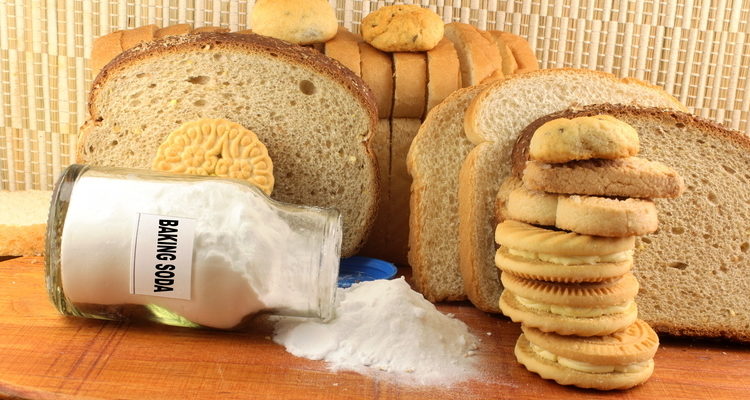
Bicarbonate of soda
Bicarbonate of soda (), also called bread soda, is a chemical raising agent that requires an acidic ingredient to activate.
Bicarbonate of soda works by reacting with acidic components in recipes to produce carbon dioxide gas. This gas creates bubbles that expand when heated, causing baked goods to rise.
Important
Bicarbonate of soda must be paired with acidic ingredients like buttermilk, yoghurt, or lemon juice to work effectively. Without acid, it will not produce the necessary chemical reaction.
Key points about bicarbonate of soda:
- Must be paired with acidic ingredients like buttermilk, yoghurt, or lemon juice
- Produces immediate reaction when mixed with acid
- Commonly used in Irish soda bread and some chocolate cakes
- Works well with naturally acidic cocoa powder
Baking powder
Baking powder is a complete raising agent containing both an alkali (usually bicarbonate of soda) and an acid (such as cream of tartar).
Unlike bicarbonate of soda, baking powder doesn't require additional acidic ingredients because it contains both components needed for the chemical reaction.
Note
How baking powder works:
Baking powder is double-acting, meaning it releases gas twice during the baking process:
- First reaction occurs when liquid is added to the mixture
- Second reaction happens during baking in the oven
- Often contains cornflour to absorb moisture and prevent premature reactions
Uses of baking powder:
- Perfect for recipes without natural acidic ingredients
- Ideal for plain cakes, biscuits and pancakes
- Provides reliable, consistent results
Biological raising agents
Biological raising agents rely on living microorganisms to create the gas needed for rising, making them fundamentally different from mechanical and chemical methods.
Fermentation process
Fermentation is a biological process where yeast (a living microorganism) converts sugars into carbon dioxide gas and alcohol, causing dough to rise.
The basic chemical equation for fermentation is:
Note
When yeast is added to dough containing sugars, it begins consuming these sugars and converting them into two main products: carbon dioxide gas (which causes the dough to rise) and ethanol (which mostly evaporates during baking, leaving behind flavour compounds).
Stages of fermentation
Fermentation involves four key enzymatic stages that work together to break down complex carbohydrates and produce the gas needed for rising.
Example
The Four Enzymatic Stages of Fermentation:
1. Starch breakdown
- Enzyme diastase (found in flour) breaks down starch into maltose
- Creates simpler sugars ready for yeast action
2. Maltose conversion
- Enzyme maltase (in yeast) converts maltose into glucose
- Makes sugar more accessible for fermentation
3. Sucrose breakdown
- Enzyme invertase (in yeast) splits sucrose into glucose and fructose
- Simplifies complex sugars for easier fermentation
4. Sugar fermentation
- Enzyme zymase (in yeast) ferments simple sugars
- Produces carbon dioxide gas and ethanol
- Gas expansion causes dough to rise
Types of yeast
Understanding the different types of yeast available helps bakers choose the right option for their specific needs and baking conditions.
Fresh yeast
- Soft, moist, beige-coloured blocks
- Also known as compressed yeast
- Must be crumbled into dough mixtures
- Requires refrigeration and short-term use
- Preferred in professional baking
Fast action dried yeast
- Dehydrated granules with longer shelf life
- Can be added directly to dry ingredients
- Popular choice for home baking
- Stores well in cool, dry conditions for months
Guidelines for successful yeast baking
Important
Essential Guidelines for Yeast Baking:
Temperature control
- Optimal fermentation occurs between 25°C and 35°C
- Too hot kills yeast; too cold slows activity
Yeast activation
- Fresh yeast should be soft and crumbly
- Dried yeast should foam when mixed with warm water
Essential techniques
- Distribute yeast evenly throughout dough
- Allow adequate proofing time for dough to double in size
- Sugar feeds yeast growth; salt regulates yeast activity
- Kneading develops gluten to trap carbon dioxide effectively
Summary
Key Points to Remember:
- Mechanical raising agents use air incorporated through mixing methods like creaming, whisking, and rubbing-in
- Chemical raising agents create gas through chemical reactions - bicarbonate of soda needs acid, whilst baking powder is self-contained
- Biological raising agents rely on yeast fermentation, involving four enzymatic stages that convert starches and sugars into carbon dioxide
- Temperature matters - yeast works best between 25-35°C, whilst chemical agents activate during baking heat
- Choose the right agent for your recipe - consider available acidic ingredients and desired texture when selecting raising agents